

IMEMR
EMRO
Volume 7, Issue 1 (2026)
J Clinic Care Skill 2026, 7(1): 1-7 |
Back to browse issues page
Article Type:
Subject:



Ethics code: IR.ARUMS. REC.1403.226
History
Received: 2025/09/16 | Accepted: 2025/11/21 | Published: 2026/01/8
Received: 2025/09/16 | Accepted: 2025/11/21 | Published: 2026/01/8
How to cite this article
Rahimi A, Ghadermazi M, Khalili Z. Prevalence of Suicidal Ideation among Nursing College Students in Ardabil, Iran. J Clinic Care Skill 2026; 7 (1) :1-7
URL: http://jccs.yums.ac.ir/article-1-426-en.html
URL: http://jccs.yums.ac.ir/article-1-426-en.html
Download citation:
BibTeX | RIS | EndNote | Medlars | ProCite | Reference Manager | RefWorks
Send citation to:


Rights and permissions
BibTeX | RIS | EndNote | Medlars | ProCite | Reference Manager | RefWorks
Send citation to:


1- Students Research Committee, Ardabil University of Medical Sciences, Ardabil, Iran
2- Department of Nursing, Faculty of Nursing and Midwifery, Urmia University of Medical Sciences, West Azarbaijan, Iran
3- Department of Medical Surgical Nursing, Faculty of Nursing and Midwifery, Ardabil University of Medical Sciences, Ardabil, Iran
2- Department of Nursing, Faculty of Nursing and Midwifery, Urmia University of Medical Sciences, West Azarbaijan, Iran
3- Department of Medical Surgical Nursing, Faculty of Nursing and Midwifery, Ardabil University of Medical Sciences, Ardabil, Iran
Full-Text (HTML) (122 Views)
Introduction
Nurses and nursing students face unique occupational stressors, including emotional exhaustion from caring for vulnerable patients, exposure to traumatic clinical environments, and workplace violence [1, 2]. These challenges commence during training, with studies reporting that 59.1% of Moroccan and 90% of Egyptian nursing students experience clinically significant stress, primarily linked to academic pressures and demographic factors [3]. If left unaddressed, these stressors persist into professional practice, contributing to adverse outcomes such as absenteeism rates (7.4% among Iranian nurses, 80% higher than in other sectors) and long-term mental health risks [4, 5]. These challenges extend to nursing students, whose rigorous academic and clinical demands amplify psychological distress [6], heightening their vulnerability to mental health disorders, including suicidal ideation (SI) and behavior [7]. Suicide remains a critical global public health issue, with over 720,000 deaths reported annually, ranking as the third leading cause of mortality among individuals aged 15-29 [8, 9]. This alarming burden is particularly pronounced in high-stress professions such as nursing [10]. A recent study highlights the severity of this crisis among nursing students, revealing that 53.3% exhibited suicidal risk, with 20.7% categorized as high-risk [10, 11]. These findings align with broader trends observed in Iranian academic settings. A systematic review by Miri et al. reports elevated suicide risks among Iranian school and university students, driven by academic pressure, socioeconomic challenges, and mental health stigma [12].
Nursing students face distinct vulnerabilities due to age-specific developmental challenges and transitional stressors. These include adapting to clinical environments, fear of medical errors, and prolonged separation from familial support [13]. These factors, compounded by psychosocial changes during early adulthood and uncertainties about career trajectories, amplify susceptibility to depression and SI [14]. Globally, suicide ranks as the second leading cause of death among university students, with reported lifetime prevalence rates of SI, plans, and attempts at 27.4% and 12.7%, respectively [15, 16]. Despite these trends, epidemiological data specific to nursing students remain limited, though emerging evidence suggests their risk profiles parallel or exceed those of general student populations [17]. Regional studies in Iran underscore the compounding stressors faced by nursing students [18]. A cross-sectional survey in Ardabil revealed that 55.4% of university students experience severe psychological stress, primarily attributed to academic workloads, financial dependence, and post-graduation employment anxieties [17]. These challenges are intensified by the region’s acute economic instability, characterized by a 40% inflation rate and 26.8% youth unemployment [19]. Such socioeconomic disparities, including financial hardship, limited mental health resources, and income inequality, disproportionately elevate suicide risk among vulnerable groups [20]. For nursing students in Ardabil, these systemic pressures intersect with clinical training demands (e.g., adapting to hospital environments, fear of medical errors) and occupational stressors, creating a high-risk environment for SI.
Notwithstanding evidence of widespread distress, no study has specifically investigated the prevalence or predictors of SI among nursing students in Ardabil. This region grapples with intersecting academic, economic, and clinical challenges. Given the unique intersection of academic, clinical, and socioeconomic stressors in this region, and the critical role of nurses in healthcare systems, this study aimed to determine the prevalence of SI among nursing students at Ardabil University of Medical Sciences, and identify modifiable risk factors, including gender, marital status, mental health history, and socioeconomic conditions. We hypothesized that female, single, and financially strained students will report significantly higher SI scores, consistent with global trends in high-stress academic populations.
Instrument and Methods
Study design and sample
This descriptive cross-sectional study was conducted between November and December 2024 at the Nurses and Midwifery Training College, Ardabil University of Medical Sciences, Iran.
The sample comprised all regularly enrolled students (n=262) in the nursing course. However, we considered sample attrition due to students declining to participate, in addition to the established inclusion and exclusion criteria. Students entered the study after the second semester, having commenced their hospital internships. Those on sick leave or absent from the course for any reason during the data collection period were excluded. Therefore, the study achieved a final sample of 256 students.
Instrument
A sociodemographic questionnaire was used to characterize the sample and classify nursing students by course year, sex, age group, marital status, residential status, history of mental illness, and use of psychiatric medications.
Another tool used was the Beck Scale for Suicidal Ideation (BSSI). It developed by Beck in 1988 to identify and measure the severity of suicidal thoughts, behaviors, and plans [21]. It is a self-report tool comprising 19 items. The first five items serve as a screening section. Item 4 assesses passive suicidal ideation, and item 5 determines the presence of active suicidal ideation. If the respondent scores “0” on item 5 (indicating no active suicidal ideation), the questionnaire ends; otherwise, the remaining 14 items are completed. These 14 items are distributed across three subscales: desire for death, preparation for suicide, and active suicidal desire. Thus, the total number of items answered by each participant ranges from 5 to 19, depending on their response to item 5. A total score between 0 and 5 indicates low-risk suicidal thoughts [22]. A sum of scores between 6 and 19 signifies a high risk of suicidal thoughts, and a sum between 20 and 38 indicates a very high risk of suicidal thoughts and suicide attempts. The tool’s designers reported a reliability of 0.87 using Cronbach’s alpha coefficient [23]. In our study, the Cronbach’s alpha coefficient for the BSSI was 0.89, indicating excellent internal consistency.
Data collection
All ethical principles were considered throughout the study. Participants were informed about the study’s objectives and methods and were assured of the confidentiality of their information. They were free to withdraw from the study at any time, and the research results would be made available to them upon request.
The tools were administered at the educational institution, according to students’ available time, by prior appointment and with an explanation of the data collection procedure. Data collection was performed in a reserved space to ensure privacy and allow students complete freedom of expression.
Data analysis
Statistical analyses were conducted using the SPSS version 22. Data were analyzed using the independent t-test and analysis of variance (ANOVA).
Findings
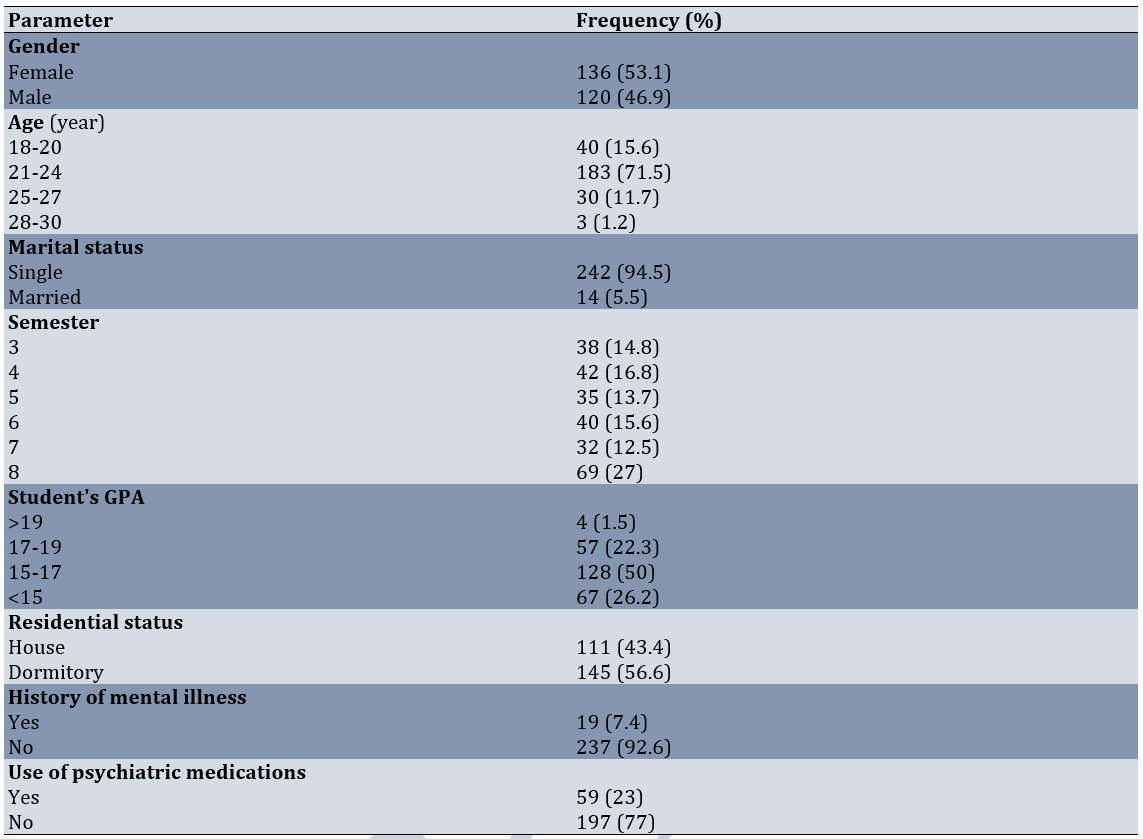
The average age of the research participants was 22.47±1.92 years, with 23-year-old students (23.8%) being the most frequent (Table 1).
Table 1. Socio‐demographic characteristics of participants (n=256)
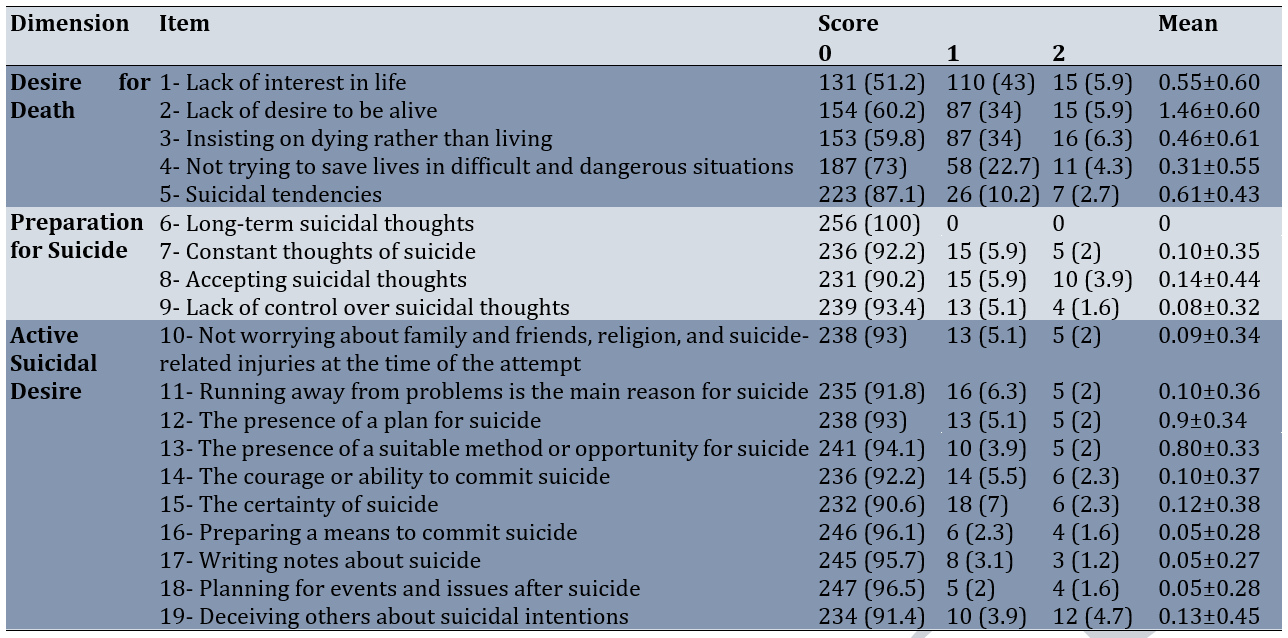
The total mean score for suicidal thoughts among students was 4.12±5.02. The mean score for the desire for death dimension was 6.77±1.74 (range: 5-10), preparation for suicide 0.31±1.02 (range: 0-6), and active suicidal desire 0.87±2.89 (range: 0-20).
Most students (n=217) exhibited low-risk suicidal thoughts (84.8%), while 12.1% were classified as having high‑risk suicidal thoughts (n=31), and 3.1% reported very high-risk suicidal thoughts or suicide attempts (n=8).
Within the “Desire for Death” dimension, the highest average score was observed for the item “lack of desire to be alive,” with an average of 1.46±0.60. The lowest average score in this dimension was for the item “not trying to save lives in difficult and dangerous situations,” with an average of 0.31±0.55. In the “Preparation for Suicide” dimension, the highest average score among students was for the item “accepting suicidal thoughts,” with an average of 0.14±0.44. The lowest score was for the item “long-term suicidal thoughts,” which had an average of 0. For the “Active Suicidal Desire” dimension, the highest average score among students was for the item “the presence of a plan for suicide,” with an average of 0.90±0.34. The lowest score was for the item “writing notes about suicide,” with an average of 0.05±0.27 (Table 2).
Table 2. Frequency and mean score of suicidal thoughts and their dimensions in nursing students by item
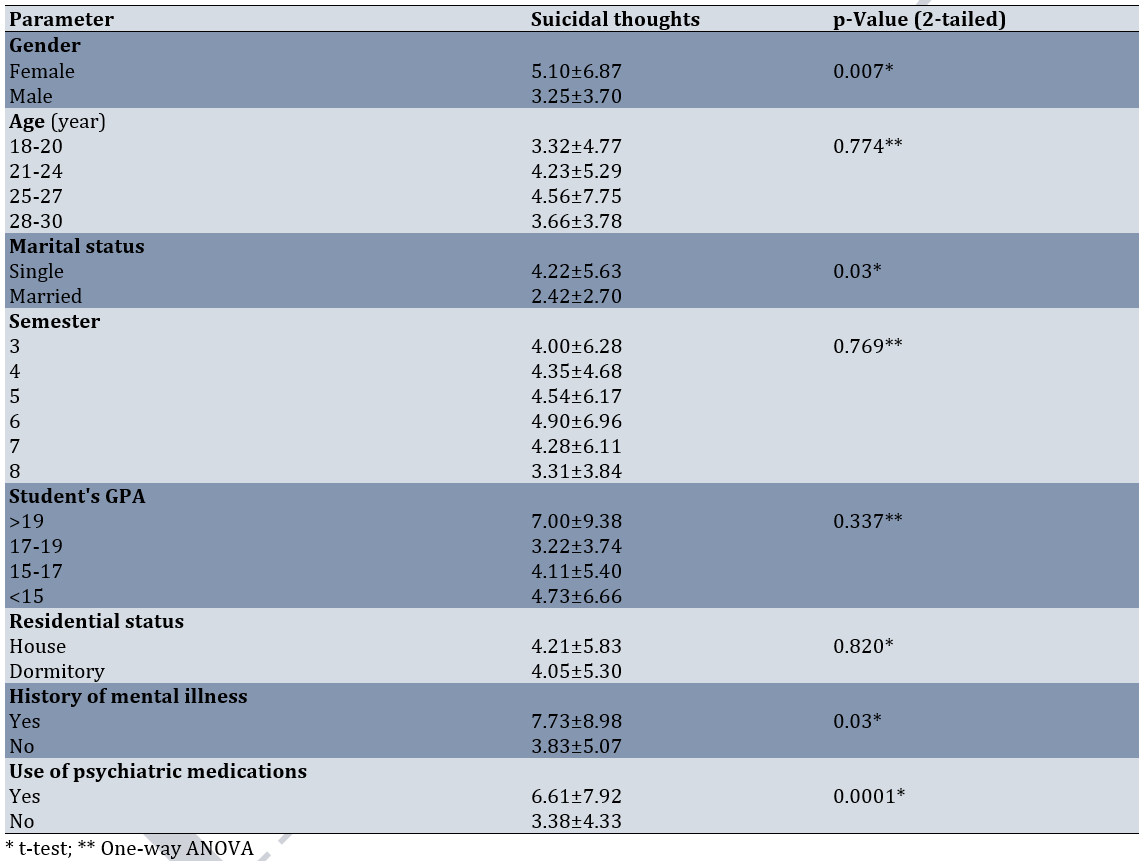
There was a relationship between suicidal thoughts and gender, marital status, history of mental illness, and history of taking psychiatric medications (p<0.05). No statistically significant relationship was observed between other parameters and suicidal thoughts.
A significant difference was found in suicidal thought scores between male students and female students (t(254)=2.70, p=0.007). A significant difference was also observed in suicidal thought scores between single students and married students (t(20)=2.21, p=0.03). Furthermore, a significant difference existed in suicidal thought scores between students with a history of mental illness and those without a history of mental illness (t(254)=3.02, p=0.03). Finally, a significant difference was noted in suicidal thought scores between students with a history of using psychiatric medications and those without a history of using psychiatric medications (t(254)=4.05, p=0.0001; Table 3).
Table 3. Comparison of suicidal thought mean scores across demographic and clinical variables in nursing students (n=256)
Discussion
This study assessed the prevalence of SI among nursing students in Ardabil, Iran and the findings revealed a concerning prevalence of SI among nursing students at Ardabil University of Medical Sciences. With 84.8% of students classified as low-risk, 12.1% as high-risk, and 3.1% as very high-risk, these results underscore the severe vulnerability of this population and highlight the urgent need for targeted interventions to address mental health challenges in this region.
The most significant finding was the high prevalence of SI among nursing students. This result aligns with global studies that identify nursing students as a high-risk group. For instance, Moraes et al. in Brazil report that 53.3% of nursing students are at risk of suicide, indicating a global crisis within the profession [7].
Furthermore, a recent systematic review by Groves et al., focusing on nursing and midwifery students, confirm that these students experience higher rates of suicidal thoughts than the general student population due to academic and clinical pressures [16]. However, some studies in countries with stronger economic resources and more developed support systems have reported lower prevalence rates. For example, a study in Germany by Schröpfer et al. showed that while psychological stress exists among nursing students, the rate of SI is significantly lower than the findings of the current study and similar research in less developed regions [24]. This difference highlights the role of structural and socio-economic factors in shaping student mental health
The high prevalence of SI in our sample can be directly attributed to the unique context of the Ardabil region. As mentioned, this region faces severe economic challenges, including a 40% inflation rate and a 26.8% youth unemployment rate [25]. These direct economic pressures, particularly on students who may be financially dependent, exacerbate anxiety about future careers and economic uncertainty. These factors, combined with the inherent stresses of nursing education (such as fear of medical errors and adaptation to clinical environments), create a “perfect storm” for psychological distress and SI. Therefore, our finding is not only a reflection of future occupational stress but also an indicator of current social and economic crises in the region.
Female students had higher SI scores compared to male students. This finding is consistent with extensive global literature indicating that women are at a higher risk for internalizing disorders such as depression and anxiety [15]. Groves et al. also noted in their review that female nursing students may be more vulnerable due to heavier “emotional labor” and socio-cultural expectations [16].
Nevertheless, some studies in different societies have found this gender gap to be smaller or even reversed. For instance, a study in Sweden by Bjuresäter et al., conducted in a context of high gender equality, reports no significant difference in SI rates between male and female nursing students [26]. These researchers argued that in societies where emotional and family responsibilities are more equally distributed and the stigma of help-seeking among men is lower, gender disparities in mental health are reduced [27].
Our findings can be attributed to the socio-cultural context of Iran. In such a setting, women may face dual pressures; on one hand, expectations for academic and professional success, and on the other, traditional family responsibilities. Furthermore, women may be more inclined to express emotions and report psychological symptoms, whereas men might conceal suicidal thoughts due to social stigma (stoicism). Therefore, the higher SI scores among female students may indicate both real vulnerability and a greater willingness to disclose these thoughts in questionnaires.
Single students reported higher SI scores compared to married students. This finding is consistent with the study by Mohammadinia et al. and confirms the protective role of marriage [28]. More recent research also supports this; for example, Kim in South Korea found that social support, often provided by a spouse, is a strong protective factor against stress and SI among students [29]. On the other hand, some studies have shown that marriage during student years can itself be a source of stress. A study in Latin America reported that young married students sometimes experience higher rates of stress and anxiety due to financial pressures and dual responsibilities [30]. This finding suggests that the quality of the relationship and the level of mutual support are more important than marital status itself. In our study, marriage functioned as a protective factor. Married students likely benefit from a more direct network of emotional and practical support [31]. A spouse can act as an outlet for emotional release and a source of strength when facing academic and clinical challenges. This support can reduce feelings of loneliness, a strong predictor of SI, and increase a sense of stability and belonging, whereas single students may have less access to this support resource.
Students with a history of mental illness and those using psychiatric medications had significantly higher SI scores. These were the strongest predictors in the current study. This finding is fully aligned with global scientific literature, as a history of psychiatric disorders is recognized as one of the strongest risk factors for SI and suicidal behaviors [15]. A global systematic review by Lovero et al. also confirms this relationship as a consistent finding across different cultures and populations [32]. In this domain, contradictory evidence is virtually nonexistent, as this is a well-documented causal relationship. However, a subtle point can be made: the use of psychiatric medications, while indicating greater illness severity, is also an indicator that the individual is in treatment. Therefore, this group of students, despite having higher SI scores, may be the very group that has accessed the mental health system, which can be a starting point for effective therapeutic interventions. Underlying conditions, like major depressive disorder, generalized anxiety disorder, or bipolar disorder are directly linked to distorted cognitions, hopelessness, and death-wish thoughts. The use of psychiatric medications also serves as a practical indicator of the severity of these conditions. Thus, these students constitute an extremely vulnerable subgroup requiring active monitoring, specialized counseling, and urgent support from the university. Our finding underscores the necessity of comprehensive mental health screening upon university entry and establishing fast, stigma-free referral pathways.
We found no significant association between SI and academic year, grade point average (GPA), or residential status (dormitory or home). This finding contrasts with some previous research suggesting that stress increases with academic progression and entry into clinical placements [13]. Some studies have also found an inverse relationship between academic performance and mental health, where students with poorer performance experience more psychological distress.
The lack of this association in our study could be due to various factors. It is possible that although entry into the clinical environment is an initial shock, students gradually develop coping mechanisms. Consequently, the level of SI may remain stable throughout the academic program as stressors and coping skills increase concurrently. For this population, the psychological pressure of fearing academic failure may be more important than the actual GPA. Alternatively, a lack of variance in GPA within our sample may have prevented finding a significant association
The social support available in dormitories (friends and roommates) might compensate for the negative effects of being away from family, and conversely, family support for students living at home might be accompanied by family pressures. These complex interactions could neutralize any simple effect of residential status.
This finding implicitly suggests that individual psychological and social factors (gender, marital status, mental health history) are far stronger predictors of SI than academic and logistical factors.
This study is among the first to investigate SI in nursing students in Ardabil, filling a critical regional research gap. The use of the validated BSSI and the high response rate (97.7%) enhance the reliability of the findings. However, the cross-sectional design limits causal inferences, and self-report measures may introduce response bias. Additionally, the single-institution sample restricts generalizability. Future longitudinal and multi-center studies are needed to validate these findings and explore temporal trends.
The findings underscore the urgency of implementing evidence-based interventions. Universities should prioritize mental health literacy programs, peer support networks, and accessible counseling services. Faculty training to recognize early warning signs of distress and reduce stigma around seeking help is equally vital. Policymakers must address socioeconomic determinants by advocating for financial aid, housing support, and job placement programs to mitigate post-graduation anxieties. Collaborative efforts between academic institutions, healthcare systems, and government agencies are essential to create a sustainable safety net for nursing students.
Conclusion
Nursing students in Ardabil exhibit a high prevalence of SI, with gender, marital status, mental health history, and psychiatric medication use identified as significant predictors.
Acknowledgments: The authors extend their gratitude to the nursing students who participated in this study and to Ardabil University of Medical Sciences for facilitating data collection.
Ethical Permissions: This study was approved by the Ethics Committee of Ardabil University of Medical Sciences (Code: IR.ARUMS.REC.1403.226).
Conflicts of Interests: The authors declared no conflicts of interests.
Authors' Contribution: Rahimi A (First Author), Introduction Writer/Methodologist/Assistant Researcher/Discussion Writer/Statistical Analyst (30%); Ghadermazi M (Second Author), Introduction Writer/Assistant Researcher/Discussion Writer (25%); Khalili Z (Third Author), Main Researcher/Discussion Writer/Statistical Analyst (45%)
Funding/Support: This research received no specific grant from funding agencies in the public, commercial, or not-for-profit sectors.
Nurses and nursing students face unique occupational stressors, including emotional exhaustion from caring for vulnerable patients, exposure to traumatic clinical environments, and workplace violence [1, 2]. These challenges commence during training, with studies reporting that 59.1% of Moroccan and 90% of Egyptian nursing students experience clinically significant stress, primarily linked to academic pressures and demographic factors [3]. If left unaddressed, these stressors persist into professional practice, contributing to adverse outcomes such as absenteeism rates (7.4% among Iranian nurses, 80% higher than in other sectors) and long-term mental health risks [4, 5]. These challenges extend to nursing students, whose rigorous academic and clinical demands amplify psychological distress [6], heightening their vulnerability to mental health disorders, including suicidal ideation (SI) and behavior [7]. Suicide remains a critical global public health issue, with over 720,000 deaths reported annually, ranking as the third leading cause of mortality among individuals aged 15-29 [8, 9]. This alarming burden is particularly pronounced in high-stress professions such as nursing [10]. A recent study highlights the severity of this crisis among nursing students, revealing that 53.3% exhibited suicidal risk, with 20.7% categorized as high-risk [10, 11]. These findings align with broader trends observed in Iranian academic settings. A systematic review by Miri et al. reports elevated suicide risks among Iranian school and university students, driven by academic pressure, socioeconomic challenges, and mental health stigma [12].
Nursing students face distinct vulnerabilities due to age-specific developmental challenges and transitional stressors. These include adapting to clinical environments, fear of medical errors, and prolonged separation from familial support [13]. These factors, compounded by psychosocial changes during early adulthood and uncertainties about career trajectories, amplify susceptibility to depression and SI [14]. Globally, suicide ranks as the second leading cause of death among university students, with reported lifetime prevalence rates of SI, plans, and attempts at 27.4% and 12.7%, respectively [15, 16]. Despite these trends, epidemiological data specific to nursing students remain limited, though emerging evidence suggests their risk profiles parallel or exceed those of general student populations [17]. Regional studies in Iran underscore the compounding stressors faced by nursing students [18]. A cross-sectional survey in Ardabil revealed that 55.4% of university students experience severe psychological stress, primarily attributed to academic workloads, financial dependence, and post-graduation employment anxieties [17]. These challenges are intensified by the region’s acute economic instability, characterized by a 40% inflation rate and 26.8% youth unemployment [19]. Such socioeconomic disparities, including financial hardship, limited mental health resources, and income inequality, disproportionately elevate suicide risk among vulnerable groups [20]. For nursing students in Ardabil, these systemic pressures intersect with clinical training demands (e.g., adapting to hospital environments, fear of medical errors) and occupational stressors, creating a high-risk environment for SI.
Notwithstanding evidence of widespread distress, no study has specifically investigated the prevalence or predictors of SI among nursing students in Ardabil. This region grapples with intersecting academic, economic, and clinical challenges. Given the unique intersection of academic, clinical, and socioeconomic stressors in this region, and the critical role of nurses in healthcare systems, this study aimed to determine the prevalence of SI among nursing students at Ardabil University of Medical Sciences, and identify modifiable risk factors, including gender, marital status, mental health history, and socioeconomic conditions. We hypothesized that female, single, and financially strained students will report significantly higher SI scores, consistent with global trends in high-stress academic populations.
Instrument and Methods
Study design and sample
This descriptive cross-sectional study was conducted between November and December 2024 at the Nurses and Midwifery Training College, Ardabil University of Medical Sciences, Iran.
The sample comprised all regularly enrolled students (n=262) in the nursing course. However, we considered sample attrition due to students declining to participate, in addition to the established inclusion and exclusion criteria. Students entered the study after the second semester, having commenced their hospital internships. Those on sick leave or absent from the course for any reason during the data collection period were excluded. Therefore, the study achieved a final sample of 256 students.
Instrument
A sociodemographic questionnaire was used to characterize the sample and classify nursing students by course year, sex, age group, marital status, residential status, history of mental illness, and use of psychiatric medications.
Another tool used was the Beck Scale for Suicidal Ideation (BSSI). It developed by Beck in 1988 to identify and measure the severity of suicidal thoughts, behaviors, and plans [21]. It is a self-report tool comprising 19 items. The first five items serve as a screening section. Item 4 assesses passive suicidal ideation, and item 5 determines the presence of active suicidal ideation. If the respondent scores “0” on item 5 (indicating no active suicidal ideation), the questionnaire ends; otherwise, the remaining 14 items are completed. These 14 items are distributed across three subscales: desire for death, preparation for suicide, and active suicidal desire. Thus, the total number of items answered by each participant ranges from 5 to 19, depending on their response to item 5. A total score between 0 and 5 indicates low-risk suicidal thoughts [22]. A sum of scores between 6 and 19 signifies a high risk of suicidal thoughts, and a sum between 20 and 38 indicates a very high risk of suicidal thoughts and suicide attempts. The tool’s designers reported a reliability of 0.87 using Cronbach’s alpha coefficient [23]. In our study, the Cronbach’s alpha coefficient for the BSSI was 0.89, indicating excellent internal consistency.
Data collection
All ethical principles were considered throughout the study. Participants were informed about the study’s objectives and methods and were assured of the confidentiality of their information. They were free to withdraw from the study at any time, and the research results would be made available to them upon request.
The tools were administered at the educational institution, according to students’ available time, by prior appointment and with an explanation of the data collection procedure. Data collection was performed in a reserved space to ensure privacy and allow students complete freedom of expression.
Data analysis
Statistical analyses were conducted using the SPSS version 22. Data were analyzed using the independent t-test and analysis of variance (ANOVA).
Findings
The average age of the research participants was 22.47±1.92 years, with 23-year-old students (23.8%) being the most frequent (Table 1).
Table 1. Socio‐demographic characteristics of participants (n=256)
The total mean score for suicidal thoughts among students was 4.12±5.02. The mean score for the desire for death dimension was 6.77±1.74 (range: 5-10), preparation for suicide 0.31±1.02 (range: 0-6), and active suicidal desire 0.87±2.89 (range: 0-20).
Most students (n=217) exhibited low-risk suicidal thoughts (84.8%), while 12.1% were classified as having high‑risk suicidal thoughts (n=31), and 3.1% reported very high-risk suicidal thoughts or suicide attempts (n=8).
Within the “Desire for Death” dimension, the highest average score was observed for the item “lack of desire to be alive,” with an average of 1.46±0.60. The lowest average score in this dimension was for the item “not trying to save lives in difficult and dangerous situations,” with an average of 0.31±0.55. In the “Preparation for Suicide” dimension, the highest average score among students was for the item “accepting suicidal thoughts,” with an average of 0.14±0.44. The lowest score was for the item “long-term suicidal thoughts,” which had an average of 0. For the “Active Suicidal Desire” dimension, the highest average score among students was for the item “the presence of a plan for suicide,” with an average of 0.90±0.34. The lowest score was for the item “writing notes about suicide,” with an average of 0.05±0.27 (Table 2).
Table 2. Frequency and mean score of suicidal thoughts and their dimensions in nursing students by item
There was a relationship between suicidal thoughts and gender, marital status, history of mental illness, and history of taking psychiatric medications (p<0.05). No statistically significant relationship was observed between other parameters and suicidal thoughts.
A significant difference was found in suicidal thought scores between male students and female students (t(254)=2.70, p=0.007). A significant difference was also observed in suicidal thought scores between single students and married students (t(20)=2.21, p=0.03). Furthermore, a significant difference existed in suicidal thought scores between students with a history of mental illness and those without a history of mental illness (t(254)=3.02, p=0.03). Finally, a significant difference was noted in suicidal thought scores between students with a history of using psychiatric medications and those without a history of using psychiatric medications (t(254)=4.05, p=0.0001; Table 3).
Table 3. Comparison of suicidal thought mean scores across demographic and clinical variables in nursing students (n=256)
Discussion
This study assessed the prevalence of SI among nursing students in Ardabil, Iran and the findings revealed a concerning prevalence of SI among nursing students at Ardabil University of Medical Sciences. With 84.8% of students classified as low-risk, 12.1% as high-risk, and 3.1% as very high-risk, these results underscore the severe vulnerability of this population and highlight the urgent need for targeted interventions to address mental health challenges in this region.
The most significant finding was the high prevalence of SI among nursing students. This result aligns with global studies that identify nursing students as a high-risk group. For instance, Moraes et al. in Brazil report that 53.3% of nursing students are at risk of suicide, indicating a global crisis within the profession [7].
Furthermore, a recent systematic review by Groves et al., focusing on nursing and midwifery students, confirm that these students experience higher rates of suicidal thoughts than the general student population due to academic and clinical pressures [16]. However, some studies in countries with stronger economic resources and more developed support systems have reported lower prevalence rates. For example, a study in Germany by Schröpfer et al. showed that while psychological stress exists among nursing students, the rate of SI is significantly lower than the findings of the current study and similar research in less developed regions [24]. This difference highlights the role of structural and socio-economic factors in shaping student mental health
The high prevalence of SI in our sample can be directly attributed to the unique context of the Ardabil region. As mentioned, this region faces severe economic challenges, including a 40% inflation rate and a 26.8% youth unemployment rate [25]. These direct economic pressures, particularly on students who may be financially dependent, exacerbate anxiety about future careers and economic uncertainty. These factors, combined with the inherent stresses of nursing education (such as fear of medical errors and adaptation to clinical environments), create a “perfect storm” for psychological distress and SI. Therefore, our finding is not only a reflection of future occupational stress but also an indicator of current social and economic crises in the region.
Female students had higher SI scores compared to male students. This finding is consistent with extensive global literature indicating that women are at a higher risk for internalizing disorders such as depression and anxiety [15]. Groves et al. also noted in their review that female nursing students may be more vulnerable due to heavier “emotional labor” and socio-cultural expectations [16].
Nevertheless, some studies in different societies have found this gender gap to be smaller or even reversed. For instance, a study in Sweden by Bjuresäter et al., conducted in a context of high gender equality, reports no significant difference in SI rates between male and female nursing students [26]. These researchers argued that in societies where emotional and family responsibilities are more equally distributed and the stigma of help-seeking among men is lower, gender disparities in mental health are reduced [27].
Our findings can be attributed to the socio-cultural context of Iran. In such a setting, women may face dual pressures; on one hand, expectations for academic and professional success, and on the other, traditional family responsibilities. Furthermore, women may be more inclined to express emotions and report psychological symptoms, whereas men might conceal suicidal thoughts due to social stigma (stoicism). Therefore, the higher SI scores among female students may indicate both real vulnerability and a greater willingness to disclose these thoughts in questionnaires.
Single students reported higher SI scores compared to married students. This finding is consistent with the study by Mohammadinia et al. and confirms the protective role of marriage [28]. More recent research also supports this; for example, Kim in South Korea found that social support, often provided by a spouse, is a strong protective factor against stress and SI among students [29]. On the other hand, some studies have shown that marriage during student years can itself be a source of stress. A study in Latin America reported that young married students sometimes experience higher rates of stress and anxiety due to financial pressures and dual responsibilities [30]. This finding suggests that the quality of the relationship and the level of mutual support are more important than marital status itself. In our study, marriage functioned as a protective factor. Married students likely benefit from a more direct network of emotional and practical support [31]. A spouse can act as an outlet for emotional release and a source of strength when facing academic and clinical challenges. This support can reduce feelings of loneliness, a strong predictor of SI, and increase a sense of stability and belonging, whereas single students may have less access to this support resource.
Students with a history of mental illness and those using psychiatric medications had significantly higher SI scores. These were the strongest predictors in the current study. This finding is fully aligned with global scientific literature, as a history of psychiatric disorders is recognized as one of the strongest risk factors for SI and suicidal behaviors [15]. A global systematic review by Lovero et al. also confirms this relationship as a consistent finding across different cultures and populations [32]. In this domain, contradictory evidence is virtually nonexistent, as this is a well-documented causal relationship. However, a subtle point can be made: the use of psychiatric medications, while indicating greater illness severity, is also an indicator that the individual is in treatment. Therefore, this group of students, despite having higher SI scores, may be the very group that has accessed the mental health system, which can be a starting point for effective therapeutic interventions. Underlying conditions, like major depressive disorder, generalized anxiety disorder, or bipolar disorder are directly linked to distorted cognitions, hopelessness, and death-wish thoughts. The use of psychiatric medications also serves as a practical indicator of the severity of these conditions. Thus, these students constitute an extremely vulnerable subgroup requiring active monitoring, specialized counseling, and urgent support from the university. Our finding underscores the necessity of comprehensive mental health screening upon university entry and establishing fast, stigma-free referral pathways.
We found no significant association between SI and academic year, grade point average (GPA), or residential status (dormitory or home). This finding contrasts with some previous research suggesting that stress increases with academic progression and entry into clinical placements [13]. Some studies have also found an inverse relationship between academic performance and mental health, where students with poorer performance experience more psychological distress.
The lack of this association in our study could be due to various factors. It is possible that although entry into the clinical environment is an initial shock, students gradually develop coping mechanisms. Consequently, the level of SI may remain stable throughout the academic program as stressors and coping skills increase concurrently. For this population, the psychological pressure of fearing academic failure may be more important than the actual GPA. Alternatively, a lack of variance in GPA within our sample may have prevented finding a significant association
The social support available in dormitories (friends and roommates) might compensate for the negative effects of being away from family, and conversely, family support for students living at home might be accompanied by family pressures. These complex interactions could neutralize any simple effect of residential status.
This finding implicitly suggests that individual psychological and social factors (gender, marital status, mental health history) are far stronger predictors of SI than academic and logistical factors.
This study is among the first to investigate SI in nursing students in Ardabil, filling a critical regional research gap. The use of the validated BSSI and the high response rate (97.7%) enhance the reliability of the findings. However, the cross-sectional design limits causal inferences, and self-report measures may introduce response bias. Additionally, the single-institution sample restricts generalizability. Future longitudinal and multi-center studies are needed to validate these findings and explore temporal trends.
The findings underscore the urgency of implementing evidence-based interventions. Universities should prioritize mental health literacy programs, peer support networks, and accessible counseling services. Faculty training to recognize early warning signs of distress and reduce stigma around seeking help is equally vital. Policymakers must address socioeconomic determinants by advocating for financial aid, housing support, and job placement programs to mitigate post-graduation anxieties. Collaborative efforts between academic institutions, healthcare systems, and government agencies are essential to create a sustainable safety net for nursing students.
Conclusion
Nursing students in Ardabil exhibit a high prevalence of SI, with gender, marital status, mental health history, and psychiatric medication use identified as significant predictors.
Acknowledgments: The authors extend their gratitude to the nursing students who participated in this study and to Ardabil University of Medical Sciences for facilitating data collection.
Ethical Permissions: This study was approved by the Ethics Committee of Ardabil University of Medical Sciences (Code: IR.ARUMS.REC.1403.226).
Conflicts of Interests: The authors declared no conflicts of interests.
Authors' Contribution: Rahimi A (First Author), Introduction Writer/Methodologist/Assistant Researcher/Discussion Writer/Statistical Analyst (30%); Ghadermazi M (Second Author), Introduction Writer/Assistant Researcher/Discussion Writer (25%); Khalili Z (Third Author), Main Researcher/Discussion Writer/Statistical Analyst (45%)
Funding/Support: This research received no specific grant from funding agencies in the public, commercial, or not-for-profit sectors.
Keywords:
References
1. Alharbi S, Hasan AA. Occupational stress, coping strategies, and quality of life among nurses in general and psychiatric setting in Jeddah City-KSA. Open J Psychiatry. 2019;9(2):124-37. [Link] [DOI:10.4236/ojpsych.2019.92010]
2. Dafny HA, McCloud C, Pearson V, Brown S, Phillips C, Waheed N, et al. Nursing students' experience of workplace violence in clinical practice: A qualitative systematic review. J Clin Nurs. 2023;32(17-18):6136-64. [Link] [DOI:10.1111/jocn.16746]
3. Hamaideh SH, Abuhammad S, Khait AA, Al-Modallal H, Hamdan-Mansour AM, Masa'deh R, et al. Levels and predictors of empathy, self-awareness, and perceived stress among nursing students: A cross sectional study. BMC Nurs. 2024;23(1):131. [Link] [DOI:10.1186/s12912-024-01774-7]
4. Sabzi Z, Jafari H, Bakhshian F, Saadat Mehr R. Factors associated with nurses' absenteeism in clinical settings: A narrative review. J Nurs Rep Clin Pract. 2024;2(1):27-31. [Link] [DOI:10.32598/JNRCP.23.36]
5. Babapour AR, Gahassab-Mozaffari N, Fathnezhad-Kazemi A. Nurses' job stress and its impact on quality of life and caring behaviors: A cross-sectional study. BMC Nurs. 2022;21(1):75. [Link] [DOI:10.1186/s12912-022-00852-y]
6. Aryuwat P, Holmgren J, Asp M, Radabutr M, Lövenmark A. Experiences of nursing students regarding challenges and support for resilience during clinical education: A qualitative study. Nurs Rep. 2024;14(3):1604-20. [Link] [DOI:10.3390/nursrep14030120]
7. Moraes SMAB, Barbosa VFB, Alexandre ACS, Santos SCd, Guimarães FJ, Veras JLdA. Risk of suicide among nursing students. REVISTA BRASILEIRA DE ENFERMAGEM. 2021;74(6):e20200867. [Link] [DOI:10.1590/0034-7167-2020-0867]
8. WHO. Suicide worldwide in 2021: Global health estimates. Geneva: World Health Organization; 2025. [Link]
9. Pranckeviciene E, Kasperiuniene J. Global suicide mortality rates (2000-2019): Clustering, themes, and causes analyzed through machine learning and bibliographic data. Int J Environ Res Public Health. 2024;21(9):1202. [Link] [DOI:10.3390/ijerph21091202]
10. Alrehaili MM, Alrashedi GSO, Alshammary GRS, Alshammari NR, Alshammari FK, Dagreri WA, et al. Caring under pressure: Unraveling the crisis of nursing workload and stress in modern healthcare. J Int Crisis Risk Commun Res. 2024;7(S4):7-15. [Link]
11. Yang X, Hu D, Li L, Rezak R. Factors of suicide-related behaviors based on stress-vulnerability model and prevention strategies among nurses: A scoping review. Front Psychol. 2025;16:1483904. [Link] [DOI:10.3389/fpsyg.2025.1483904]
12. Miri M, Rezaeian M, Ghasemi SA. A systematic review on the prevalence and causes of suicide (thoughts and actions) in Iranian school and university students. J Rafsanjan Univ Med Sci. 2022;21(5):551-74. [Link] [DOI:10.52547/jrums.21.5.551]
13. Sonmez Y, Akdemir M, Meydanlioglu A, Aktekin MR. Psychological distress, depression, and anxiety in nursing students: A longitudinal study. Healthcare. 2023;11(5):636. [Link] [DOI:10.3390/healthcare11050636]
14. Fergusson DM, Woodward LJ, Horwood LJ. Risk factors and life processes associated with the onset of suicidal behaviour during adolescence and early adulthood. Psychol Med. 2000;30(1):23-39. [Link] [DOI:10.1017/S003329179900135X]
15. Mortier P, Alonso J, Auerbach RP, Bantjes J, Benjet C, Bruffaerts R, et al. Childhood adversities and suicidal thoughts and behaviors among first-year college students: Results from the WMH-ICS initiative. Soc Psychiatry Psychiatr Epidemiol. 2022;57(8):1591-601. [Link] [DOI:10.1007/s00127-021-02151-4]
16. Groves S, Lascelles K, Hawton K. Suicidal thoughts and behaviours among student nurses and midwives: A systematic review. J Adv Nurs. 2024;80(6):2202-13. [Link] [DOI:10.1111/jan.15982]
17. Khademian F, Aslani A, Ravangard R, Nami M, Abbasi S, Bastani P. Iranian university students' stressors and coping strategies: A qualitative study. J Educ Health Promot. 2021;10:244. [Link] [DOI:10.4103/jehp.jehp_1278_20]
18. Goudarzian AH, Nikbakht Nasrabadi A, Sharif-Nia H, Farhadi B, Navab E. Exploring the concept and management strategies of caring stress among clinical nurses: A scoping review. Front Psychiatry. 2024;15:1337938. [Link] [DOI:10.3389/fpsyt.2024.1337938]
19. Geda A. The challenge of unemployment and youth unemployment amidst fast economic growth in Ethiopia. Nairobi: African Economic Research Consortium; 2022. [Link]
20. Sinyor M, Silverman M, Pirkis J, Hawton K. The effect of economic downturn, financial hardship, unemployment, and relevant government responses on suicide. Lancet Public Health. 2024;9(10):e802-6. [Link] [DOI:10.1016/S2468-2667(24)00152-X]
21. Beck AT, Steer RA, Ranieri WF. Scale for suicide ideation: Psychometric properties of a self‐report version. J Clin Psychol. 1988;44(4):499-505.
https://doi.org/10.1002/1097-4679(198807)44:4<499::AID-JCLP2270440404>3.0.CO;2-6 [Link] [DOI:10.1002/1097-4679(198807)44:43.0.CO;2-6]
22. Baek IC, Jo S, Kim EJ, Lee GR, Lee DH, Jeon HJ. A review of suicide risk assessment tools and their measured psychometric properties in Korea. Front Psychiatry. 2021;12:679779. [Link] [DOI:10.3389/fpsyt.2021.679779]
23. Esfahani M, Hashemi Y, Alavi K. Psychometric assessment of beck scale for suicidal ideation (BSSI) in general population in Tehran. Med J Islam Repub Iran. 2015;29:268. [Link]
24. Schröpfer K, Schmidt N, Kus S, Koob C, Coenen M. Psychological stress among students in health-related fields during the COVID-19 pandemic: Results of a cross-sectional study at selected Munich universities. Int J Environ Res Public Health. 2021;18(12):6611. [Link] [DOI:10.3390/ijerph18126611]
25. Statistical Center of Iran (SCI). Tehran: Statistical Center of Iran; [cited 2026 May 20]. Available from: https://www.amar.org.ir/english/News/Item/1004088 [Link]
26. Bjuresäter K, Olsson C, Larsson M, Nilsson J. Self-reported professional competence among Swedish contact nurses in cancer care: A cross-sectional study. Cancer Care Res Online. 2022;2(3):e024. [Link] [DOI:10.1097/CR9.0000000000000024]
27. McKenzie SK, Oliffe JL, Black A, Collings S. Men's experiences of mental illness stigma across the lifespan: A scoping review. Am J Mens Health. 2022;16(1):15579883221074789. [Link] [DOI:10.1177/15579883221074789]
28. Mohammadinia N, Rezaei M, Sameizadehtoosi T, Darban F. Assessing suicidal ideation frequency in medical students. Q J Nurs Manag. 2012;1(1):83-91. [Persian] [Link]
29. Kim JH. Behavioral, psychological, and physical predictors of adolescent drug use in South Korea: Insights obtained using machine learning. Int J Ment Health Addctn. 2025. [Link] [DOI:10.1007/s11469-025-01496-0]
30. Hernandez K. The effects of family role obligations on first-generation Latina college students' experience. Fresno: California State University; 2024. [Link]
31. Karimi R, Bakhtiyari M, Arani AM. Protective factors of marital stability in long-term marriage globally: A systematic review. Epidemiol Health. 2019;41:e2019023. [Link] [DOI:10.4178/epih.e2019023]
32. Lovero KL, Dos Santos PF, Come AX, Wainberg ML, Oquendo MA. Suicide in global mental health. Curr Psychiatry Rep. 2023;25(6):255-62. [Link] [DOI:10.1007/s11920-023-01423-x]