

IMEMR
EMRO
Volume 6, Issue 4 (2025)
J Clinic Care Skill 2025, 6(4): 237-242 |
Back to browse issues page
Article Type:
Subject:


History
Received: 2025/08/6 | Accepted: 2025/09/16 | Published: 2025/09/25
Received: 2025/08/6 | Accepted: 2025/09/16 | Published: 2025/09/25
How to cite this article
Hatamipour K, Nabizadeh H, Sadafizadeh M. Relationship between Emotional Intelligence and Attachment Styles and Communication Skills in Nurses. J Clinic Care Skill 2025; 6 (4) :237-242
URL: http://jccs.yums.ac.ir/article-1-447-en.html
URL: http://jccs.yums.ac.ir/article-1-447-en.html
Download citation:
BibTeX | RIS | EndNote | Medlars | ProCite | Reference Manager | RefWorks
Send citation to:


Rights and permissions
BibTeX | RIS | EndNote | Medlars | ProCite | Reference Manager | RefWorks
Send citation to:

Relationship between Emotional Intelligence and Attachment Styles and Communication Skills in Nurses


1- Department of Nursing, Tonekabon Campus (To.C.), Islamic Azad University, Tonekabon, Iran
2- Department of Psychology, Tonekabon Campus (To.C.), Islamic Azad University, Tonekabon, Iran
2- Department of Psychology, Tonekabon Campus (To.C.), Islamic Azad University, Tonekabon, Iran
Full-Text (HTML) (120 Views)
Introduction
Nurses constitute the largest group of healthcare providers who, by utilizing their considerable potential, can play an important role in improving the quality of healthcare [1]. As the healthcare professionals closest to patients and their families, they establish direct and close interactions with care recipients and play a valuable role in maintaining, providing, and promoting health, as well as preventing diseases and alleviating patients’ suffering [2]. Effective communication by nurses not only facilitates the collection of medical history and the understanding of its various aspects but also, by creating empathy and emotional support, can enhance patient comfort [3].
On the other hand, optimal communication in organizational environments increases staff capability, and evidence shows that human relationships are influenced more by emotional factors than by rational ones [4]. As an influential parameter and a part of social skills, communication skills play a key role in nurses’ interpersonal interactions [5]. These skills comprise a set of abilities and competencies that enable an individual to convey messages, thoughts, emotions, and information clearly, effectively, and appropriately to the audience, as well as to listen and provide appropriate feedback. They include verbal and written communication, nonverbal communication (body language, facial expressions, eye contact, and tone of voice), active listening, empathy, and the ability to adjust messages in different situations and with different audiences [6]. Deficiencies in these skills can lead to consequences such as social anxiety, feelings of loneliness, depression, and occupational failure. Strengthening communication skills requires attention to contextual and teachable factors, such as emotional intelligence [7].
Various factors influence communication skills. Emotional intelligence is recognized as one of the psychological factors affecting human interactions [8]. It comprises a set of abilities that includes understanding, accurately recognizing, and perceiving one’s own and others’ emotions; adaptively regulating emotions; and using this emotional awareness to guide thinking and behavior in human interactions. These abilities help individuals develop more effective interpersonal relationships, make better decisions, and have emotional responses that are appropriate to the situation [9]. Emotional intelligence is not only a positive trait but also a set of cognitive and emotional abilities that impact quality of life, social relationships, and occupational success [10]. Nurses with higher levels of emotional intelligence can better understand their own and others’ emotions, and by regulating these emotions, they can establish more effective interpersonal relationships [11]. The importance of these skills becomes even more pronounced when the patient is in physical distress and requires intimate and supportive human interaction [12].
In addition to emotional intelligence, attachment styles are among the other factors affecting human interactions [13]. Attachment styles refer to relatively stable emotional and behavioral patterns that individuals adopt in their close relationships—especially those based on early interactions with their caregivers—which influence their perceptions of themselves and others. These styles affect the way individuals experience security, intimacy, conflict, dependency, and trust [14]. Attachment theory emphasizes the role of emotional bonds in the quality of social relationships and demonstrates that individuals’ attachment types can affect their communication and social skills [11]. Based on these foundations, it can be expected that nurses’ attachment styles also play a role in improving the quality of their professional relationships with patients and colleagues [15].
Given the necessity of conducting this research, and since no such study has yet been conducted in the country, the researcher decided to conduct a study aiming to determine the relationship between emotional intelligence and attachment styles with communication skills among nurses in hospitals affiliated with Tehran University of Medical Sciences in 2024.
Instrument and Methods
The present descriptive-correlational study was conducted on 291 nurses in hospitals affiliated with Tehran University of Medical Sciences in 2025 selected using the convenience sampling method.
The inclusion criteria were employment as a formal, contractual, or official nurse in one of the hospitals affiliated with Tehran University of Medical Sciences, at least one year of clinical work experience to ensure sufficient familiarity with the hospital environment and the required communication skills, willingness and informed consent to participate in the study and complete the questionnaires, no known psychiatric disorders or debilitating chronic diseases reported based on self-reports, ability to read and write in Persian to respond accurately to the questionnaires, and employment in one of the active work shifts (morning, evening, or night) during the study period.
A demographic characteristics questionnaire collected data on age, sex, marital status, and hospital of employment.
Emotional intelligence was assessed using the Bradbury and Graves Emotional Intelligence Questionnaire developed in 2004, which was translated and validated by Ganji in 2006 [16]. This questionnaire includes 28 items scored on a 6-point Likert scale and assesses four components: self-awareness, self-management, social awareness, and relationship management, as well as providing a total emotional intelligence score. Scores above 80 indicate high emotional intelligence, whereas scores below 60 indicate low emotional intelligence. Construct validity was established by administering this questionnaire alongside the Bar-On Emotional Intelligence Test to a group of 97 participants, yielding a significant correlation coefficient of 0.99 [16]. In the present study, reliability was confirmed with a Cronbach’s alpha of 0.88, indicating high internal consistency. Nejati and Meshkat. [17] in 2013 reported a reliability of 0.94.
The Barton Communication Skills Questionnaire developed in 1990 was used to assess communication skills. This questionnaire includes 18 items measuring three dimensions of communication skills. Items are rated on a 5-point Likert scale from “very low” to “very high.” Scores range from 18 to 90, with scores below 36 indicating low communication skills, scores between 36 and 72 indicating moderate skills, and scores above 73 indicating high communication skills. In the present study, the reliability of the instrument was 0.72.
Attachment styles were assessed using the Collins and Read Adult Attachment Scale developed in 1990, which is based on the Hazan and Shaver Adult Attachment Questionnaire, and was revised in 1996. This 18-item scale, rated on a 5-point Likert scale, measures three main attachment styles: secure, avoidant, and anxious-ambivalent. Each subscale consists of six items: Items 1, 6, 8, 12, 13, and 17 measure secure attachment; items 2, 5, 7, 14, 16, and 18 measure avoidant attachment; and items 3, 4, 9, 10, 11, and 15 measure anxious-ambivalent attachment. Collins and Read [18] reported a Cronbach’s alpha above 0.80. Construct validity was confirmed through confirmatory factor analysis, which revealed three factors corresponding to secure, avoidant, and anxious attachment styles. Test-retest reliability over a one-month interval in Iran with a sample of 100 participants showed stable results for all subscales, with a 95% confidence level [19]. In the present study, the reliability of the instrument was 0.70.
After the objectives of the study were explained to the nurses, written informed consent was obtained. Participants were assured that their information would remain confidential and that there was no need to provide their names. The questionnaires were distributed to nurses after the study objectives were explained, and confidentiality was emphasized.
Data analysis was performed using SPSS version 25 by Pearson correlation coefficient and multiple regression. The Kolmogorov-Smirnov test was used to assess the normality of the data. The significance level was considered to be 0.05.
Findings
The total number of participants was 291, with the majority employed in Imam and Shariati Hospitals (87 (29.90%)). Most participants were female (261 (96.97%)), and the largest age group was 35-50 years (140 (48.11%)). Regarding marital status, most participants were married (234 (80.41%)).
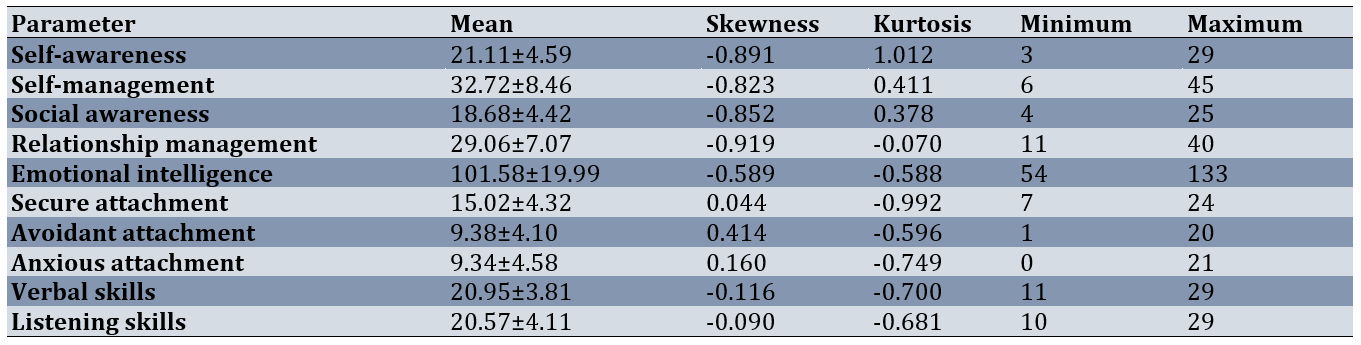
Among the components of the Emotional Intelligence Questionnaire, self-management had the highest score (72.32±8.46), while social awareness had the lowest score (68.18±4.42). The overall mean emotional intelligence score was 101.58±19.99, indicating that participants performed better in managing their own emotions than in social awareness.
In the Attachment Styles Questionnaire, the highest mean was observed for secure attachment (15.02±4.32), while the lowest was observed for anxious attachment (9.34±4.58), indicating that among the participants, the tendency toward secure attachment was greater than that toward other styles.
In the Communication Skills Questionnaire, verbal communication had the highest mean score (20.95±3.81), and listening skills had the lowest score (20.57±4.11). The overall mean number of communication skills was 62.30±11.15, suggesting that participants’ verbal expression was better than their listening and feedback skills (Table 1).
Table 1. Descriptive statistics of the research parameters obtained from questionnaires
The one-sample Kolmogorov-Smirnov test confirmed that the data were normally distributed.
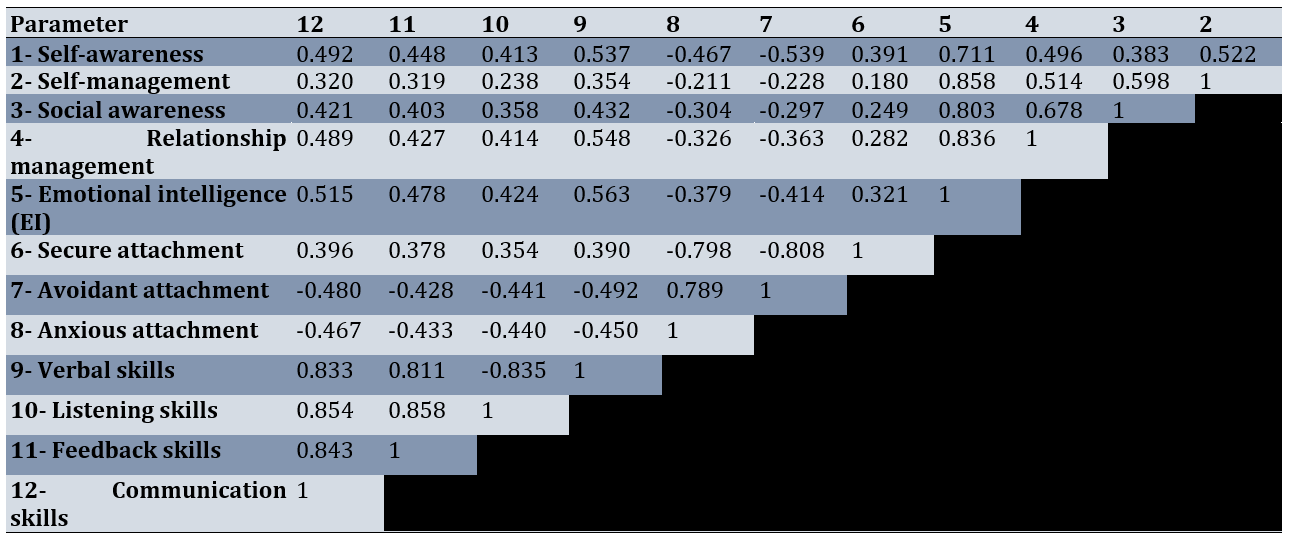
There was a positive and significant relationship between emotional intelligence and communication skills (p<0.01). Additionally, the components of emotional intelligence (self-awareness, self-management, social awareness, and relationship management) showed a positive and significant relationship with secure attachment. In contrast, avoidant and anxious attachment styles were found to have a negative and significant relationship with the components of emotional intelligence and communication skills (p<0.01; Table 2).
Table 2. Correlation test results between research parameters
The correlation coefficient between attachment styles and emotional intelligence with communication skills was 0.604. Furthermore, based on the R² value (0.365), attachment styles and emotional intelligence together predicted 36.5% of the variance in nurses’ communication skills (adjusted R²=0.356; Standard error of estimate=8.957).
The significance level of the model was less than 0.05. Therefore, the regression model demonstrated an adequate fit (Table 3).
Table 3. The regression model fit assessment

The significance levels for avoidant attachment, anxious attachment, and emotional intelligence were all less than 0.05, indicating their relationship with nurses’ communication skills. Based on the beta coefficients, emotional intelligence ranked first (β=0.367), anxious attachment ranked second (β=-0.220), and avoidant attachment ranked third (β=-0.211). Emotional intelligence indicated a direct relationship with nurses’ communication skills, whereas avoidant and anxious attachment indicated an inverse relationship with nurses’ communication skills (Table 4).
Table 4. Regression path coefficients and significance test

Discussion
This study examined the relationships between emotional intelligence and attachment styles with communication skills among nurses in hospitals affiliated with Tehran University of Medical Sciences in 2024. There was a positive and significant relationship between attachment styles and emotional intelligence and nurses’ communication skills. Attachment styles and emotional intelligence together explained approximately 36.5% of the variance in nurses’ communication skills. According to the regression model, emotional intelligence had the highest predictive power for communication skills, while avoidant and anxious attachment styles exhibited a negative relationship with communication skills.
These findings indicate that nurses with higher levels of emotional intelligence are more successful in establishing effective communication with patients, families, and colleagues. Emotional intelligence enables them to identify their own emotions and the emotions of others while managing their emotional responses in stressful situations. In contrast, individuals with insecure attachment styles often experience difficulties in trusting others and forming close relationships, which consequently reduces the quality of their professional communication. This finding is consistent with the results of Rafati et al. and Warnock et al. [20, 21], who also emphasize that emotional intelligence and secure attachment are two key factors in improving communication skills in service and caregiving professions. A combination of high emotional intelligence and a secure attachment style enhances empathy, mutual understanding, and more effective communication in healthcare settings. Nurses who possess greater emotional stability and self-awareness can, when faced with anxious or worried patients, create a safe environment for communication and mutual trust by remaining calm and controlling their emotions. Therefore, strengthening emotional intelligence and educating nurses about attachment styles should be considered essential components of nursing training programs.
There was a positive and significant relationship between emotional intelligence and nurses’ communication skills. Self-awareness, social awareness, and relationship management were positively associated with communication skills, while self-management was not significantly related. Among these components, self-awareness played the most important role in predicting communication skills. This finding suggests that nurses who have a better understanding of their own emotions and those of others, as well as the ability to manage interpersonal relationships effectively, perform more successfully in both verbal and nonverbal communication. This result aligns with the findings of Mafi & Asefzadeh and Zina et al. [22, 23], reporting that higher emotional intelligence increases communication efficiency and reduces workplace conflicts in nursing. Researchers believe that emotional intelligence plays a fundamental role in the quality of human interactions. Nurses with high emotional intelligence not only understand patients’ emotions but can also control their own emotions and act professionally. These abilities enable nurses to maintain effective, calm, and compassionate communication even in critical or high-stress situations. Therefore, emphasizing the training of emotional intelligence skills, including self-awareness, empathy, and relationship management, is essential in nursing education programs.
There was also a significant relationship between attachment styles and nurses’ communication skills. Secure attachment was positively associated with communication skills, while avoidant and anxious attachment styles exhibited a negative and significant relationship. This finding confirms that nurses with secure attachment are more inclined to establish intimate relationships, mutual trust, and empathetic behaviors, whereas individuals with insecure attachment typically avoid close relationships or experience anxiety and distrust in their interactions. These characteristics can hinder effective communication with patients and colleagues. This finding is consistent with the results of Fatizadeh et al. [24], Wei et al. [15], and Saad Ahmed et al. [13], who considere secure attachment a prerequisite for effective interaction and job satisfaction in clinical settings. Secure attachment, as a foundation of mental and social health, plays a determinant role in shaping nurses’ communicative behaviors. Individuals who experience stable and secure emotional relationships in childhood tend to feel more secure and confident in adulthood, which enables them to exhibit more empathetic and effective behaviors in the workplace.
Considering the importance of communication skills and emotional intelligence in nursing, the need for related classes and workshops is increasingly evident. It is recommended that courses on “Effective Communication and Communication Skills” be incorporated into the curriculum for nursing students, allowing them to become familiar with these skills and acquire practical application before entering clinical settings. Additionally, it is suggested that the findings of this study and similar research be shared with counseling centers and hospitals to ensure the practical application of the results rather than limiting the studies to theoretical investigations.
Although the present study aimed to provide effective findings, it had several limitations. Some participants were less willing to engage, so explanations regarding the importance of the study were offered before they completed the questionnaires to encourage participation. Moreover, due to the self-reported nature of the questionnaires, there was a possibility of self-censorship in the responses; some nurses had a neutral or negative attitude toward receiving research feedback because they had not received results from previous studies.
Conclusion
There is a positive and significant relationship between emotional intelligence, attachment style, and nurses’ communication skills.
Acknowledgments: This study is the result of a master’s thesis in Industrial-Organizational Psychology at the Islamic Azad University, Tonekabon Branch. We sincerely wish for the good health of all participants in the study and express our heartfelt gratitude to everyone who assisted us in conducting this research.
Ethical Permissions: Not applicable.
Conflicts of Interests: The authors reported no conflicts of interests.
Authors' Contribution: Hatamipour Kh (First Author), Main Researcher (35%); Nabizadeh H (Second Author), Introduction Writer (30%); Sadafizadeh M (Third Author), Methodologist/Discussion Writer/Statistical Analyst (35%)
Funding/Support: This study did not receive any financial support.
Nurses constitute the largest group of healthcare providers who, by utilizing their considerable potential, can play an important role in improving the quality of healthcare [1]. As the healthcare professionals closest to patients and their families, they establish direct and close interactions with care recipients and play a valuable role in maintaining, providing, and promoting health, as well as preventing diseases and alleviating patients’ suffering [2]. Effective communication by nurses not only facilitates the collection of medical history and the understanding of its various aspects but also, by creating empathy and emotional support, can enhance patient comfort [3].
On the other hand, optimal communication in organizational environments increases staff capability, and evidence shows that human relationships are influenced more by emotional factors than by rational ones [4]. As an influential parameter and a part of social skills, communication skills play a key role in nurses’ interpersonal interactions [5]. These skills comprise a set of abilities and competencies that enable an individual to convey messages, thoughts, emotions, and information clearly, effectively, and appropriately to the audience, as well as to listen and provide appropriate feedback. They include verbal and written communication, nonverbal communication (body language, facial expressions, eye contact, and tone of voice), active listening, empathy, and the ability to adjust messages in different situations and with different audiences [6]. Deficiencies in these skills can lead to consequences such as social anxiety, feelings of loneliness, depression, and occupational failure. Strengthening communication skills requires attention to contextual and teachable factors, such as emotional intelligence [7].
Various factors influence communication skills. Emotional intelligence is recognized as one of the psychological factors affecting human interactions [8]. It comprises a set of abilities that includes understanding, accurately recognizing, and perceiving one’s own and others’ emotions; adaptively regulating emotions; and using this emotional awareness to guide thinking and behavior in human interactions. These abilities help individuals develop more effective interpersonal relationships, make better decisions, and have emotional responses that are appropriate to the situation [9]. Emotional intelligence is not only a positive trait but also a set of cognitive and emotional abilities that impact quality of life, social relationships, and occupational success [10]. Nurses with higher levels of emotional intelligence can better understand their own and others’ emotions, and by regulating these emotions, they can establish more effective interpersonal relationships [11]. The importance of these skills becomes even more pronounced when the patient is in physical distress and requires intimate and supportive human interaction [12].
In addition to emotional intelligence, attachment styles are among the other factors affecting human interactions [13]. Attachment styles refer to relatively stable emotional and behavioral patterns that individuals adopt in their close relationships—especially those based on early interactions with their caregivers—which influence their perceptions of themselves and others. These styles affect the way individuals experience security, intimacy, conflict, dependency, and trust [14]. Attachment theory emphasizes the role of emotional bonds in the quality of social relationships and demonstrates that individuals’ attachment types can affect their communication and social skills [11]. Based on these foundations, it can be expected that nurses’ attachment styles also play a role in improving the quality of their professional relationships with patients and colleagues [15].
Given the necessity of conducting this research, and since no such study has yet been conducted in the country, the researcher decided to conduct a study aiming to determine the relationship between emotional intelligence and attachment styles with communication skills among nurses in hospitals affiliated with Tehran University of Medical Sciences in 2024.
Instrument and Methods
The present descriptive-correlational study was conducted on 291 nurses in hospitals affiliated with Tehran University of Medical Sciences in 2025 selected using the convenience sampling method.
The inclusion criteria were employment as a formal, contractual, or official nurse in one of the hospitals affiliated with Tehran University of Medical Sciences, at least one year of clinical work experience to ensure sufficient familiarity with the hospital environment and the required communication skills, willingness and informed consent to participate in the study and complete the questionnaires, no known psychiatric disorders or debilitating chronic diseases reported based on self-reports, ability to read and write in Persian to respond accurately to the questionnaires, and employment in one of the active work shifts (morning, evening, or night) during the study period.
A demographic characteristics questionnaire collected data on age, sex, marital status, and hospital of employment.
Emotional intelligence was assessed using the Bradbury and Graves Emotional Intelligence Questionnaire developed in 2004, which was translated and validated by Ganji in 2006 [16]. This questionnaire includes 28 items scored on a 6-point Likert scale and assesses four components: self-awareness, self-management, social awareness, and relationship management, as well as providing a total emotional intelligence score. Scores above 80 indicate high emotional intelligence, whereas scores below 60 indicate low emotional intelligence. Construct validity was established by administering this questionnaire alongside the Bar-On Emotional Intelligence Test to a group of 97 participants, yielding a significant correlation coefficient of 0.99 [16]. In the present study, reliability was confirmed with a Cronbach’s alpha of 0.88, indicating high internal consistency. Nejati and Meshkat. [17] in 2013 reported a reliability of 0.94.
The Barton Communication Skills Questionnaire developed in 1990 was used to assess communication skills. This questionnaire includes 18 items measuring three dimensions of communication skills. Items are rated on a 5-point Likert scale from “very low” to “very high.” Scores range from 18 to 90, with scores below 36 indicating low communication skills, scores between 36 and 72 indicating moderate skills, and scores above 73 indicating high communication skills. In the present study, the reliability of the instrument was 0.72.
Attachment styles were assessed using the Collins and Read Adult Attachment Scale developed in 1990, which is based on the Hazan and Shaver Adult Attachment Questionnaire, and was revised in 1996. This 18-item scale, rated on a 5-point Likert scale, measures three main attachment styles: secure, avoidant, and anxious-ambivalent. Each subscale consists of six items: Items 1, 6, 8, 12, 13, and 17 measure secure attachment; items 2, 5, 7, 14, 16, and 18 measure avoidant attachment; and items 3, 4, 9, 10, 11, and 15 measure anxious-ambivalent attachment. Collins and Read [18] reported a Cronbach’s alpha above 0.80. Construct validity was confirmed through confirmatory factor analysis, which revealed three factors corresponding to secure, avoidant, and anxious attachment styles. Test-retest reliability over a one-month interval in Iran with a sample of 100 participants showed stable results for all subscales, with a 95% confidence level [19]. In the present study, the reliability of the instrument was 0.70.
After the objectives of the study were explained to the nurses, written informed consent was obtained. Participants were assured that their information would remain confidential and that there was no need to provide their names. The questionnaires were distributed to nurses after the study objectives were explained, and confidentiality was emphasized.
Data analysis was performed using SPSS version 25 by Pearson correlation coefficient and multiple regression. The Kolmogorov-Smirnov test was used to assess the normality of the data. The significance level was considered to be 0.05.
Findings
The total number of participants was 291, with the majority employed in Imam and Shariati Hospitals (87 (29.90%)). Most participants were female (261 (96.97%)), and the largest age group was 35-50 years (140 (48.11%)). Regarding marital status, most participants were married (234 (80.41%)).
Among the components of the Emotional Intelligence Questionnaire, self-management had the highest score (72.32±8.46), while social awareness had the lowest score (68.18±4.42). The overall mean emotional intelligence score was 101.58±19.99, indicating that participants performed better in managing their own emotions than in social awareness.
In the Attachment Styles Questionnaire, the highest mean was observed for secure attachment (15.02±4.32), while the lowest was observed for anxious attachment (9.34±4.58), indicating that among the participants, the tendency toward secure attachment was greater than that toward other styles.
In the Communication Skills Questionnaire, verbal communication had the highest mean score (20.95±3.81), and listening skills had the lowest score (20.57±4.11). The overall mean number of communication skills was 62.30±11.15, suggesting that participants’ verbal expression was better than their listening and feedback skills (Table 1).
Table 1. Descriptive statistics of the research parameters obtained from questionnaires
The one-sample Kolmogorov-Smirnov test confirmed that the data were normally distributed.
There was a positive and significant relationship between emotional intelligence and communication skills (p<0.01). Additionally, the components of emotional intelligence (self-awareness, self-management, social awareness, and relationship management) showed a positive and significant relationship with secure attachment. In contrast, avoidant and anxious attachment styles were found to have a negative and significant relationship with the components of emotional intelligence and communication skills (p<0.01; Table 2).
Table 2. Correlation test results between research parameters
The correlation coefficient between attachment styles and emotional intelligence with communication skills was 0.604. Furthermore, based on the R² value (0.365), attachment styles and emotional intelligence together predicted 36.5% of the variance in nurses’ communication skills (adjusted R²=0.356; Standard error of estimate=8.957).
The significance level of the model was less than 0.05. Therefore, the regression model demonstrated an adequate fit (Table 3).
Table 3. The regression model fit assessment
The significance levels for avoidant attachment, anxious attachment, and emotional intelligence were all less than 0.05, indicating their relationship with nurses’ communication skills. Based on the beta coefficients, emotional intelligence ranked first (β=0.367), anxious attachment ranked second (β=-0.220), and avoidant attachment ranked third (β=-0.211). Emotional intelligence indicated a direct relationship with nurses’ communication skills, whereas avoidant and anxious attachment indicated an inverse relationship with nurses’ communication skills (Table 4).
Table 4. Regression path coefficients and significance test
Discussion
This study examined the relationships between emotional intelligence and attachment styles with communication skills among nurses in hospitals affiliated with Tehran University of Medical Sciences in 2024. There was a positive and significant relationship between attachment styles and emotional intelligence and nurses’ communication skills. Attachment styles and emotional intelligence together explained approximately 36.5% of the variance in nurses’ communication skills. According to the regression model, emotional intelligence had the highest predictive power for communication skills, while avoidant and anxious attachment styles exhibited a negative relationship with communication skills.
These findings indicate that nurses with higher levels of emotional intelligence are more successful in establishing effective communication with patients, families, and colleagues. Emotional intelligence enables them to identify their own emotions and the emotions of others while managing their emotional responses in stressful situations. In contrast, individuals with insecure attachment styles often experience difficulties in trusting others and forming close relationships, which consequently reduces the quality of their professional communication. This finding is consistent with the results of Rafati et al. and Warnock et al. [20, 21], who also emphasize that emotional intelligence and secure attachment are two key factors in improving communication skills in service and caregiving professions. A combination of high emotional intelligence and a secure attachment style enhances empathy, mutual understanding, and more effective communication in healthcare settings. Nurses who possess greater emotional stability and self-awareness can, when faced with anxious or worried patients, create a safe environment for communication and mutual trust by remaining calm and controlling their emotions. Therefore, strengthening emotional intelligence and educating nurses about attachment styles should be considered essential components of nursing training programs.
There was a positive and significant relationship between emotional intelligence and nurses’ communication skills. Self-awareness, social awareness, and relationship management were positively associated with communication skills, while self-management was not significantly related. Among these components, self-awareness played the most important role in predicting communication skills. This finding suggests that nurses who have a better understanding of their own emotions and those of others, as well as the ability to manage interpersonal relationships effectively, perform more successfully in both verbal and nonverbal communication. This result aligns with the findings of Mafi & Asefzadeh and Zina et al. [22, 23], reporting that higher emotional intelligence increases communication efficiency and reduces workplace conflicts in nursing. Researchers believe that emotional intelligence plays a fundamental role in the quality of human interactions. Nurses with high emotional intelligence not only understand patients’ emotions but can also control their own emotions and act professionally. These abilities enable nurses to maintain effective, calm, and compassionate communication even in critical or high-stress situations. Therefore, emphasizing the training of emotional intelligence skills, including self-awareness, empathy, and relationship management, is essential in nursing education programs.
There was also a significant relationship between attachment styles and nurses’ communication skills. Secure attachment was positively associated with communication skills, while avoidant and anxious attachment styles exhibited a negative and significant relationship. This finding confirms that nurses with secure attachment are more inclined to establish intimate relationships, mutual trust, and empathetic behaviors, whereas individuals with insecure attachment typically avoid close relationships or experience anxiety and distrust in their interactions. These characteristics can hinder effective communication with patients and colleagues. This finding is consistent with the results of Fatizadeh et al. [24], Wei et al. [15], and Saad Ahmed et al. [13], who considere secure attachment a prerequisite for effective interaction and job satisfaction in clinical settings. Secure attachment, as a foundation of mental and social health, plays a determinant role in shaping nurses’ communicative behaviors. Individuals who experience stable and secure emotional relationships in childhood tend to feel more secure and confident in adulthood, which enables them to exhibit more empathetic and effective behaviors in the workplace.
Considering the importance of communication skills and emotional intelligence in nursing, the need for related classes and workshops is increasingly evident. It is recommended that courses on “Effective Communication and Communication Skills” be incorporated into the curriculum for nursing students, allowing them to become familiar with these skills and acquire practical application before entering clinical settings. Additionally, it is suggested that the findings of this study and similar research be shared with counseling centers and hospitals to ensure the practical application of the results rather than limiting the studies to theoretical investigations.
Although the present study aimed to provide effective findings, it had several limitations. Some participants were less willing to engage, so explanations regarding the importance of the study were offered before they completed the questionnaires to encourage participation. Moreover, due to the self-reported nature of the questionnaires, there was a possibility of self-censorship in the responses; some nurses had a neutral or negative attitude toward receiving research feedback because they had not received results from previous studies.
Conclusion
There is a positive and significant relationship between emotional intelligence, attachment style, and nurses’ communication skills.
Acknowledgments: This study is the result of a master’s thesis in Industrial-Organizational Psychology at the Islamic Azad University, Tonekabon Branch. We sincerely wish for the good health of all participants in the study and express our heartfelt gratitude to everyone who assisted us in conducting this research.
Ethical Permissions: Not applicable.
Conflicts of Interests: The authors reported no conflicts of interests.
Authors' Contribution: Hatamipour Kh (First Author), Main Researcher (35%); Nabizadeh H (Second Author), Introduction Writer (30%); Sadafizadeh M (Third Author), Methodologist/Discussion Writer/Statistical Analyst (35%)
Funding/Support: This study did not receive any financial support.
Keywords:
References
1. Kharazmi E, Bordbar N, Bordbar S. Distribution of nursing workforce in the world using Gini coefficient. BMC Nurs. 2023;22(1):151. [Link] [DOI:10.1186/s12912-023-01313-w]
2. Hosseinnejad A, Rassouli M, Jahani S, Elahi N, Molavynejad S. Scope of Iranian community health nurses 'services from the viewpoint of the managers and nurses: A content analysis study. BMC Nurs. 2022;21(1):145. [Link] [DOI:10.1186/s12912-022-00908-z]
3. Mazhariazad F, Taghadosi M, Erami E. Challenges of nurse-patient communication in Iran: A review study. Sci J Nurs Midwifery Paramed Fac. 2019;4(4):15-29. [Link]
4. Zhang Y, Fu Y, Zheng X, Shi X, Liu J, Chen C. The impact of nursing work environment, emotional intelligence, and empathy fatigue on nurses' presenteeism: A structural equation model. BMC Nurs. 2025;24(1):291. [Link] [DOI:10.1186/s12912-025-02905-4]
5. Moropa TD, Matshaka L, Makhene A. Enhancing effective interpersonal interactions through soft skills: Perceptions of nurse educators. BMC Nurs. 2025;24(1):380. [Link] [DOI:10.1186/s12912-025-02864-w]
6. Ono N, Yang J. Communication skills of medical interpreters: A qualitative explanatory study of healthcare professionals' and medical interpreters' perceptions. Healthcare. 2024;12(20):2073. [Link] [DOI:10.3390/healthcare12202073]
7. Ghrayeb F, Zaben K, Haddad RH, Ghrayeb N, Barhoush M, Zuraikat N, et al. Exploring the relationship between emotional intelligence and communication skills in nurses: A cross-sectional study. BMC Nurs. 2025;24(1):1002. [Link] [DOI:10.1186/s12912-025-03679-5]
8. Khademi E, Abdi M, Saeidi M, Piri S, Mohammadian R. Emotional intelligence and quality of nursing care: A need for continuous professional development. Iran J Nurs Midwifery Res. 2021;26(4):361-7. [Link] [DOI:10.4103/ijnmr.IJNMR_268_19]
9. Mortillaro M, Schlegel K. Embracing the emotion in emotional intelligence measurement: Insights from emotion theory and research. J Intell. 2023;11(11):210. [Link] [DOI:10.3390/jintelligence11110210]
10. Roellyanti MV. Relationship between social relationships quality, emotional intelligence, and work environment to psychological well-being. Relevance J Manag Bus. 2024;7(1):1-19. [Link] [DOI:10.22515/relevance.v7i1.8675]
11. Fatehinia M, Fattah Moghadam L, Ashktorab T. The effect of acceptance and commitment therapy on happiness of nurses in pediatric intensive care units: A quasi-experimental study. Med Sci J Islam Azad Univ Tehran Med Branch. 2021;31(3):346-57. [Link] [DOI:10.52547/iau.31.3.346]
12. Alhakami IY, Baker OG. Emotional intelligence among nurses in a general hospital setting in Jeddah, Saudi Arabia. Front Med. 2025;12:1610150. [Link] [DOI:10.3389/fmed.2025.1610150]
13. Saad Ahmed A, Said Sayed Ibrahim F, Abdel Baseer Mahmoud D. Correlation between attachment styles, emotional needs and empowerment among nurses working at psychiatric hospital. J Nurs Sci Benha Univ. 2023;4(2):553-65. [Link] [DOI:10.21608/jnsbu.2023.308783]
14. Plantade-Gipch A, Bruno J, Strub L, Bouvard M, Martin-Krumm C. Emotional regulation, attachment style, and assertiveness as determinants of well-being in emerging adults. Front Educ. 2023;8:1058519. [Link] [DOI:10.3389/feduc.2023.1058519]
15. Wei T, Guo M, Jin H, Zhang B. Attachment styles and empathy in trainee nurses: The mediating and moderating roles of attitudes toward death. Front Psychol. 2024;15:1445587. [Link] [DOI:10.3389/fpsyg.2024.1445587]
16. Ganji H, Mirhashemi M, Sabet M. Preliminary norming of the Bradbury-Graves Emotional Intelligence Test. J Thought Behav Clin Psychol. 2006:1(2): 23-33. [Persian] [Link]
17. Nejati R, Meshkat M. Validity and reliability of the Bar-On Emotional Intelligence Questionnaire for assessing emotional intelligence in Iranian English learners. Linguist Res Foreign Lang. 2013:6(1):131-154. [Persian] [Link]
18. Collins NL, Read SJ. Adult attachment, working models, and relationship quality in dating couples. J Pers Soc Psychol. 1990;58(4):644. [Link] [DOI:10.1037/0022-3514.58.4.644]
19. Hamidi F. Investigating the relationship between the attachment styles of runaway girls and their parents. Q J Women Cultur Def Stud. 2008:4(12):71-96. [Persian] [Link]
20. Rafati A, Tajik S, Torbati S. The role of attachment styles in students' communication skills and educational status. Jundishapur Educ Dev J. 2021;12(1):49-61. [Persian] [Link]
21. Warnock KN, Ju CS, Katz IM. A meta-analysis of attachment at work. J Bus Psychol. 2024;39(6):1239-57. [Link] [DOI:10.1007/s10869-024-09960-9]
22. Mafi L, Asefzadeh S. Association of emotional intelligence and communication skills with patients in nurses. J Inflamm Dis. 2014;18(3):e155839. [Persian] [Link]
23. Zina YM, Mahmoud HG, Helaly SH. The relation between emotional intelligence, communication skills, and caring behaviors among staff nurses at Main Mansoura University Hospital. Mansoura Nurs J. 2024;11(2):199-213. [Link] [DOI:10.21608/mnj.2024.249850.1358]
24. Fatizadeh Y, Aghaei H, Taher M, Tabatabaei SM. Modeling the structural equations of happiness based on attachment styles and communication skills with the mediation of self-compassion in the elderly. Med J Mashhad Univ Med Sci. 2023;66(2):363-77. [Persian] [Link]