

IMEMR
EMRO
Volume 7, Issue 1 (2026)
J Clinic Care Skill 2026, 7(1): 45-50 |
Back to browse issues page
Article Type:
Subject:




Ethics code: IR.IUMS.REC.1403.215
History
Received: 2025/12/20 | Accepted: 2026/02/27 | Published: 2026/03/15
Received: 2025/12/20 | Accepted: 2026/02/27 | Published: 2026/03/15
How to cite this article
Hani D, Mohammadi R, Al-Narawi A, Haghani S. The Quality of Life in Adolescents with Type 1 Diabetes and Their Parents in Al-Najaf City Hospitals, Iraq. J Clinic Care Skill 2026; 7 (1) :45-50
URL: http://jccs.yums.ac.ir/article-1-471-en.html
URL: http://jccs.yums.ac.ir/article-1-471-en.html
Download citation:
BibTeX | RIS | EndNote | Medlars | ProCite | Reference Manager | RefWorks
Send citation to:


Rights and permissions
BibTeX | RIS | EndNote | Medlars | ProCite | Reference Manager | RefWorks
Send citation to:


1- Department of Pediatric Nursing, Faculty of Nursing and Midwifery, Iran University of Medical Sciences and Health Services, Tehran, Iran
2- Department of Pediatric Nursing, Faculty of Nursing and Midwifery, Iran University of Medical Sciences, Tehran, Iran
3- Department of Pediatrics, Faculty of Medicine, University of Kufa, Kufa, Iraq
4- Department of Nursing, School of Nursing and Midwifery, Iran University of Medical Sciences and Health Services, Tehran, Iran
2- Department of Pediatric Nursing, Faculty of Nursing and Midwifery, Iran University of Medical Sciences, Tehran, Iran
3- Department of Pediatrics, Faculty of Medicine, University of Kufa, Kufa, Iraq
4- Department of Nursing, School of Nursing and Midwifery, Iran University of Medical Sciences and Health Services, Tehran, Iran
Full-Text (HTML) (146 Views)
Introduction
Type 1 diabetes mellitus (T1DM) is a heterogeneous disease that often manifests in childhood and adolescence, characterized by insulin deficiency due to pancreatic beta-cell destruction. T1DM is one of the most common chronic childhood diseases. While exact figures are unavailable, estimates suggest that T1DM accounts for about 5% of all diabetes cases, with a prevalence of approximately 0.25%. Its incidence is increasing by 3-5% annually in most studied populations [1]. Although predisposing factors for diabetes mellitus are defined, its incidence in the South East Asia Region is projected to rise from 30 million in 2025 to 80 million in 2030 [2]. The Middle East has seen an epidemic increase in diabetes. In Basrah, Iraq, diabetes prevalence is extremely high, with at least one in five adults affected, placing significant strain on the healthcare system and fiscal resources [3]. The total number of cases across Iraqi provinces from 2018 to 2022 was 2,933,397, consistent with the International Diabetes Federation’s 2021 report stating that 9.4% of Iraqi adults (approximately 2,011,400 individuals) have diabetes [4].
Poor knowledge, low educational levels, inadequate healthcare provider practices, and insufficient policymaker involvement directly affect the prevalence of diabetes in Iraq [5]. Adolescents with T1DM must adapt to a lifestyle requiring self-management of diet, exercise, and insulin adjustment while developing autonomy and self-identity. The rapid biological changes of adolescence, combined with chronic illness management, can place adolescents at risk for poor metabolic control and difficulties in life adjustment, potentially interfering with developmental tasks, psychological adjustment, and overall quality of life (QoL). Lower QoL scores have been associated with older age, poor glycemic control, increased hypoglycemic episodes, complications, lower education levels, self-reported depression, and female gender [6]. QoL is a significant patient-reported outcome reflecting subjective assessments of general well-being, daily life satisfaction, work and leisure capacity, emotional state, and social participation. Youth QoL encompasses developmentally appropriate social, emotional, and physical functioning [7]. Poor adolescent glycemic control has been linked to inadequate self-management, leading to high family conflict and distress. Literature suggests that metabolic control and health-related QoL (HRQoL) for parents of adolescents with T1DM are negatively correlated with low affectionate sensitivity, overly reactive discipline, low family income, and high parental distress. While HRQoL in T1DM adolescents has been studied in several countries, only one hospital-based study in Saudi Arabia has reported HRQoL solely from the adolescent perspective [8]. QoL in children with diabetes is a complex and multidimensional phenomenon influenced by physical health, emotional well-being, social relationships, and familial support. Understanding the factors affecting QoL and implementing strategies to enhance it can lead to better health outcomes and improved overall well-being for children living with diabetes.
A collaborative approach involving healthcare providers, families, schools, and communities is essential in promoting a supportive environment that nurtures the QoL for these young patients [9–11]. The stress of raising a child with T1DM can be overwhelming. Parental coping with the stress of diabetes is likely to have an essential influence on how well children and families adjust to the disease. Parents mention the need for constant monitoring and a sense of ongoing obligation to maintain metabolic control and prevent episodes of hypoglycemia. Maternal distress and children’s reported QoL in school-age and older children have both been linked to how much mothers find managing diabetes distressing [12]. Parents of children with diabetes often experience a significant emotional and psychological burden due to the demands of managing their child’s chronic condition. This burden can affect their overall QoL, including their mental, emotional, physical, and social well-being. Understanding these challenges and improving the QoL for parents is essential in the context of pediatric diabetes management [13]. Enhancing the QoL for parents of adolescents with diabetes is crucial for fostering a supportive environment for both the child and the family as a whole. By addressing the emotional, financial, and social challenges parents face, healthcare providers and advocates can implement strategies that enhance their well-being and resilience. Nurses play a crucial role in diabetes management, a role that depends on patients' health status. A solid educational foundation for competent self-care is essential for all patients with diabetes to manage long-term care and avoid complications affecting QoL, making it a central focus of nursing care.
This study aimed to assess the QoL of adolescents with T1DM and their parents in hospitals in Al-Najaf City, Iraq.
Instrument and Methods
This descriptive study was conducted among 376 referrals to hospitals in Al-Najaf City, Iraq, selected through convenience sampling from June to October 2024. The research population was all parents with their adolescent who has diabetes type 1 and is hospitalized in pediatric wards and health centers for chronic diseases that they visit to receive treatment. The minimum required sample size for estimating QoL at a 95% confidence level, with an accuracy estimate of d=1 and a standard deviation of 9.89, was calculated to be 376 participants.
Inclusion criteria were adolescents aged 13-18 years, no other chronic diseases, adolescents and their parents residing in Al-Najaf, no hearing or speech problems, Arabic-speaking, and at least six months since T1DM diagnosis.
Data were collected using a demographic questionnaire and the PedsQL Diabetes Module for adolescents and the PedsQL Family Impact Module for parents.
The demographic questionnaire included gender, age, educational level, residence, illness duration, and weight.
The PedsQL Diabetes Module is a widely used, internationally validated instrument assessing diabetes-specific HRQoL in children, adolescents, and young adults from both patient and parent perspectives. It comprises 28 items across five subdomains: treatment barriers (4 items), treatment adherence (7 items), diabetes symptoms (11 items), communication (3 items), and worry (3 items). It uses a five-point Likert scale (0=never to 4=almost always), except for the child report version for ages 5-7 years, which uses a three-point scale with visual aids. Items are reverse-scored and linearly transformed to a 0-100 scale, with higher scores indicating better HRQoL.
The PedsQL Family Impact Module for parents consists of 36 items across eight scales: physical functioning (6 items), emotional functioning (5 items), social functioning (4 items), cognitive functioning (5 items), communication (3 items), worry (5 items), daily activities (3 items), and family relationships (5 items). It also uses a five-point Likert scale, which is reverse-scored and transformed to a 0-100 scale, with higher scores indicating better functioning. Both instruments have demonstrated reliability and validity [14]. The reliability of the Pediatric Quality of Life Inventory (PedsQL) was measured using Cronbach's alpha after completing the questionnaire by 10 parents and adolescents. Cronbach's alpha coefficient was calculated as 0.86.
Written informed consent was obtained from all study participants after explaining the data collection method and study procedures. It was explained to the parents and adolescents that the questionnaires were anonymous and the results would be published without mentioning participants’ names. For this purpose, the researcher, according to a predetermined schedule, visited the research site during different shifts, introduced herself to the head nurses, and obtained their permission. First, the researcher introduced herself and provided sufficient information about the research objectives. The stages of the questionnaire were explained before it was presented to participants, and sufficient time was provided for each person to complete and answer all the questions. The importance of the study for parents and adolescents was also emphasized. Each participant was given enough time to carefully read and complete the informed consent form.
Data were analyzed using the Chi-square test and correlation coefficients with SPSS 22.
Findings
Of the adolescents, 129 (68.6%) were female, 42 (22.3%) were intermediate school graduates, and 99 (52.7%) lived in rural areas. The mean age was 15.16±1.59 years, and the mean illness duration was 5.16±2.98 years. Weight for 74 (39.4%) adolescents ranged from 50 to 60kg, with a mean of 54.97±14.88kg. Among parents, 121 (64.4%) were male, 85 (45.2%) had a middle economic status, 127 (67.6%) were married, 149 (79.3%) were employed, and 42 (22.3%) were primary school graduates. The mean parental age was 45.53±8.41 years.
The mean diabetes-specific QoL scores among adolescents with type 1 diabetes were: diabetes symptoms (50.84±11.28), treatment barriers (50.96±17.18), treatment adherence (49.84±13.77), worry (48.75±21.66), communication (49.29±20.59), and the total (50.22±6.90).
The parents’ mean quality of life scores in Al-Najaf City hospitals, Iraq, were as follows: physical functioning 70.40±12.80, emotional functioning 62.40±14.30, social functioning 50.21±13.60, cognitive functioning 69.81±13.40, communication 71.01±16.40, worry 70.15±13.27, daily activities 68.70±16.70, family relationships 62.47±15.30, and the total score was 67.48±5.10
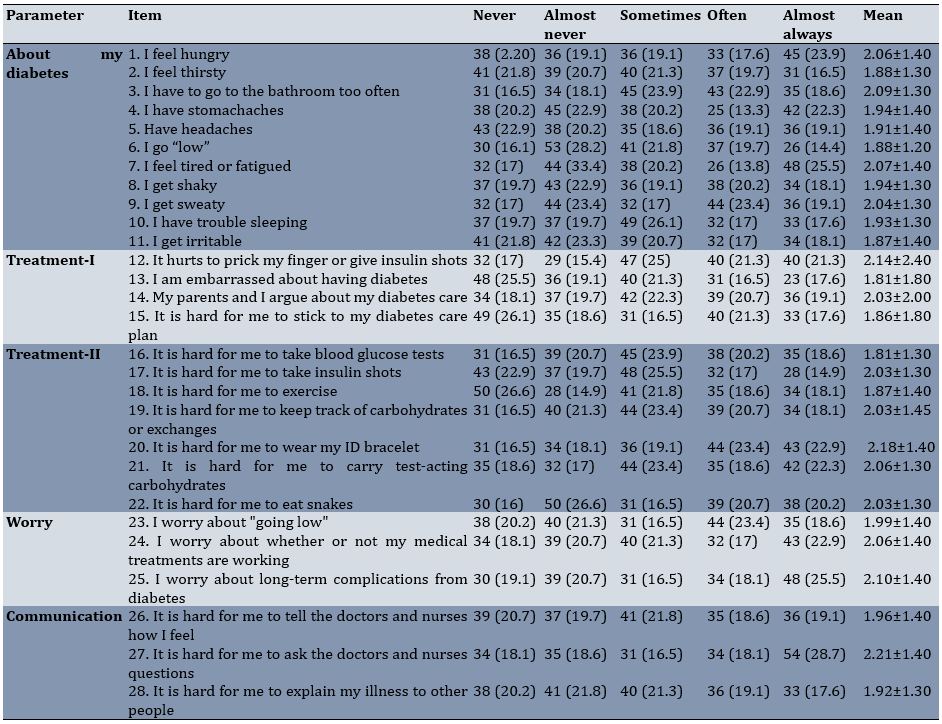
Item-level analysis identified the following lowest-mean challenges across domains: “About Child Diabetes” was lowest for “I feel physically weak” (1.80±1.39), Emotional Functioning for “I feel angry” (1.90±1.40), Social Functioning for “I feel isolated from others” (1.88±1.30), Cognitive Functioning for “It is hard for me to keep my attention on things” (1.91±1.30), Communication for “It is hard for me to talk about my child’s health with others” (1.96±1.40), Worry for “I worry about how my child’s illness is affecting other family members” (1.81±1.30), Daily Activities for “I feel too tired to do the things I like to do” (1.92±1.30), and Family Relationships for “Conflicts between family members” (1.88±1.40; Table 1).
No significant correlation was found between adolescent QoL and sex (t=-0.11, p=0.907), age (r=-0.008; p=0.913), illness duration (r=0.004; p=0.959), residency (t=1.05; p=0.293), or educational level (F=0.145; p=0.965). However, a significant negative correlation was observed with adolescent weight (r=-0.163; p=0.025).
Parental socioeconomic level was not correlated with their QoL (F=0.43, p=0.43), but employment status was (t=2.57, p=0.011). Unemployed parents had significantly lower QoL (65.40±4.60) than employed parents (67.68±5.02). Parental educational level also correlated with QoL, with a trend (p=0.066) suggesting lower QoL among intermediate school graduates.
Table 1. Frequency and mean scores of items of quality of life domains in adolescents with type 1 diabetes in Al-Najaf City hospitals, Iraq
Discussion
This study aimed to determine the QoL of parents and adolescents with type 1 diabetes. There was a moderate QoL level, highlighting the balance these adolescents maintain between managing their condition and typical childhood experiences. A study conducted in Turkey reports a mean QoL score of 65.3 among children with diabetes, indicating a significantly higher QoL than in our study. Other studies in Ethiopia [15] and Kuwait also report higher QoL than our findings [16]. This discrepancy may reflect differences in healthcare access, diabetes management education, and parental support systems in these countries compared with those in Iraq [17]. In a study from Egypt, researchers report a mean QoL score of 56.4 for children with diabetes, which, while still higher than our findings, suggests a somewhat closer context [18]. Differences in healthcare infrastructure and public health policies may also account for the observed variances between these populations. Conversely, research conducted in lower-resource settings, such as Somalia, reported a mean QoL score of 45.0, closer to our findings [19]. This highlights potential commonalities in challenges faced by children with diabetes in regions with limited resources and healthcare access. The observed differences in QoL scores between our study and others are likely attributable to various factors, particularly the effectiveness of healthcare systems and diabetes education programs [20]. In many higher-income countries, comprehensive diabetes management programs and educational services are well established, contributing to better health outcomes and enhanced QoL for children [21]. These gaps can directly impact how children perceive their QoL, especially in managing the daily demands of diabetes.
The mean score of 67.48±5.10 provides insights into the emotional and social complexities of parenting a child with a chronic illness. Research on QoL among parents of children with diabetes has yielded mixed results, often reflecting differences in methodology, population demographics, and contextual factors. For instance, Lloyd et al. [22] reported a mean QoL score of 75.9 among parents, which is significantly higher than our findings. This difference may be attributed to the study’s focus on a more homogeneous group of parents with higher socioeconomic status and access to diabetes education resources, suggesting that socioeconomic factors play a critical role in parental well-being. Conversely, Kovacs et al. [23] declare that parents of children with poorly controlled diabetes report lower QoL scores, averaging 61.2. This aligns more closely with our findings and reinforces the idea that when parents struggle with their child’s diabetes management, their QoL can significantly decline. Our findings, in line with this literature, indicate a potential avenue for intervention: enhancing educational initiatives and support networks may improve the psychosocial outcomes for parents of children with diabetes [9, 24].
A significant correlation was found between adolescent QoL and weight, emphasizing the importance of weight management in diabetes care. Compared with other studies, several key themes and implications emerge regarding the impact of weight on QoL among pediatric patients with diabetes. Other studies have indicated that children with better glycemic control, often associated with maintaining a healthy weight, report higher QoL scores [25, 26]. Conversely, González-Muniesa et al. found that children who are overweight or obese not only have poorer QoL but also face additional complications related to diabetes management. The study suggested that excess weight can exacerbate physical limitations and emotional strain, leading to a notable decline in QoL [27]. Our findings highlight the potential of proactive weight management in improving QoL outcomes. Identifying children at risk of obesity and providing early interventions could be beneficial. Initiatives that promote awareness about healthy lifestyle choices and provide resources for families struggling with weight-related issues are crucial in this population.
Unemployed parents had significantly lower QoL than employed parents, which highlights the influence of employment status on parental well-being, particularly in the context of chronic illness management. Comparative analyses with existing literature further emphasize the implications of these findings. The significant difference in quality-of-life scores between unemployed and employed parents aligns with findings from Zheng et al., who report that job-related factors play a critical role in caregivers' overall well-being. Employed parents often experience a sense of structure, purpose, and social engagement that can contribute positively to their mental and emotional health. In contrast, unemployment can lead to feelings of inadequacy, low self-esteem, and increased stress, which negatively impact QoL [28]. Some studies have also highlighted that unemployed parents of children with chronic conditions, including diabetes, face additional psychological burdens, such as anxiety and depression, which can hinder their ability to provide effective care [29, 30]. Peer support groups and community services aimed at families coping with chronic illness may help bridge this gap by providing unemployed parents with the necessary tools and emotional support to enhance their well-being [31].
The cross-sectional design of our study in one hospital limits our ability to infer causation. Future research should aim for multi-center studies that include diverse populations to strengthen the generalizability of the findings. Additionally, other factors contributing to QoL, such as psychosocial elements and family dynamics, may not have been fully explored in our analysis. Based on our results, future research efforts should focus on exploring disparities in experiences and developing effective interventions that address the diverse needs of parents. Future studies should also consider longitudinal designs to assess how weight changes over time influence QoL and how interventions can effectively target both weight management and psychosocial support. Expanding the scope of research to include diverse populations will provide a more comprehensive understanding of the relationship between weight and QoL in children with diabetes.
Conclusion
Parents of adolescents with diabetes have an acceptable level of quality of life, while adolescents have lower quality of life.
Acknowledgments: We thank the participants and their families for their cooperation. We also extend our gratitude to Iran University of Medical Sciences and Health Services, the Clinical Research Development Unit, Al-Zahra Teaching Hospital, Al-Hakim Hospital, Diabetes Center, Al-Sadr Teaching Hospital, and Al-Manathira Hospital in Al-Najaf City, Iraq.
Ethical Permissions: Ethical approval (code: IR.IUMS.REC.1403.215) was obtained from the ethics committee of Iran University of Medical Sciences and the Najaf Hospitals Directorate.
Conflicts of Interest: The authors declare no conflicts of interest.
Authors' Contribution: Hani DK (First Author), Introduction Writer/Main Researcher (35%); Mohammadi R (Second Author), Methodologist/Main Researcher/Discussion Writer (35%); Al-Narawi AJ (Third Author), Assistant Researcher (15%); Haghani Sh (Fourth Author), Methodologist/Statistical Analyst (15%)
Funding/Support: This article was derived from an MSc thesis research project.
Type 1 diabetes mellitus (T1DM) is a heterogeneous disease that often manifests in childhood and adolescence, characterized by insulin deficiency due to pancreatic beta-cell destruction. T1DM is one of the most common chronic childhood diseases. While exact figures are unavailable, estimates suggest that T1DM accounts for about 5% of all diabetes cases, with a prevalence of approximately 0.25%. Its incidence is increasing by 3-5% annually in most studied populations [1]. Although predisposing factors for diabetes mellitus are defined, its incidence in the South East Asia Region is projected to rise from 30 million in 2025 to 80 million in 2030 [2]. The Middle East has seen an epidemic increase in diabetes. In Basrah, Iraq, diabetes prevalence is extremely high, with at least one in five adults affected, placing significant strain on the healthcare system and fiscal resources [3]. The total number of cases across Iraqi provinces from 2018 to 2022 was 2,933,397, consistent with the International Diabetes Federation’s 2021 report stating that 9.4% of Iraqi adults (approximately 2,011,400 individuals) have diabetes [4].
Poor knowledge, low educational levels, inadequate healthcare provider practices, and insufficient policymaker involvement directly affect the prevalence of diabetes in Iraq [5]. Adolescents with T1DM must adapt to a lifestyle requiring self-management of diet, exercise, and insulin adjustment while developing autonomy and self-identity. The rapid biological changes of adolescence, combined with chronic illness management, can place adolescents at risk for poor metabolic control and difficulties in life adjustment, potentially interfering with developmental tasks, psychological adjustment, and overall quality of life (QoL). Lower QoL scores have been associated with older age, poor glycemic control, increased hypoglycemic episodes, complications, lower education levels, self-reported depression, and female gender [6]. QoL is a significant patient-reported outcome reflecting subjective assessments of general well-being, daily life satisfaction, work and leisure capacity, emotional state, and social participation. Youth QoL encompasses developmentally appropriate social, emotional, and physical functioning [7]. Poor adolescent glycemic control has been linked to inadequate self-management, leading to high family conflict and distress. Literature suggests that metabolic control and health-related QoL (HRQoL) for parents of adolescents with T1DM are negatively correlated with low affectionate sensitivity, overly reactive discipline, low family income, and high parental distress. While HRQoL in T1DM adolescents has been studied in several countries, only one hospital-based study in Saudi Arabia has reported HRQoL solely from the adolescent perspective [8]. QoL in children with diabetes is a complex and multidimensional phenomenon influenced by physical health, emotional well-being, social relationships, and familial support. Understanding the factors affecting QoL and implementing strategies to enhance it can lead to better health outcomes and improved overall well-being for children living with diabetes.
A collaborative approach involving healthcare providers, families, schools, and communities is essential in promoting a supportive environment that nurtures the QoL for these young patients [9–11]. The stress of raising a child with T1DM can be overwhelming. Parental coping with the stress of diabetes is likely to have an essential influence on how well children and families adjust to the disease. Parents mention the need for constant monitoring and a sense of ongoing obligation to maintain metabolic control and prevent episodes of hypoglycemia. Maternal distress and children’s reported QoL in school-age and older children have both been linked to how much mothers find managing diabetes distressing [12]. Parents of children with diabetes often experience a significant emotional and psychological burden due to the demands of managing their child’s chronic condition. This burden can affect their overall QoL, including their mental, emotional, physical, and social well-being. Understanding these challenges and improving the QoL for parents is essential in the context of pediatric diabetes management [13]. Enhancing the QoL for parents of adolescents with diabetes is crucial for fostering a supportive environment for both the child and the family as a whole. By addressing the emotional, financial, and social challenges parents face, healthcare providers and advocates can implement strategies that enhance their well-being and resilience. Nurses play a crucial role in diabetes management, a role that depends on patients' health status. A solid educational foundation for competent self-care is essential for all patients with diabetes to manage long-term care and avoid complications affecting QoL, making it a central focus of nursing care.
This study aimed to assess the QoL of adolescents with T1DM and their parents in hospitals in Al-Najaf City, Iraq.
Instrument and Methods
This descriptive study was conducted among 376 referrals to hospitals in Al-Najaf City, Iraq, selected through convenience sampling from June to October 2024. The research population was all parents with their adolescent who has diabetes type 1 and is hospitalized in pediatric wards and health centers for chronic diseases that they visit to receive treatment. The minimum required sample size for estimating QoL at a 95% confidence level, with an accuracy estimate of d=1 and a standard deviation of 9.89, was calculated to be 376 participants.
Inclusion criteria were adolescents aged 13-18 years, no other chronic diseases, adolescents and their parents residing in Al-Najaf, no hearing or speech problems, Arabic-speaking, and at least six months since T1DM diagnosis.
Data were collected using a demographic questionnaire and the PedsQL Diabetes Module for adolescents and the PedsQL Family Impact Module for parents.
The demographic questionnaire included gender, age, educational level, residence, illness duration, and weight.
The PedsQL Diabetes Module is a widely used, internationally validated instrument assessing diabetes-specific HRQoL in children, adolescents, and young adults from both patient and parent perspectives. It comprises 28 items across five subdomains: treatment barriers (4 items), treatment adherence (7 items), diabetes symptoms (11 items), communication (3 items), and worry (3 items). It uses a five-point Likert scale (0=never to 4=almost always), except for the child report version for ages 5-7 years, which uses a three-point scale with visual aids. Items are reverse-scored and linearly transformed to a 0-100 scale, with higher scores indicating better HRQoL.
The PedsQL Family Impact Module for parents consists of 36 items across eight scales: physical functioning (6 items), emotional functioning (5 items), social functioning (4 items), cognitive functioning (5 items), communication (3 items), worry (5 items), daily activities (3 items), and family relationships (5 items). It also uses a five-point Likert scale, which is reverse-scored and transformed to a 0-100 scale, with higher scores indicating better functioning. Both instruments have demonstrated reliability and validity [14]. The reliability of the Pediatric Quality of Life Inventory (PedsQL) was measured using Cronbach's alpha after completing the questionnaire by 10 parents and adolescents. Cronbach's alpha coefficient was calculated as 0.86.
Written informed consent was obtained from all study participants after explaining the data collection method and study procedures. It was explained to the parents and adolescents that the questionnaires were anonymous and the results would be published without mentioning participants’ names. For this purpose, the researcher, according to a predetermined schedule, visited the research site during different shifts, introduced herself to the head nurses, and obtained their permission. First, the researcher introduced herself and provided sufficient information about the research objectives. The stages of the questionnaire were explained before it was presented to participants, and sufficient time was provided for each person to complete and answer all the questions. The importance of the study for parents and adolescents was also emphasized. Each participant was given enough time to carefully read and complete the informed consent form.
Data were analyzed using the Chi-square test and correlation coefficients with SPSS 22.
Findings
Of the adolescents, 129 (68.6%) were female, 42 (22.3%) were intermediate school graduates, and 99 (52.7%) lived in rural areas. The mean age was 15.16±1.59 years, and the mean illness duration was 5.16±2.98 years. Weight for 74 (39.4%) adolescents ranged from 50 to 60kg, with a mean of 54.97±14.88kg. Among parents, 121 (64.4%) were male, 85 (45.2%) had a middle economic status, 127 (67.6%) were married, 149 (79.3%) were employed, and 42 (22.3%) were primary school graduates. The mean parental age was 45.53±8.41 years.
The mean diabetes-specific QoL scores among adolescents with type 1 diabetes were: diabetes symptoms (50.84±11.28), treatment barriers (50.96±17.18), treatment adherence (49.84±13.77), worry (48.75±21.66), communication (49.29±20.59), and the total (50.22±6.90).
The parents’ mean quality of life scores in Al-Najaf City hospitals, Iraq, were as follows: physical functioning 70.40±12.80, emotional functioning 62.40±14.30, social functioning 50.21±13.60, cognitive functioning 69.81±13.40, communication 71.01±16.40, worry 70.15±13.27, daily activities 68.70±16.70, family relationships 62.47±15.30, and the total score was 67.48±5.10
Item-level analysis identified the following lowest-mean challenges across domains: “About Child Diabetes” was lowest for “I feel physically weak” (1.80±1.39), Emotional Functioning for “I feel angry” (1.90±1.40), Social Functioning for “I feel isolated from others” (1.88±1.30), Cognitive Functioning for “It is hard for me to keep my attention on things” (1.91±1.30), Communication for “It is hard for me to talk about my child’s health with others” (1.96±1.40), Worry for “I worry about how my child’s illness is affecting other family members” (1.81±1.30), Daily Activities for “I feel too tired to do the things I like to do” (1.92±1.30), and Family Relationships for “Conflicts between family members” (1.88±1.40; Table 1).
No significant correlation was found between adolescent QoL and sex (t=-0.11, p=0.907), age (r=-0.008; p=0.913), illness duration (r=0.004; p=0.959), residency (t=1.05; p=0.293), or educational level (F=0.145; p=0.965). However, a significant negative correlation was observed with adolescent weight (r=-0.163; p=0.025).
Parental socioeconomic level was not correlated with their QoL (F=0.43, p=0.43), but employment status was (t=2.57, p=0.011). Unemployed parents had significantly lower QoL (65.40±4.60) than employed parents (67.68±5.02). Parental educational level also correlated with QoL, with a trend (p=0.066) suggesting lower QoL among intermediate school graduates.
Table 1. Frequency and mean scores of items of quality of life domains in adolescents with type 1 diabetes in Al-Najaf City hospitals, Iraq
Discussion
This study aimed to determine the QoL of parents and adolescents with type 1 diabetes. There was a moderate QoL level, highlighting the balance these adolescents maintain between managing their condition and typical childhood experiences. A study conducted in Turkey reports a mean QoL score of 65.3 among children with diabetes, indicating a significantly higher QoL than in our study. Other studies in Ethiopia [15] and Kuwait also report higher QoL than our findings [16]. This discrepancy may reflect differences in healthcare access, diabetes management education, and parental support systems in these countries compared with those in Iraq [17]. In a study from Egypt, researchers report a mean QoL score of 56.4 for children with diabetes, which, while still higher than our findings, suggests a somewhat closer context [18]. Differences in healthcare infrastructure and public health policies may also account for the observed variances between these populations. Conversely, research conducted in lower-resource settings, such as Somalia, reported a mean QoL score of 45.0, closer to our findings [19]. This highlights potential commonalities in challenges faced by children with diabetes in regions with limited resources and healthcare access. The observed differences in QoL scores between our study and others are likely attributable to various factors, particularly the effectiveness of healthcare systems and diabetes education programs [20]. In many higher-income countries, comprehensive diabetes management programs and educational services are well established, contributing to better health outcomes and enhanced QoL for children [21]. These gaps can directly impact how children perceive their QoL, especially in managing the daily demands of diabetes.
The mean score of 67.48±5.10 provides insights into the emotional and social complexities of parenting a child with a chronic illness. Research on QoL among parents of children with diabetes has yielded mixed results, often reflecting differences in methodology, population demographics, and contextual factors. For instance, Lloyd et al. [22] reported a mean QoL score of 75.9 among parents, which is significantly higher than our findings. This difference may be attributed to the study’s focus on a more homogeneous group of parents with higher socioeconomic status and access to diabetes education resources, suggesting that socioeconomic factors play a critical role in parental well-being. Conversely, Kovacs et al. [23] declare that parents of children with poorly controlled diabetes report lower QoL scores, averaging 61.2. This aligns more closely with our findings and reinforces the idea that when parents struggle with their child’s diabetes management, their QoL can significantly decline. Our findings, in line with this literature, indicate a potential avenue for intervention: enhancing educational initiatives and support networks may improve the psychosocial outcomes for parents of children with diabetes [9, 24].
A significant correlation was found between adolescent QoL and weight, emphasizing the importance of weight management in diabetes care. Compared with other studies, several key themes and implications emerge regarding the impact of weight on QoL among pediatric patients with diabetes. Other studies have indicated that children with better glycemic control, often associated with maintaining a healthy weight, report higher QoL scores [25, 26]. Conversely, González-Muniesa et al. found that children who are overweight or obese not only have poorer QoL but also face additional complications related to diabetes management. The study suggested that excess weight can exacerbate physical limitations and emotional strain, leading to a notable decline in QoL [27]. Our findings highlight the potential of proactive weight management in improving QoL outcomes. Identifying children at risk of obesity and providing early interventions could be beneficial. Initiatives that promote awareness about healthy lifestyle choices and provide resources for families struggling with weight-related issues are crucial in this population.
Unemployed parents had significantly lower QoL than employed parents, which highlights the influence of employment status on parental well-being, particularly in the context of chronic illness management. Comparative analyses with existing literature further emphasize the implications of these findings. The significant difference in quality-of-life scores between unemployed and employed parents aligns with findings from Zheng et al., who report that job-related factors play a critical role in caregivers' overall well-being. Employed parents often experience a sense of structure, purpose, and social engagement that can contribute positively to their mental and emotional health. In contrast, unemployment can lead to feelings of inadequacy, low self-esteem, and increased stress, which negatively impact QoL [28]. Some studies have also highlighted that unemployed parents of children with chronic conditions, including diabetes, face additional psychological burdens, such as anxiety and depression, which can hinder their ability to provide effective care [29, 30]. Peer support groups and community services aimed at families coping with chronic illness may help bridge this gap by providing unemployed parents with the necessary tools and emotional support to enhance their well-being [31].
The cross-sectional design of our study in one hospital limits our ability to infer causation. Future research should aim for multi-center studies that include diverse populations to strengthen the generalizability of the findings. Additionally, other factors contributing to QoL, such as psychosocial elements and family dynamics, may not have been fully explored in our analysis. Based on our results, future research efforts should focus on exploring disparities in experiences and developing effective interventions that address the diverse needs of parents. Future studies should also consider longitudinal designs to assess how weight changes over time influence QoL and how interventions can effectively target both weight management and psychosocial support. Expanding the scope of research to include diverse populations will provide a more comprehensive understanding of the relationship between weight and QoL in children with diabetes.
Conclusion
Parents of adolescents with diabetes have an acceptable level of quality of life, while adolescents have lower quality of life.
Acknowledgments: We thank the participants and their families for their cooperation. We also extend our gratitude to Iran University of Medical Sciences and Health Services, the Clinical Research Development Unit, Al-Zahra Teaching Hospital, Al-Hakim Hospital, Diabetes Center, Al-Sadr Teaching Hospital, and Al-Manathira Hospital in Al-Najaf City, Iraq.
Ethical Permissions: Ethical approval (code: IR.IUMS.REC.1403.215) was obtained from the ethics committee of Iran University of Medical Sciences and the Najaf Hospitals Directorate.
Conflicts of Interest: The authors declare no conflicts of interest.
Authors' Contribution: Hani DK (First Author), Introduction Writer/Main Researcher (35%); Mohammadi R (Second Author), Methodologist/Main Researcher/Discussion Writer (35%); Al-Narawi AJ (Third Author), Assistant Researcher (15%); Haghani Sh (Fourth Author), Methodologist/Statistical Analyst (15%)
Funding/Support: This article was derived from an MSc thesis research project.
Keywords:
References
1. Aljallad WMA, Al-Ghabban SI, Al-Mhanna MGH. Quality of life among sample of children and teenagers with type 1 diabetes mellitus in holy city of Karbala/Iraq 2019. Indian J Public Health. 2020;11(2):1197. [Link] [DOI:10.37506/v11/i2/2020/ijphrd/194984]
2. Ahmad J, Masoodi MA, Ashraf M, Rashid R, Ahmad R, Ahmad A, et al. Prevalence of diabetes mellitus and its associated risk factors in age group of 20 years and above in Kashmir. India Al Ameen J Med Sci. 2011;4:38-44. [Link]
3. Mansour AA, Al-Maliky AA, Kasem B, Jabar A, Mosbeh KA. Prevalence of diagnosed and undiagnosed diabetes mellitus in adults aged 19 years and older in Basrah, Iraq. Diabetes Metab Syndr Obes Targets Ther. 2014;7:139-44. [Link] [DOI:10.2147/DMSO.S59652]
4. Mustafa MA, Hattab WAA, Kadhim SA, Abdulwahhab MM. Prevalence of diabetes mellitus over the years in Iraqi governorates. Med Forum. 2025;36(1):63. [Link] [DOI:10.60110/medforum.360113]
5. Alnassar HAG, Alnaffakh MS, Kareem MMA. Assessment of knowledge of diabetic patients regarding diabetic foot care at Al-Najaf center for diabetes and endocrine. [Link]
6. Abolfotouh M, Kamal, El-Bourgy, Mohamed. Quality of life and glycemic control in adolescents with type 1 diabetes and the impact of an education intervention. Int J Gen Med. 2011:141. [Link] [DOI:10.2147/IJGM.S16951]
7. Hilliard ME, Minard CG, Marrero DG, De Wit M, Thompson D, DuBose SN, et al. Assessing health-related quality of life in children and adolescents with diabetes: Development and psychometrics of the type 1 diabetes and life (T1DAL) measures. J Pediatr Psychol. 2020;45(3):328-39. [Link] [DOI:10.1093/jpepsy/jsz083]
8. AlBuhairan F, Nasim M, Al Otaibi A, Shaheen NA, Al Jaser S, Al Alwan I. Health related quality of life and family impact of type 1 diabetes among adolescents in Saudi Arabia. Diabetes Res Clin Pract. 2016;114:173-9. [Link] [DOI:10.1016/j.diabres.2016.01.001]
9. Hirose M, Beverly EA, Weinger K. Quality of life and technology: Impact on children and families with diabetes. Curr Diabetes Rep. 2012;12:711-20. [Link] [DOI:10.1007/s11892-012-0313-4]
10. Khemakhem R, Dridi Y, Hamza M, Hamouda AB, Khlayfia Z, Ouerda H, et al. Living with type 1 diabetes mellitus: How does the condition affect children's and adolescents' quality of life?. Arch Pediatr. 2020;27(1):24-8. [Link] [DOI:10.1016/j.arcped.2019.11.002]
11. Petersson C, Huus K, Enskär K, Hanberger L, Samulesson U, Åkesson K. Impact of type 1 diabetes on health-related quality of life among 8-18-year-old children. Compr Child Adolesc Nurs. 2016;39(4):245-55. [Link] [DOI:10.1080/24694193.2016.1196265]
12. Grey M, Jaser SS, Whittemore R, Jeon S, Lindemann E. Coping skills training for parents of children with type 1 diabetes: 12-month outcomes. Nurs Res. 2011;60(3):173-81. [Link] [DOI:10.1097/NNR.0b013e3182159c8f]
13. Choi S, Shin H. The burdens faced by parents of preschoolers with type 1 diabetes mellitus: An integrative review. Child Health Nurs Res. 2023;29(3):166. [Link] [DOI:10.4094/chnr.2023.29.3.166]
14. Varni JW, Sherman SA, Burwinkle TM, Dickinson PE, Dixon P. The PedsQLTM family impact module: Preliminary reliability and validity. Health Qual Life Outcomes. 2004;2(1). [Link] [DOI:10.1186/1477-7525-2-55]
15. Bekele BT, Demie TG, Worku F. Health-related quality-of-Life and associated factors among children and adolescents with type 1 diabetes mellitus: A cross-sectional study. Pediatr Health Med Ther. 2022:243-56. [Link] [DOI:10.2147/PHMT.S364454]
16. Abdul-Rasoul M, AlOtaibi F, Abdulla A, Rahme Z, AlShawaf F. Quality of life of children and adolescents with type 1 diabetes in Kuwait. Med Princ Pract. 2013;22(4):379-84. [Link] [DOI:10.1159/000347052]
17. Caferoğlu Z, İnanç N, Hatipoğlu N, Kurtoğlu S. Health-related quality of life and metabolic control in children and adolescents with type 1 diabetes mellitus. J Clin Res Pediatr Endocrinol. 2016;8(1):67. [Link] [DOI:10.4274/jcrpe.2051]
18. Gadallah MA, Ismail T, Aty NSA. Health related quality of life among children with Type I diabetes, Assiut city, Egypt. J Nurs Educ Pract. 2017;7(10):73-82. [Link] [DOI:10.5430/jnep.v7n10p73]
19. Wallin AM, Löfvander M, Ahlström G. Diabetes: A cross‐cultural interview study of immigrants from Somalia. J Clin Nurs. 2007;16(11c):305-14. [Link] [DOI:10.1111/j.1365-2702.2007.02099.x]
20. Lukács A, Varga B, Kiss-Tóth E, Soós A, Barkai L. Factors influencing the diabetes-specific health-related quality of life in children and adolescents with type 1 diabetes mellitus. J Child Health Care. 2014;18(3):253-60. [Link] [DOI:10.1177/1367493513486964]
21. Zan H, Meng Z, Li J, Zhang X, Liu T. Factors associated with quality of life among elderly patients with type 2 diabetes mellitus: The role of family caregivers. BMC Public Health. 2024;24(1):539. [Link] [DOI:10.1186/s12889-024-17917-z]
22. Lloyd CE, Gill P, Stone M. Psychological care in a national health service: Challenges for people with diabetes. Curr Diabet Report, 2013;13:894-9. [Link] [DOI:10.1007/s11892-013-0416-6]
23. Kovacs CS, Seshiah V, Merker L, Christiansen AV, Roux F, Salsali A, et al. Empagliflozin as add-on therapy to pioglitazone with or without metformin in patients with type 2 diabetes mellitus. Clin Therap. 2015;37(8):1773-88. [Link] [DOI:10.1016/j.clinthera.2015.05.511]
24. Thompson R. Structured education for diabetes. Psychosocial aspects of diabetes. Boca Raton: CRC Press; 2021. p. 126-40. [Link] [DOI:10.4324/9781785230967-11]
25. Aljawarneh YM, Wood GL, Wardell DW, Al-Jarrah MD. The associations between physical activity, health-related quality of life, regimen adherence, and glycemic control in adolescents with type 1 diabetes: A cross-sectional study. Prim Care Diabetes. 2023;17(4):392-400. [Link] [DOI:10.1016/j.pcd.2023.04.003]
26. Elian V, Popovici V, Ozon EA, Musuc AM, Fița AC, Rusu E, et al. Current technologies for managing type 1 diabetes mellitus and their impact on quality of life-a narrative review. Life. 2023;13(8):1663. [Link] [DOI:10.3390/life13081663]
27. González-Muniesa P, Mártinez-González MA, Hu FB, Després JP, Matsuzawa Y, Loos RJ, et al. Obesity (primer). Nat Rev Dis Primers. 2017;3(1):17034. [Link] [DOI:10.1038/nrdp.2017.34]
28. Zheng J, Feng S, Gao R, Gong X, Ji X, Li Y, et al. The relationship between organizational support, professional quality of life, decent work, and professional well-being among nurses: A cross-sectional study. BMC Nurs. 2024;23(1):425. [Link] [DOI:10.1186/s12912-024-02114-5]
29. Miller DS, Lin EH. Children in sheltered homeless families: Reported health status and use of health services. Pediatrics. 1988;81(5):668-73. [Link] [DOI:10.1542/peds.81.5.668]
30. Toledano-Toledano F, Luna D. The psychosocial profile of family caregivers of children with chronic diseases: A cross-sectional study. BioPsychoSocial Med. 2020;14:1-9. [Link] [DOI:10.1186/s13030-020-00201-y]
31. Niela-Vilén H, Axelin A, Salanterä S, Melender HL. Internet-based peer support for parents: A systematic integrative review. Int J Nurs Stud. 2014;51(11):1524-37. [Link] [DOI:10.1016/j.ijnurstu.2014.06.009]