

IMEMR
EMRO
Volume 7, Issue 1 (2026)
J Clinic Care Skill 2026, 7(1): 39-44 |
Back to browse issues page
Article Type:
Subject:




History
Received: 2026/01/8 | Accepted: 2026/02/28 | Published: 2026/03/15
Received: 2026/01/8 | Accepted: 2026/02/28 | Published: 2026/03/15
How to cite this article
Ansari H, Pournesaei G, Sabze Arai Langaroudi M. Comparison of Anxiety Disorders between Children with and without a Healthcare-Employed Parent. J Clinic Care Skill 2026; 7 (1) :39-44
URL: http://jccs.yums.ac.ir/article-1-480-en.html
URL: http://jccs.yums.ac.ir/article-1-480-en.html
Download citation:
BibTeX | RIS | EndNote | Medlars | ProCite | Reference Manager | RefWorks
Send citation to:


Rights and permissions
BibTeX | RIS | EndNote | Medlars | ProCite | Reference Manager | RefWorks
Send citation to:


1- Department of Psychology, Rahman Institute of Higher Education, Ramsar, Iran
2- Department of Psychology, Ahrar Institute of Higher Education, Rasht, Iran
2- Department of Psychology, Ahrar Institute of Higher Education, Rasht, Iran
Full-Text (HTML) (128 Views)
Introduction
In contemporary societies, the number of working parents has been steadily increasing each year [1]. In Iran, although precise statistics are not available, economic and social conditions have led to a noticeable rise in the number of families in which both parents are employed [2]. Employment, while enhancing the family’s financial capacity and being associated with increased self-esteem [3] and efficiency [4] for parents, may also have adverse consequences for children, including heightened feelings of loneliness [5, 6] and anxiety [7].
Among working parents, healthcare professionals represent a group that experiences particularly distinct family conditions due to the unique demands of their occupation [8]. Employment in professions directly related to human health and life is associated with elevated levels of occupational stress among healthcare workers [9]. Furthermore, shift work and night duties can contribute to increased occupational burnout in this population [10]. Exposure to such work-related stressors may also be stressful for the children of healthcare workers [11]. In line with this, existing research indicates a high prevalence of stress experiences and mental health problems among children of healthcare professionals [11, 12].
One of the major psychological problems faced by children of healthcare workers is anxiety disorders [13]. According to the fifth edition, text revision of the Diagnostic and Statistical Manual of Mental Disorders (DSM-5-TR), anxiety disorders comprise a category of disorders in which excessive fear, apprehension, and worry play a central role [14]. Somatic symptoms of these disorders include sweating, palpitations, mild gastrointestinal discomfort, headaches, and chest tightness, while affective and cognitive symptoms encompass irritability, speech disturbances, rumination, confusion, and impaired concentration. Notably, individuals with anxiety disorders are at an increased risk of suicide [15]. This category includes separation anxiety disorder, selective mutism, specific phobias, panic disorder, agoraphobia, generalized anxiety disorder, social anxiety disorder, anxiety disorders due to medical conditions, and substance/medication-induced anxiety disorders [14].
Anxiety disorders are the most prevalent mental disorders worldwide, affecting approximately 34% of the global population [16]. These disorders often emerge during childhood or adolescence, and affected individuals frequently present with comorbid mental disorders such as depression [17], as well as physical conditions including cardiovascular disease, hyperthyroidism, asthma, and epilepsy [18]. The prevalence of anxiety disorders is approximately twice as high in women as in men [14]. Due to their high prevalence, chronic course, and frequent comorbidities, the World Health Organization has ranked anxiety disorders as the ninth leading cause of health-related disability worldwide [19]. In addition to severely impairing daily functioning and quality of life, anxiety disorders impose a substantial societal burden, accounting for 3.3% of the global burden of disease [16].
The prevalence of anxiety disorders among children and adolescents is particularly high. In this regard, Liu et al. [5], in a 30-year trend analysis from 1990 to 2019, report that globally, 932 million cases of anxiety disorders occurred among children and adolescents. In Iran, Ahmadi et al. [20] found that the prevalence of psychiatric disorders among children and adolescents is 35.5%, with anxiety disorders being the most prevalent (22.2%). Among anxiety disorders, separation anxiety disorder (8.7%) and generalized anxiety disorder (8.6%) are the most common.
Several studies have compared psychological functioning, particularly anxiety disorders, in children with and without working parents. For instance, Pourakbari and Mosayebi Dariani [21] report no significant differences in anxiety levels between elementary school children of employed and unemployed mothers. In contrast, Fili et al. [22] found that overall anxiety, fear of physical injury, and generalized anxiety are significantly higher among children of employed mothers compared to those with unemployed mothers. Similarly, Fadakar et al. [23], using family drawings, show that children of employed mothers exhibit more anxiety symptoms. In that study, boys with employed mothers are more likely to omit themselves and devalue the mother figure compared to boys with stay-at-home mothers.
Despite these findings, studies comparing the psychological status of children with and without parents employed in the healthcare sector are scarce. In this context, Sadeghian Dehkordi and Motaghi [24] demonstrate that anxiety scores are significantly higher among adolescent children of healthcare workers compared to those of administrative staff. Khorsandi et al. [25] examined the impact of parental occupational status on the mental health of healthcare workers’ children during the COVID-19 pandemic and, based on a review of existing studies, concluded that these children experience substantial psychological pressure, including anxiety, depression, increased violence, and suicidal ideation. Moreover, Dörtkardeşler et al. [11] found that children of healthcare workers report higher levels of moderate to severe anxiety and more sleep problems compared to their peers without healthcare-worker parents.
Overall, healthcare worker parents face numerous challenges, including high occupational stress, work-family conflict, feelings of guilt, insufficient time for parent-child interaction, and reduced emotional connection with their children [8]. Consequently, their children are more likely to experience loneliness, concerns about their parents’ health, and health-
related worries due to their parents’ stressful working conditions and shift schedules [11]. Therefore, gaining a clearer understanding of the psychological status of this group may be beneficial for healthcare families, as well as health-related institutions in designing and implementing preventive programs. This study aimed to compare anxiety disorders in children with and without a parent employed in the healthcare sector.
Instrument and Methods
Design and participants
This descriptive, causal-comparative study was performed on children and adolescents aged 10 to 18 years living in Rasht, whose parents were either employed in the healthcare sector or engaged in non-healthcare occupations in 2025. Considering that the minimum sample size recommended for causal-comparative studies is 30 participants per group [26], a total of 60 participants were selected through purposive sampling. The sample included 30 children with at least one parent employed in the healthcare sector and 30 children whose parents were employed in non-healthcare occupations.
The inclusion criteria were willingness of both the child and parents to participate in the study, literacy (ability to read and write), and absence of diagnosed physical, psychiatric, or psychological disorders—except anxiety disorders—based on the children’s medical and psychiatric records. The exclusion criterion was refusal or failure to complete the questionnaire.
Instrument
Screen for Child Anxiety Related Emotional Disorders (SCARED; Birmaher et al., 1997)
The SCARED was developed by Birmaher et al. [27] and consists of 41 items designed to assess anxiety disorder symptoms in children and adolescents aged 8 to 18 years based on DSM-IV criteria. The questionnaire yields a total anxiety score and five subscales: generalized anxiety disorder (items 5, 7, 14, 21, 23, 28, 33, 35, 38), separation anxiety disorder (items 4, 8, 13, 16, 20, 25, 29, 31), social anxiety disorder (items 3, 10, 26, 32, 39–41), school phobia (items 2, 11, 17, 36), and panic disorder/somatic symptoms (items 1, 6, 9, 12, 15, 18, 19, 22, 24, 27, 30, 34, 38). Items are rated on a three-point Likert scale ranging from 0 (not true) to 2 (very true or often true). A total score above 25 indicates the presence of an anxiety disorder. In the original study by Birmaher et al. [27], five factors were extracted, with internal consistency coefficients ranging from 0.74 to 0.93 across subscales. Test-retest reliability ranged from 0.70 to 0.90, and discriminant validity was confirmed, with an agreement coefficient of r=0.20.
In Iran, Palahang et al. [28] conducted an exploratory factor analysis using principal component analysis with varimax rotation, which resulted in the extraction of seven factors explaining 43% of the total variance. Internal consistency coefficients of the subscales ranged from 0.91 to 0.95 in the non-clinical sample and from 0.86 to 0.94 in the clinical sample, indicating satisfactory reliability.
Procedure
After obtaining official approval from Rahman Institute of Higher Education, the researcher visited Pars Hospital in Rasht. Following coordination with hospital management and receipt of research permission, participant recruitment was initiated. Among healthcare staff, those whose children expressed willingness to participate and whose parents provided informed consent were selected using purposive sampling in accordance with the study criteria, resulting in 30 participants. The comparison group, consisting of 30 children without parents employed in the healthcare sector, was also selected purposively from hospital visitors. Participants were assured that their responses would remain confidential, and written informed consent was obtained from parents prior to data collection.
Data analysis
Data analyses were conducted using one-way analysis of variance (ANOVA) and multivariate analysis of variance (MANOVA) in SPSS 27.
Findings
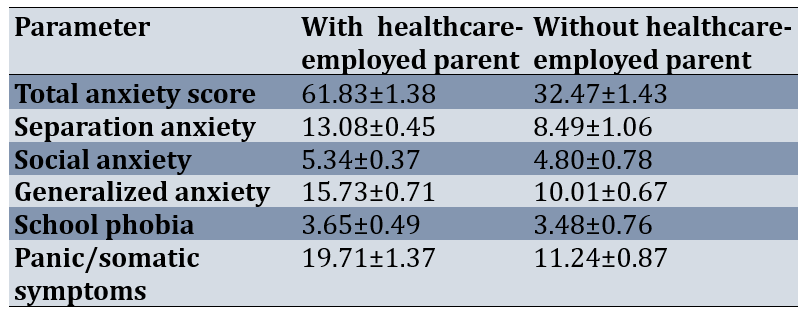
The mean age of participants was 9.34±2.14 in the group with a healthcare worker parent and 10.54±2.03 in the group without a healthcare worker parent. The mean scores of all anxiety-related parameters were higher among children with a parent employed in the healthcare sector compared to their counterparts (Table 1).
Table 1. Mean scores of anxiety disorders among children with and without a healthcare worker parent
To examine group differences across the dependent parameters, MANOVA was conducted. Prior to conducting the analysis, statistical assSumptions were evaluated. Normality of the data distribution was assessed using the Kolmogorov–Smirnov test; homogeneity of variances was examined using Levene’s test; and homogeneity of the variance–covariance matrices was assessed using Box’s M test; all were confirmed (p>0.05). All multivariate significance tests were statistically significant, supporting the appropriateness of conducting MANOVA. There was a statistically significant difference between children with and without a healthcare worker parent on at least one of the dependent parameters (Hypothesis df=6, Error df=58, F=3.26): Wilks’ Lambda=0.71 (p=0.001), Pillai’s Trace=0.29 (p=0.001), Hotelling’s Trace=0.41 (p=0.001), and Roy’s Largest Root=0.41 (p=0.001).
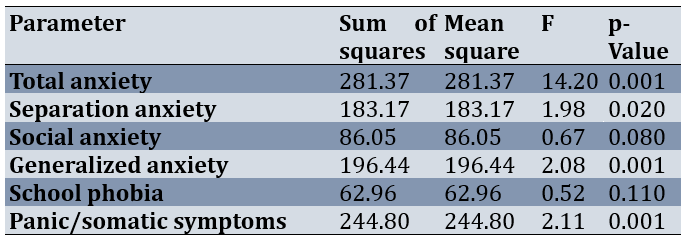
A statistically significant difference was observed between the two groups in total anxiety scores (p<0.001), indicating that children with a parent employed in the healthcare sector differed in overall anxiety from children without a healthcare worker parent. In addition, a significant between-group difference was found for separation anxiety (p<0.05). No statistically significant between-group difference was found in social anxiety (p>0.05). However, a significant between-group difference was observed in generalized anxiety (p<0.001). No significant between-group difference was found for school phobia (p>0.05). Finally, the results revealed a statistically significant between-group difference in panic disorder/somatic symptoms (p<0.001; Table 2)
Table 2. Between-group comparison results of univariate analyses of variance assessing anxiety parameters (df=1 for all)
Discussion
This study compared anxiety disorders in children with and without a parent employed in the healthcare sector. Children with a parent employed in the healthcare sector exhibited significantly higher levels of overall anxiety compared to children whose parents were not employed in healthcare-related occupations. This result is consistent with previous studies conducted by Fadakar et al. [23], Sadeghian Dehkordi and Motaghi [24], Pourakbari and Mosayebi Dariani [21], Fili et al. [22], Khorsandi et al. [25], Şahin et al. [13], Adhikari [7], and Dörtkardeşler et al. [11].
Several explanations may account for this finding. One plausible factor contributing to higher anxiety levels among children of healthcare workers is the elevated occupational stress experienced by their parents. Healthcare professionals are often required to work long and irregular shifts, including night duties and weekends [29]. Such work schedules may substantially reduce the amount of time parents spend with their children, potentially leading to feelings of loneliness, emotional neglect, and insecurity in children. Moreover, working in healthcare settings is inherently stressful due to frequent exposure to critically ill patients, mortality, resource shortages, and organizational pressures. These stressors can negatively affect parents’ mental health, increasing irritability, emotional exhaustion, and reduced emotional availability, which may indirectly influence children’s psychological well-being.
In addition, healthcare workers are at heightened risk of occupational burnout due to excessive workload and chronic psychological pressure [30, 31]. Burnout may limit parents’ emotional energy and responsiveness, impairing their ability to engage in warm, supportive, and emotionally attuned interactions with their children. As a result, children’s emotional needs may remain unmet, increasing their vulnerability to anxiety symptoms.
Another important factor is children’s concern about their parents’ safety and health. Children of healthcare workers may worry that their parents are exposed to infectious diseases and could transmit illnesses to family members—a concern that becomes particularly salient during outbreaks of contagious diseases, such as the COVID-19 pandemic [32]. Additionally, children may fear that their parents could be physically harmed in high-risk clinical environments, such as emergency departments or intensive care units. These persistent worries may contribute to heightened anxiety and hypervigilance.
Irregular work schedules may also complicate the arrangement of consistent childcare. Difficulties in securing stable caregivers at different times of day and night may result in children frequently transitioning between caregivers, fostering feelings of instability, insecurity, and a lack of predictability. Furthermore, healthcare worker parents may experience guilt due to limited time with their children [33, 34]. Such guilt may manifest as overly strict parenting practices or, conversely, attempts to compensate through material rewards rather than emotional connection. Both patterns may interfere with effective parent-child communication and emotional bonding.
Chronic stress and fatigue may further hinder parents’ ability to communicate effectively with their children. Parents may struggle to listen attentively, demonstrate empathy, or respond adequately to their children’s emotional concerns. From a social learning perspective, children also learn coping strategies by observing their parents’ responses to stress. Continuous exposure to parental anxiety, distress, or depressive symptoms may increase the likelihood that children adopt similar maladaptive coping patterns, thereby elevating their risk of developing anxiety-related problems.
Despite its contributions, the present study has several limitations. First, data were collected using self-report questionnaires, which may be subject to response bias or inaccurate reporting. Future research could benefit from incorporating additional data collection methods, such as clinical interviews, parent or teacher reports, and observational measures, to obtain a more comprehensive assessment. Second, the causal-comparative design does not allow for causal inferences, and the observed relationships may be influenced by unmeasured confounding parameters. Experimental or longitudinal designs with greater control over potential confounders are recommended to clarify causal pathways between parental occupational status and child anxiety. Finally, the findings are limited to children and adolescents aged 10 to 18 years who reside in Rasht in 2025. Conducting similar studies with younger children, older adolescents, and samples from different cities or cultural contexts would enhance the generalizability of the results.
Our findings highlight the heightened vulnerability of children of healthcare workers to anxiety-related problems. Greater awareness of this population's psychological needs may assist families and healthcare institutions in developing targeted preventive and supportive interventions to promote children’s mental health and resilience.
Conclusion
Children of healthcare workers experience higher levels of anxiety disorders compared to their peers, likely influenced by parental occupational stress and psychological burden.
Acknowledgments: The researchers wish to thank all the individuals who participated in the study.
Ethical Permissions: This article is derived from a master’s thesis in psychology, which was approved on February 13, 2025, by the Vice Chancellor for Education of Rahman Institute of Higher Education.
Conflicts of Interest: No conflicts of interest to declare.
Authors' Contribution: Ansar H (First Author), Introduction Writer/Methodologist/Main Researcher/Discussion Writer (40%); Pournesaei GhS (Second Author), Introduction Writer/Methodologist/Assistant Researcher/Statistical Analyst (30%); Sabze Arai Langaroudi M (Third Author), Introduction Writer/Assistant Researcher/Discussion Writer/Statistical Analyst (30%)
Funding/Support: This study did not receive any funding.
In contemporary societies, the number of working parents has been steadily increasing each year [1]. In Iran, although precise statistics are not available, economic and social conditions have led to a noticeable rise in the number of families in which both parents are employed [2]. Employment, while enhancing the family’s financial capacity and being associated with increased self-esteem [3] and efficiency [4] for parents, may also have adverse consequences for children, including heightened feelings of loneliness [5, 6] and anxiety [7].
Among working parents, healthcare professionals represent a group that experiences particularly distinct family conditions due to the unique demands of their occupation [8]. Employment in professions directly related to human health and life is associated with elevated levels of occupational stress among healthcare workers [9]. Furthermore, shift work and night duties can contribute to increased occupational burnout in this population [10]. Exposure to such work-related stressors may also be stressful for the children of healthcare workers [11]. In line with this, existing research indicates a high prevalence of stress experiences and mental health problems among children of healthcare professionals [11, 12].
One of the major psychological problems faced by children of healthcare workers is anxiety disorders [13]. According to the fifth edition, text revision of the Diagnostic and Statistical Manual of Mental Disorders (DSM-5-TR), anxiety disorders comprise a category of disorders in which excessive fear, apprehension, and worry play a central role [14]. Somatic symptoms of these disorders include sweating, palpitations, mild gastrointestinal discomfort, headaches, and chest tightness, while affective and cognitive symptoms encompass irritability, speech disturbances, rumination, confusion, and impaired concentration. Notably, individuals with anxiety disorders are at an increased risk of suicide [15]. This category includes separation anxiety disorder, selective mutism, specific phobias, panic disorder, agoraphobia, generalized anxiety disorder, social anxiety disorder, anxiety disorders due to medical conditions, and substance/medication-induced anxiety disorders [14].
Anxiety disorders are the most prevalent mental disorders worldwide, affecting approximately 34% of the global population [16]. These disorders often emerge during childhood or adolescence, and affected individuals frequently present with comorbid mental disorders such as depression [17], as well as physical conditions including cardiovascular disease, hyperthyroidism, asthma, and epilepsy [18]. The prevalence of anxiety disorders is approximately twice as high in women as in men [14]. Due to their high prevalence, chronic course, and frequent comorbidities, the World Health Organization has ranked anxiety disorders as the ninth leading cause of health-related disability worldwide [19]. In addition to severely impairing daily functioning and quality of life, anxiety disorders impose a substantial societal burden, accounting for 3.3% of the global burden of disease [16].
The prevalence of anxiety disorders among children and adolescents is particularly high. In this regard, Liu et al. [5], in a 30-year trend analysis from 1990 to 2019, report that globally, 932 million cases of anxiety disorders occurred among children and adolescents. In Iran, Ahmadi et al. [20] found that the prevalence of psychiatric disorders among children and adolescents is 35.5%, with anxiety disorders being the most prevalent (22.2%). Among anxiety disorders, separation anxiety disorder (8.7%) and generalized anxiety disorder (8.6%) are the most common.
Several studies have compared psychological functioning, particularly anxiety disorders, in children with and without working parents. For instance, Pourakbari and Mosayebi Dariani [21] report no significant differences in anxiety levels between elementary school children of employed and unemployed mothers. In contrast, Fili et al. [22] found that overall anxiety, fear of physical injury, and generalized anxiety are significantly higher among children of employed mothers compared to those with unemployed mothers. Similarly, Fadakar et al. [23], using family drawings, show that children of employed mothers exhibit more anxiety symptoms. In that study, boys with employed mothers are more likely to omit themselves and devalue the mother figure compared to boys with stay-at-home mothers.
Despite these findings, studies comparing the psychological status of children with and without parents employed in the healthcare sector are scarce. In this context, Sadeghian Dehkordi and Motaghi [24] demonstrate that anxiety scores are significantly higher among adolescent children of healthcare workers compared to those of administrative staff. Khorsandi et al. [25] examined the impact of parental occupational status on the mental health of healthcare workers’ children during the COVID-19 pandemic and, based on a review of existing studies, concluded that these children experience substantial psychological pressure, including anxiety, depression, increased violence, and suicidal ideation. Moreover, Dörtkardeşler et al. [11] found that children of healthcare workers report higher levels of moderate to severe anxiety and more sleep problems compared to their peers without healthcare-worker parents.
Overall, healthcare worker parents face numerous challenges, including high occupational stress, work-family conflict, feelings of guilt, insufficient time for parent-child interaction, and reduced emotional connection with their children [8]. Consequently, their children are more likely to experience loneliness, concerns about their parents’ health, and health-
related worries due to their parents’ stressful working conditions and shift schedules [11]. Therefore, gaining a clearer understanding of the psychological status of this group may be beneficial for healthcare families, as well as health-related institutions in designing and implementing preventive programs. This study aimed to compare anxiety disorders in children with and without a parent employed in the healthcare sector.
Instrument and Methods
Design and participants
This descriptive, causal-comparative study was performed on children and adolescents aged 10 to 18 years living in Rasht, whose parents were either employed in the healthcare sector or engaged in non-healthcare occupations in 2025. Considering that the minimum sample size recommended for causal-comparative studies is 30 participants per group [26], a total of 60 participants were selected through purposive sampling. The sample included 30 children with at least one parent employed in the healthcare sector and 30 children whose parents were employed in non-healthcare occupations.
The inclusion criteria were willingness of both the child and parents to participate in the study, literacy (ability to read and write), and absence of diagnosed physical, psychiatric, or psychological disorders—except anxiety disorders—based on the children’s medical and psychiatric records. The exclusion criterion was refusal or failure to complete the questionnaire.
Instrument
Screen for Child Anxiety Related Emotional Disorders (SCARED; Birmaher et al., 1997)
The SCARED was developed by Birmaher et al. [27] and consists of 41 items designed to assess anxiety disorder symptoms in children and adolescents aged 8 to 18 years based on DSM-IV criteria. The questionnaire yields a total anxiety score and five subscales: generalized anxiety disorder (items 5, 7, 14, 21, 23, 28, 33, 35, 38), separation anxiety disorder (items 4, 8, 13, 16, 20, 25, 29, 31), social anxiety disorder (items 3, 10, 26, 32, 39–41), school phobia (items 2, 11, 17, 36), and panic disorder/somatic symptoms (items 1, 6, 9, 12, 15, 18, 19, 22, 24, 27, 30, 34, 38). Items are rated on a three-point Likert scale ranging from 0 (not true) to 2 (very true or often true). A total score above 25 indicates the presence of an anxiety disorder. In the original study by Birmaher et al. [27], five factors were extracted, with internal consistency coefficients ranging from 0.74 to 0.93 across subscales. Test-retest reliability ranged from 0.70 to 0.90, and discriminant validity was confirmed, with an agreement coefficient of r=0.20.
In Iran, Palahang et al. [28] conducted an exploratory factor analysis using principal component analysis with varimax rotation, which resulted in the extraction of seven factors explaining 43% of the total variance. Internal consistency coefficients of the subscales ranged from 0.91 to 0.95 in the non-clinical sample and from 0.86 to 0.94 in the clinical sample, indicating satisfactory reliability.
Procedure
After obtaining official approval from Rahman Institute of Higher Education, the researcher visited Pars Hospital in Rasht. Following coordination with hospital management and receipt of research permission, participant recruitment was initiated. Among healthcare staff, those whose children expressed willingness to participate and whose parents provided informed consent were selected using purposive sampling in accordance with the study criteria, resulting in 30 participants. The comparison group, consisting of 30 children without parents employed in the healthcare sector, was also selected purposively from hospital visitors. Participants were assured that their responses would remain confidential, and written informed consent was obtained from parents prior to data collection.
Data analysis
Data analyses were conducted using one-way analysis of variance (ANOVA) and multivariate analysis of variance (MANOVA) in SPSS 27.
Findings
The mean age of participants was 9.34±2.14 in the group with a healthcare worker parent and 10.54±2.03 in the group without a healthcare worker parent. The mean scores of all anxiety-related parameters were higher among children with a parent employed in the healthcare sector compared to their counterparts (Table 1).
Table 1. Mean scores of anxiety disorders among children with and without a healthcare worker parent
To examine group differences across the dependent parameters, MANOVA was conducted. Prior to conducting the analysis, statistical assSumptions were evaluated. Normality of the data distribution was assessed using the Kolmogorov–Smirnov test; homogeneity of variances was examined using Levene’s test; and homogeneity of the variance–covariance matrices was assessed using Box’s M test; all were confirmed (p>0.05). All multivariate significance tests were statistically significant, supporting the appropriateness of conducting MANOVA. There was a statistically significant difference between children with and without a healthcare worker parent on at least one of the dependent parameters (Hypothesis df=6, Error df=58, F=3.26): Wilks’ Lambda=0.71 (p=0.001), Pillai’s Trace=0.29 (p=0.001), Hotelling’s Trace=0.41 (p=0.001), and Roy’s Largest Root=0.41 (p=0.001).
A statistically significant difference was observed between the two groups in total anxiety scores (p<0.001), indicating that children with a parent employed in the healthcare sector differed in overall anxiety from children without a healthcare worker parent. In addition, a significant between-group difference was found for separation anxiety (p<0.05). No statistically significant between-group difference was found in social anxiety (p>0.05). However, a significant between-group difference was observed in generalized anxiety (p<0.001). No significant between-group difference was found for school phobia (p>0.05). Finally, the results revealed a statistically significant between-group difference in panic disorder/somatic symptoms (p<0.001; Table 2)
Table 2. Between-group comparison results of univariate analyses of variance assessing anxiety parameters (df=1 for all)
Discussion
This study compared anxiety disorders in children with and without a parent employed in the healthcare sector. Children with a parent employed in the healthcare sector exhibited significantly higher levels of overall anxiety compared to children whose parents were not employed in healthcare-related occupations. This result is consistent with previous studies conducted by Fadakar et al. [23], Sadeghian Dehkordi and Motaghi [24], Pourakbari and Mosayebi Dariani [21], Fili et al. [22], Khorsandi et al. [25], Şahin et al. [13], Adhikari [7], and Dörtkardeşler et al. [11].
Several explanations may account for this finding. One plausible factor contributing to higher anxiety levels among children of healthcare workers is the elevated occupational stress experienced by their parents. Healthcare professionals are often required to work long and irregular shifts, including night duties and weekends [29]. Such work schedules may substantially reduce the amount of time parents spend with their children, potentially leading to feelings of loneliness, emotional neglect, and insecurity in children. Moreover, working in healthcare settings is inherently stressful due to frequent exposure to critically ill patients, mortality, resource shortages, and organizational pressures. These stressors can negatively affect parents’ mental health, increasing irritability, emotional exhaustion, and reduced emotional availability, which may indirectly influence children’s psychological well-being.
In addition, healthcare workers are at heightened risk of occupational burnout due to excessive workload and chronic psychological pressure [30, 31]. Burnout may limit parents’ emotional energy and responsiveness, impairing their ability to engage in warm, supportive, and emotionally attuned interactions with their children. As a result, children’s emotional needs may remain unmet, increasing their vulnerability to anxiety symptoms.
Another important factor is children’s concern about their parents’ safety and health. Children of healthcare workers may worry that their parents are exposed to infectious diseases and could transmit illnesses to family members—a concern that becomes particularly salient during outbreaks of contagious diseases, such as the COVID-19 pandemic [32]. Additionally, children may fear that their parents could be physically harmed in high-risk clinical environments, such as emergency departments or intensive care units. These persistent worries may contribute to heightened anxiety and hypervigilance.
Irregular work schedules may also complicate the arrangement of consistent childcare. Difficulties in securing stable caregivers at different times of day and night may result in children frequently transitioning between caregivers, fostering feelings of instability, insecurity, and a lack of predictability. Furthermore, healthcare worker parents may experience guilt due to limited time with their children [33, 34]. Such guilt may manifest as overly strict parenting practices or, conversely, attempts to compensate through material rewards rather than emotional connection. Both patterns may interfere with effective parent-child communication and emotional bonding.
Chronic stress and fatigue may further hinder parents’ ability to communicate effectively with their children. Parents may struggle to listen attentively, demonstrate empathy, or respond adequately to their children’s emotional concerns. From a social learning perspective, children also learn coping strategies by observing their parents’ responses to stress. Continuous exposure to parental anxiety, distress, or depressive symptoms may increase the likelihood that children adopt similar maladaptive coping patterns, thereby elevating their risk of developing anxiety-related problems.
Despite its contributions, the present study has several limitations. First, data were collected using self-report questionnaires, which may be subject to response bias or inaccurate reporting. Future research could benefit from incorporating additional data collection methods, such as clinical interviews, parent or teacher reports, and observational measures, to obtain a more comprehensive assessment. Second, the causal-comparative design does not allow for causal inferences, and the observed relationships may be influenced by unmeasured confounding parameters. Experimental or longitudinal designs with greater control over potential confounders are recommended to clarify causal pathways between parental occupational status and child anxiety. Finally, the findings are limited to children and adolescents aged 10 to 18 years who reside in Rasht in 2025. Conducting similar studies with younger children, older adolescents, and samples from different cities or cultural contexts would enhance the generalizability of the results.
Our findings highlight the heightened vulnerability of children of healthcare workers to anxiety-related problems. Greater awareness of this population's psychological needs may assist families and healthcare institutions in developing targeted preventive and supportive interventions to promote children’s mental health and resilience.
Conclusion
Children of healthcare workers experience higher levels of anxiety disorders compared to their peers, likely influenced by parental occupational stress and psychological burden.
Acknowledgments: The researchers wish to thank all the individuals who participated in the study.
Ethical Permissions: This article is derived from a master’s thesis in psychology, which was approved on February 13, 2025, by the Vice Chancellor for Education of Rahman Institute of Higher Education.
Conflicts of Interest: No conflicts of interest to declare.
Authors' Contribution: Ansar H (First Author), Introduction Writer/Methodologist/Main Researcher/Discussion Writer (40%); Pournesaei GhS (Second Author), Introduction Writer/Methodologist/Assistant Researcher/Statistical Analyst (30%); Sabze Arai Langaroudi M (Third Author), Introduction Writer/Assistant Researcher/Discussion Writer/Statistical Analyst (30%)
Funding/Support: This study did not receive any funding.
References
1. Uyan S, Tabancali E, Korumaz M. The new crisis of the modern world: New generation parenting and changing parental roles. Int Online J Educ Sci. 2024;16(1). [Link]
2. Razeghi Nasrabad HB, Hosseini Z. The experience of combination of work and family in employed mothers with younger children. J Appl Sociol. 2019;30(3):109-34. [Persian] [Link]
3. Miloș CA, Sandu ML. Self-esteem and satisfaction in the workgroup. The post-pandemic perspective. Tech Soc Sci J. 2023;41(1):208-21. [Link] [DOI:10.47577/tssj.v41i1.8508]
4. Carter WR, Nesbit PL, Badham RJ, Parker SK, Sung LK. The effects of employee engagement and self-efficacy on job performance: A longitudinal field study. Int J Hum Resour Manag. 2018;29(17):2483-502. [Link] [DOI:10.1080/09585192.2016.1244096]
5. Liu X, Yang F, Huang N, Zhang S, Guo J. Thirty-year trends of anxiety disorders among adolescents based on the 2019 Global Burden of Disease Study. Gen Psychiatr. 2024;37(2):e101288. [Link] [DOI:10.1136/gpsych-2023-101288]
6. Mohammadi M. Employed mothers and children's liberation in the embrace of loneliness. PAYAM-E-ZAN. 2014;22(9):56. [Persian] [Link]
7. Adhikari H. Anxiety and depression: Comparative study between working and non-working mothers. Glob J Hum Soc Sci. 2012;12(c12):1-7. [Link]
8. Hesabi M, Maghsoudi S, Emami Sigaroudi A, Leili EK, Monfared A. Work-family conflict among nurses working in Gilan university of medical sciences. Womens Stud Sociol Psychol. 2015;13(4):123-52. [Persian] [Link]
9. Mohammed Alabduljabbar Z, Al Beshri ZS, Alhejji EA, Qismayn AI, Al Shuhaib JY, Abushomi HQ, et al. A review of psychological and moral challenges faced by medical staff in high-stress environments. J Ecohumanism. 2024;3(8):983-90. [Link] [DOI:10.62754/joe.v3i8.4792]
10. Czyż-Szypenbejl K, Mędrzycka-Dąbrowska W. The impact of night work on the sleep and health of medical staff-a review of the latest scientific reports. J Clin Med. 2024;13(15):4505. [Link] [DOI:10.3390/jcm13154505]
11. Dörtkardeşler EB, Şahbudak B, Bal ZŞ. Comparison of anxiety of the children of healthcare workers and non-healthcare workers during the COVID-19 pandemic. J Pediatr Res. 2024;11(1):58-65. [Link] [DOI:10.4274/jpr.galenos.2023.95770]
12. Demirpençe Seçinti D, Seda Albayrak Z, Vasileva M, De Young AC. Mental health difficulties of Turkish healthcare workers and non-healthcare workers and their young children during coronavirus disease 2019 pandemic. Alpha Psychiatry. 2023;24(4):153-60. [Link] [DOI:10.5152/alphapsychiatry.2023.221056]
13. Şahin B, Hoşoğlu E, Önal B. Anxiety symptoms in healthcare workers and their children during the COVID-19 pandemic in Turkey. NAMIK KEMAL TIP DERGISI. 2020;8(3):321-30. [Link]
14. American Psychiatric Association. Diagnostic and statistical manual of mental disorders: DSM-5-TR. Washington, D.C.: American Psychiatric Association Publishing; 2022. [Link] [DOI:10.1176/appi.books.9780890425787]
15. Boland RJ, Verduin ML, Ruiz P. Kaplan & sadock's synopsis of psychiatry. 12th ed. Philadelphia: Lippincott Williams & Wilkins; 2022. [Link]
16. Cao H, Wu Y, Yin H, Sun Y, Yuan H, Tao M. Global trends in the incidence of anxiety disorders from 1990 to 2019: Joinpoint and age-period-cohort analysis study. JMIR Public Health Surveill. 2024;10:e49609. [Link] [DOI:10.2196/49609]
17. Li Z, Hao Y, Han Y, Wu S, Zhu D, Liu M, et al. Prevalence and associated physical symptoms of depressive and anxiety symptoms in neurology outpatient clinic. J Neurol Neurosurg Psychiatry. 2019;90(11):1286-7. [Link] [DOI:10.1136/jnnp-2018-320130]
18. Smaardijk VR, Maas AHEM, Lodder P, Kop WJ, Mommersteeg PMC. Sex and gender-stratified risks of psychological factors for adverse clinical outcomes in patients with ischemic heart disease: A systematic review and meta-analysis. Int J Cardiol. 2020;302:21-9. [Link] [DOI:10.1016/j.ijcard.2019.12.014]
19. GBD 2016 Disease and Injury Incidence and Prevalence Collaborators. Global, regional, and national incidence, prevalence, and years lived with disability for 328 diseases and injuries for 195 countries, 1990-2016: A systematic analysis for the Global Burden of Disease Study 2016. Lancet. 2017;390(10100):1211-59. [Link] [DOI:10.1016/S0140-6736(17)32154-2]
20. Ahmadi N, Mohammadi MR, Sadr Bafghi SM, Yassini Ardekani SM, Mirzaei M, Hooshyari Z, et al. Epidemiology of psychiatric disorders and the relevant comorbidities in children and adolescents in Yazd province in 2016. J Shahid Sadoughi Univ Med Sci. 2023;30(11):6086-96. [Persian] [Link] [DOI:10.18502/ssu.v30i11.11783]
21. Pourakbari S, Massibi Dariyani P. A comparison of anxiety levels in children with employed mothers and non-employed mothers. Proceedings of the 3rd National Conference on Psychology, Education, and Lifestyle. Qazvin: CIVILICA; 2019. [Persian] [Link]
22. Fili A, Fotouh Abadi L, Rezaeian M. Comparison of anxiety in children with employed and non-employed mothers in preschool centers of Fasa. Proceedings of the 1st National Conference on Future School. Ardabil: CIVILICA; 2019. [Persian] [Link]
23. Fadakar P, Mahmoudpour A, BorjAli A, Yazdanpanah MA. The comparison of children with working mothers and children with housekeeping mothers in family drawing. J Child Ment Health. 2015;2(2):9-19. [Persian] [Link]
24. Sadeghian Dehkordi Z, Motaghi M. Comparison of anxiety levels in adolescent children of administrative staff and healthcare staff at Imam Ali Hospital, Farkhshahr, in 2015. Proceedings of the 2nd International Congress on Community Empowerment in the Field of Counseling, Family and Islamic Education. Tehran: CIVILICA; 2016. [Persian] [Link]
25. Khorsandi T, Sharafi F, Chavoshi F, Barzegar B. The impact of healthcare workers' occupational status on children's mental health during COVID-19: A systematic review. Proceedings of the 14th Student Health Sciences Conference. Tehran: CIVILICA; 2021. [Persian] [Link]
26. Hooman HA. Understanding scientific methods in behavioral sciences. Tehran: SAMT; 2016. [Persian] [Link]
27. Birmaher B, Khetarpal S, Brent D, Cully M, Balach L, Kaufman J, et al. The screen for child anxiety related emotional disorders (SCARED): Scale construction and psychometric characteristics. J Am Acad Child Adolesc Psychiatry. 1997;36(4):545-53. [Link] [DOI:10.1097/00004583-199704000-00018]
28. Palahang H, Rabiei M, Khorramdel K, Zerehpush A, Sajjadian P. Validity, reliability and factor structure analysis of the revised version of the screen for child anxiety related emotional disorders-71 (SCARED-71). Iran J Psychiatry Clin Psychol. 2012;18(3):202-10. [Persian] [Link]
29. Hulsegge G, Loef B, Van Kerkhof LW, Roenneberg T, Van Der Beek AJ, Proper KI. Shift work, sleep disturbances and social jetlag in healthcare workers. J Sleep Res. 2019;28(4):e12802. [Link] [DOI:10.1111/jsr.12802]
30. Ungur AP, Bârsan M, Socaciu AI, Râjnoveanu AG, Ionuț R, Goia L, et al. A narrative review of burnout syndrome in medical personnel. Diagnostics. 2024;14(17):1971. [Link] [DOI:10.3390/diagnostics14171971]
31. Eyni S, Kermani A, Keyvanlo S, Javdan Z, Ebadi M. Comparison of perceived stress, work-family conflict and job burnout in nurses and teachers in Bandar Abbas. Occup Hyg Health Promot J. 2021;5(2):170-85. [Persian] [Link] [DOI:10.18502/ohhp.v5i2.7013]
32. Zhou Y, Wang W, Sun Y, Qian W, Liu Z, Wang R, et al. The prevalence and risk factors of psychological disturbances of frontline medical staff in China under the COVID-19 epidemic: Workload should be concerned. J Affect Disord. 2020;277:510-4. [Link] [DOI:10.1016/j.jad.2020.08.059]
33. Paine LS. Work and family: Should parents feel guilty?. Public Aff Q. 1991;5(1):81-99. [Link]
34. Zhou Y, Luo Y, Zhang N, Liu S. Ten years of researches on generalized anxiety disorder (GAD): A scientometric review. Curr Psychol. 2024;43(24):21393-408. [Link] [DOI:10.1007/s12144-024-05872-2]