

IMEMR
EMRO
Volume 7, Issue 1 (2026)
J Clinic Care Skill 2026, 7(1): 27-31 |
Back to browse issues page
Article Type:
Subject:




Ethics code: IR.IAU.AHVAZ.REC.1404.271
History
Received: 2025/10/21 | Accepted: 2025/12/10 | Published: 2026/01/11
Received: 2025/10/21 | Accepted: 2025/12/10 | Published: 2026/01/11
How to cite this article
Roustaei R, Bavi S. Effect of Emotion-Focused Therapy on Aggression and Distress Tolerance in Students with Clinical Aggression Symptoms. J Clinic Care Skill 2026; 7 (1) :27-31
URL: http://jccs.yums.ac.ir/article-1-487-en.html
URL: http://jccs.yums.ac.ir/article-1-487-en.html
Download citation:
BibTeX | RIS | EndNote | Medlars | ProCite | Reference Manager | RefWorks
Send citation to:


Rights and permissions
BibTeX | RIS | EndNote | Medlars | ProCite | Reference Manager | RefWorks
Send citation to:


1- Department of Psychology, Ahv.C. (Ahvaz Campus), Islamic Azad University, Ahvaz, Iran
Full-Text (HTML) (120 Views)
Introduction
Adolescence represents a critical developmental window characterized by profound physiological, neurological, and social transitions. For many middle school students, particularly young females, this period is marked by heightened emotional reactivity and increased vulnerability to psychological distress [1]. Clinical observations and recent statistics indicate a rising prevalence of externalizing behaviors among adolescent girls, with aggression emerging as a primary concern for educators and mental health professionals alike [2]. These students often struggle with the transition from childhood to early youth, during which social expectations and peer dynamics can exacerbate underlying emotional sensitivities. When left unaddressed, early patterns of aggressive behavior in middle school settings can solidify into persistent personality traits, leading to academic underachievement, social isolation, and a higher risk of comorbid psychiatric disorders later in life [3, 4].
Aggression in this population is a multidimensional construct encompassing physical, verbal, and relational hostility. In the context of adolescent girls, aggression often manifests as a reactive response to perceived social threats or internal emotional turmoil [5]. This behavioral pattern is not merely a conduct issue but is deeply rooted in the inability to modulate intense affective states. Research suggests that high levels of aggression in middle school students are strongly correlated with poor self-regulation and a tendency to interpret neutral social cues as hostile [6]. Consequently, chronic aggression serves as a dysfunctional coping mechanism intended to exert control over one’s environment or to mask underlying feelings of vulnerability and rejection [7].
Closely linked to the management of aggression is the construct of distress tolerance, defined as the perceived or actual capacity to withstand negative emotional states or other aversive experiences [8]. For adolescent girls exhibiting clinical aggression, distress tolerance is frequently impaired, leading to an “emotional urgency” in which the individual feels compelled to act out to terminate an unpleasant feeling [9]. Individuals with low distress tolerance are characterized by an inability to accept emotional pain, often perceiving it as catastrophic or unbearable. Enhancing this psychological capacity is essential, as it allows adolescents to pause and process internal states rather than reacting impulsively through aggressive outbursts [10]. Therefore, strengthening distress tolerance is increasingly recognized as a foundational component in the successful treatment of behavioral dysregulation [11].
To address these challenges, emotion-focused therapy (EFT) has emerged as a potent evidence-based intervention. Rooted in the principle that emotions are inherently adaptive, EFT focuses on transforming “maladaptive” primary emotions—such as deep-seated shame or fear—by activating “adaptive” ones [12]. Previous research has demonstrated that EFT is highly effective in treating a variety of internalizing and externalizing disorders by helping individuals identify, experience, and make sense of their emotional lives [13]. In the context of aggression, EFT moves beyond mere behavioral modification; it guides adolescents to access the vulnerable feelings beneath their anger, thereby fostering genuine emotional healing. Recent clinical trials have shown that short-term EFT interventions can lead to significant improvements in emotional resilience and interpersonal functioning among youth populations [14, 15].
Despite the growing body of literature on adolescent mental health, a critical gap remains in understanding how integrated emotional interventions specifically impact the dual challenges of aggression and distress tolerance in middle school girls. Most traditional approaches focus strictly on cognitive-behavioral techniques, often overlooking the profound affective drivers of behavior. Given the unique developmental needs of this age group and the lasting impact of early intervention, there is an urgent need for specialized clinical trials that evaluate the sustainability of therapeutic gains. This research can provide a robust framework for school-based psychological interventions that prioritize emotional depth over surface-level behavior. Consequently, this study aimed to investigate the efficacy of EFT on aggression and distress tolerance among middle school female students through a randomized clinical trial with a three-month follow-up.
Materials and Methods
Design and sample
This randomized clinical trial was conducted on 40 female middle school students in Tehran during the 2024-2025 academic year. It involved a pre-test, post-test, and a three-month follow-up phase.
Using multi-stage random sampling, one educational district was selected, and schools within that district were screened for clinical aggression. A total of 40 students who met the inclusion criteria were selected and randomly assigned to either the experimental group (n=20) or the control group (n=20).
Inclusion criteria included a diagnosis of clinical aggression based on the Ahvaz Aggression Inventory (AAI), being an active eighth-grade student, receiving concurrent psychological counseling, and providing informed parental consent. Exclusion criteria were defined as missing more than two intervention sessions and a self-reported desire to withdraw from the study.
Procedure
Ethically, participants were informed of their right to withdraw at any stage, and confidentiality was strictly maintained. To adhere to ethical standards, the control group was placed on a waitlist to receive the intervention after the follow-up phase.
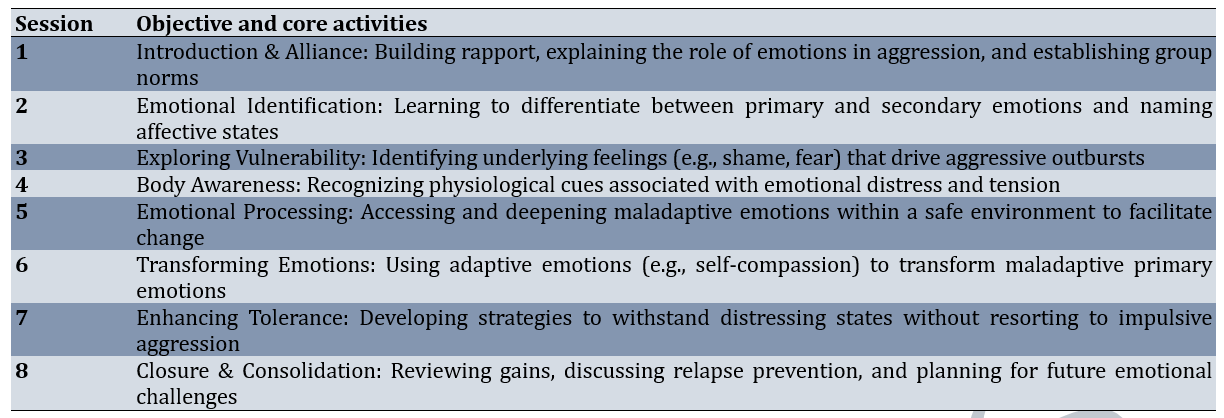
After obtaining the necessary permits and ethical approvals, participants in both groups underwent a pre-test. The experimental group then received eight weekly 90-minute EFT sessions, while the control group received no intervention during this period. The EFT protocol was adapted from the models of Greenberg and Johnson [16], with a focus on identifying and transforming maladaptive emotions. Following the intervention, a post-test was administered to both groups, and a follow-up assessment was conducted three months later to evaluate the sustainability of the results (Table 1).
Table 1. Summary of emotion-focused therapy (EFT) sessions
Instrument
Ahvaz Aggression Inventory (AAI): This self-report scale was developed by Zahedifar et al. [17] to assess aggression levels in the Iranian population. It consists of 30 items rated on a 4-point Likert scale (0=never to 3=always), with total scores ranging from 0 to 90. Higher scores indicate greater severity of aggressive behavior. In previous Persian validation studies, the AAI demonstrated high internal consistency, with Cronbach’s alpha coefficients reported around 0.84 [17]. In this study, Cronbach’s alpha was 0.89, indicating robust reliability for assessing aggression in female adolescents.
Distress Tolerance Scale (DTS): Developed by Simons and Gaher [18], the DTS is a 15-item instrument designed to measure the perceived capacity to experience and withstand negative psychological states. Responses are recorded on a 5-point Likert scale (1=strongly agree to 5=strongly disagree). The scale covers four sub-dimensions: tolerance, absorption, appraisal, and regulation. Higher total scores reflect a higher level of distress tolerance. Validation studies in Iran have reported a Cronbach’s alpha of 0.82 for the total scale [19]. In this study, the internal consistency was 0.84, indicating high psychometric stability in this population.
Data analysis
Data were analyzed using SPSS 26. Repeated measures analysis of variance (ANOVA) was employed to compare differences between the experimental and control groups across the three time points (pre-test, post-test, and 3-month follow-up), ensuring that the assumptions of normality and homogeneity of variance were met.
Findings
The sample consisted of 40 female eighth-grade students with a mean age of 14.45±0.58 years, ranging from 14 to 15 years. There were no significant differences between the experimental and control groups in age or initial academic standing (p>0.05), ensuring homogeneity of participants at baseline. All participants completed the full course of the intervention and the subsequent follow-up assessments.
In the experimental group, the mean aggression score decreased significantly from 61.29±7.31 at pre-test to 42.90±4.58 at post-test and remained stable at 42.05±4.72 during the three-month follow-up. In contrast, the control group’s aggression scores showed no significant change, with a mean of 64.08±8.27 at pre-test, 63.94±7.02 at post-test, and 63.83±7.93 at follow-up.
Regarding distress tolerance, the experimental group demonstrated a marked increase, with scores rising from 27.85±8.02 at pre-test to 49.84±6.81 at post-test and further to 50.09±5.39 at follow-up. The control group’s distress tolerance remained relatively constant throughout the study period, with scores ranging from 25.91±9.06 at pre-test to 26.06±8.40 at post-test and 25.74±8.94 at follow-up
The Shapiro-Wilk test confirmed the normality of the distribution for both aggression and distress tolerance scores across all measurement stages (p>0.05). Additionally, Levene’s test was performed to verify the homogeneity of variances, yielding non-significant results. For the repeated-measures analysis, Mauchly’s test of sphericity was conducted; when the assumption was violated, the Greenhouse-Geisser correction was applied to ensure the robustness of the F-statistics.
The group×time interaction effect was statistically significant for both aggression and distress tolerance, indicating significant improvements over time compared to the control group (Table 2).
Table 2. Repeated measures ANOVA results for inter- and intra-group comparisons

For aggression, the difference between pre-test and post-test was significant (p=0.001), but the difference between post-test and follow-up was not (p=0.209), indicating that the treatment effect was stable. Similarly, for distress tolerance, a significant increase was observed from pre-test to post-test (p=0.001), with no significant decline during the follow-up phase (p=0.103; Table 3).
Table 3. Bonferroni post-hoc test for pairwise comparisons of the stages

Discussion
The present study aimed to investigate the effectiveness of EFT on aggression and distress tolerance among female middle school students exhibiting clinical symptoms of aggression. EFT significantly reduced aggression levels and enhanced distress tolerance in the experimental group compared to the control group. Importantly, these therapeutic gains were maintained during the three-month follow-up period, suggesting that the intervention fosters enduring psychological changes rather than transient symptomatic relief [20].
The observed reduction in aggression following EFT can be attributed to the core mechanism of this approach: the transformation of primary maladaptive emotions. Adolescents often resort to aggression as a “secondary emotion” to mask underlying “primary” feelings of shame, fear, or rejection [21]. By facilitating a safe, empathic therapeutic environment, EFT allows students to access and process these vulnerable primary emotions [22]. Instead of merely suppressing aggressive impulses through cognitive-behavioral techniques, EFT encourages the “co-activation” of incompatible emotions [23]. For instance, by accessing self-compassion or assertive anger—rather than destructive rage—participants learn to reorganize their emotional schemas [24]. This internal reorganization reduces the need for externalized hostility, as emotional triggers are resolved at their source rather than being repressed [25].
Furthermore, the significant increase in distress tolerance underscores EFT's role in expanding the “window of tolerance” for adolescents [9]. Students with low distress tolerance often perceive negative emotional states as catastrophic and unendurable, leading to impulsive or aggressive outbursts as desperate attempts to escape emotional pain [26]. EFT provides these individuals with “emotional coaching,” teaching them to identify, label, and stay with their emotions rather than flee from them [27]. As participants learn to tolerate the physiological and psychological discomfort of intense feelings within the sessions, they internalize a sense of agency. This increased capacity to endure distress without resorting to maladaptive coping mechanisms explains the significant improvement in their distress tolerance scale scores.
Our findings are consistent with prior studies on process-experiential therapies. For example, Watson and Greenberg indicate that EFT-based interventions effectively reduce externalizing behaviors and anger in adolescents by improving emotional regulation strategies [28]. Similarly, Seyed Mousavi et al. demonstrate that emotion-focused interventions significantly enhance psychological resilience and distress tolerance in clinical populations, reinforcing the idea that focusing on the emotional “meaning-making” process is a potent catalyst for behavioral change [14].
One of the most noteworthy aspects of this study is the stability of the results at the three-month follow-up. During adolescence, when hormonal fluctuations and social pressures are at their peak, the maintenance of therapeutic effects suggests that EFT may have influenced the participants’ underlying personality structures, or “emotional scripts.” By changing how these students relate to their inner experiences, the therapy provided them with a portable toolkit for navigating future stressors, thereby preventing relapse into aggressive patterns [16, 20].
Despite the significant findings, this study has certain limitations. First, the sample was restricted to female eighth-grade students in Tehran, which limits the generalizability of the results to male adolescents, different age groups, or other cultural contexts. Second, the reliance on self-report inventories may introduce social desirability bias. Future research should incorporate multi-informant assessments (e.g., teacher and parent reports) and explore the long-term efficacy of EFT across more diverse demographic cohorts to enhance external validity.
Conclusion
Emotion-focused therapy is an effective intervention for mitigating aggression and enhancing distress tolerance in adolescent girls.
Acknowledgments: The authors would like to express their sincere gratitude to the participating students and their families for their cooperation throughout the study.
Ethical Permissions: This clinical trial (IRCT20250709066427N1) obtained ethical approval from the Institutional Review Board of Islamic Azad University (No: IR.IAU.AHVAZ.REC.1404.271).
Conflicts of Interest: The authors declared no conflicts of interest.
Authors' Contribution: Roustaei R (First Author), Methodologist/Main Researcher/Discussion Writer/Statistical Analyst (60%); Bavi S (Second Author), Introduction Writer/Methodologist/Assistant Researcher/Statistical Analyst (40%)
Funding/Support: This study received no specific grant from any funding agency in the public, commercial, or not-for-profit sectors.
Adolescence represents a critical developmental window characterized by profound physiological, neurological, and social transitions. For many middle school students, particularly young females, this period is marked by heightened emotional reactivity and increased vulnerability to psychological distress [1]. Clinical observations and recent statistics indicate a rising prevalence of externalizing behaviors among adolescent girls, with aggression emerging as a primary concern for educators and mental health professionals alike [2]. These students often struggle with the transition from childhood to early youth, during which social expectations and peer dynamics can exacerbate underlying emotional sensitivities. When left unaddressed, early patterns of aggressive behavior in middle school settings can solidify into persistent personality traits, leading to academic underachievement, social isolation, and a higher risk of comorbid psychiatric disorders later in life [3, 4].
Aggression in this population is a multidimensional construct encompassing physical, verbal, and relational hostility. In the context of adolescent girls, aggression often manifests as a reactive response to perceived social threats or internal emotional turmoil [5]. This behavioral pattern is not merely a conduct issue but is deeply rooted in the inability to modulate intense affective states. Research suggests that high levels of aggression in middle school students are strongly correlated with poor self-regulation and a tendency to interpret neutral social cues as hostile [6]. Consequently, chronic aggression serves as a dysfunctional coping mechanism intended to exert control over one’s environment or to mask underlying feelings of vulnerability and rejection [7].
Closely linked to the management of aggression is the construct of distress tolerance, defined as the perceived or actual capacity to withstand negative emotional states or other aversive experiences [8]. For adolescent girls exhibiting clinical aggression, distress tolerance is frequently impaired, leading to an “emotional urgency” in which the individual feels compelled to act out to terminate an unpleasant feeling [9]. Individuals with low distress tolerance are characterized by an inability to accept emotional pain, often perceiving it as catastrophic or unbearable. Enhancing this psychological capacity is essential, as it allows adolescents to pause and process internal states rather than reacting impulsively through aggressive outbursts [10]. Therefore, strengthening distress tolerance is increasingly recognized as a foundational component in the successful treatment of behavioral dysregulation [11].
To address these challenges, emotion-focused therapy (EFT) has emerged as a potent evidence-based intervention. Rooted in the principle that emotions are inherently adaptive, EFT focuses on transforming “maladaptive” primary emotions—such as deep-seated shame or fear—by activating “adaptive” ones [12]. Previous research has demonstrated that EFT is highly effective in treating a variety of internalizing and externalizing disorders by helping individuals identify, experience, and make sense of their emotional lives [13]. In the context of aggression, EFT moves beyond mere behavioral modification; it guides adolescents to access the vulnerable feelings beneath their anger, thereby fostering genuine emotional healing. Recent clinical trials have shown that short-term EFT interventions can lead to significant improvements in emotional resilience and interpersonal functioning among youth populations [14, 15].
Despite the growing body of literature on adolescent mental health, a critical gap remains in understanding how integrated emotional interventions specifically impact the dual challenges of aggression and distress tolerance in middle school girls. Most traditional approaches focus strictly on cognitive-behavioral techniques, often overlooking the profound affective drivers of behavior. Given the unique developmental needs of this age group and the lasting impact of early intervention, there is an urgent need for specialized clinical trials that evaluate the sustainability of therapeutic gains. This research can provide a robust framework for school-based psychological interventions that prioritize emotional depth over surface-level behavior. Consequently, this study aimed to investigate the efficacy of EFT on aggression and distress tolerance among middle school female students through a randomized clinical trial with a three-month follow-up.
Materials and Methods
Design and sample
This randomized clinical trial was conducted on 40 female middle school students in Tehran during the 2024-2025 academic year. It involved a pre-test, post-test, and a three-month follow-up phase.
Using multi-stage random sampling, one educational district was selected, and schools within that district were screened for clinical aggression. A total of 40 students who met the inclusion criteria were selected and randomly assigned to either the experimental group (n=20) or the control group (n=20).
Inclusion criteria included a diagnosis of clinical aggression based on the Ahvaz Aggression Inventory (AAI), being an active eighth-grade student, receiving concurrent psychological counseling, and providing informed parental consent. Exclusion criteria were defined as missing more than two intervention sessions and a self-reported desire to withdraw from the study.
Procedure
Ethically, participants were informed of their right to withdraw at any stage, and confidentiality was strictly maintained. To adhere to ethical standards, the control group was placed on a waitlist to receive the intervention after the follow-up phase.
After obtaining the necessary permits and ethical approvals, participants in both groups underwent a pre-test. The experimental group then received eight weekly 90-minute EFT sessions, while the control group received no intervention during this period. The EFT protocol was adapted from the models of Greenberg and Johnson [16], with a focus on identifying and transforming maladaptive emotions. Following the intervention, a post-test was administered to both groups, and a follow-up assessment was conducted three months later to evaluate the sustainability of the results (Table 1).
Table 1. Summary of emotion-focused therapy (EFT) sessions
Instrument
Ahvaz Aggression Inventory (AAI): This self-report scale was developed by Zahedifar et al. [17] to assess aggression levels in the Iranian population. It consists of 30 items rated on a 4-point Likert scale (0=never to 3=always), with total scores ranging from 0 to 90. Higher scores indicate greater severity of aggressive behavior. In previous Persian validation studies, the AAI demonstrated high internal consistency, with Cronbach’s alpha coefficients reported around 0.84 [17]. In this study, Cronbach’s alpha was 0.89, indicating robust reliability for assessing aggression in female adolescents.
Distress Tolerance Scale (DTS): Developed by Simons and Gaher [18], the DTS is a 15-item instrument designed to measure the perceived capacity to experience and withstand negative psychological states. Responses are recorded on a 5-point Likert scale (1=strongly agree to 5=strongly disagree). The scale covers four sub-dimensions: tolerance, absorption, appraisal, and regulation. Higher total scores reflect a higher level of distress tolerance. Validation studies in Iran have reported a Cronbach’s alpha of 0.82 for the total scale [19]. In this study, the internal consistency was 0.84, indicating high psychometric stability in this population.
Data analysis
Data were analyzed using SPSS 26. Repeated measures analysis of variance (ANOVA) was employed to compare differences between the experimental and control groups across the three time points (pre-test, post-test, and 3-month follow-up), ensuring that the assumptions of normality and homogeneity of variance were met.
Findings
The sample consisted of 40 female eighth-grade students with a mean age of 14.45±0.58 years, ranging from 14 to 15 years. There were no significant differences between the experimental and control groups in age or initial academic standing (p>0.05), ensuring homogeneity of participants at baseline. All participants completed the full course of the intervention and the subsequent follow-up assessments.
In the experimental group, the mean aggression score decreased significantly from 61.29±7.31 at pre-test to 42.90±4.58 at post-test and remained stable at 42.05±4.72 during the three-month follow-up. In contrast, the control group’s aggression scores showed no significant change, with a mean of 64.08±8.27 at pre-test, 63.94±7.02 at post-test, and 63.83±7.93 at follow-up.
Regarding distress tolerance, the experimental group demonstrated a marked increase, with scores rising from 27.85±8.02 at pre-test to 49.84±6.81 at post-test and further to 50.09±5.39 at follow-up. The control group’s distress tolerance remained relatively constant throughout the study period, with scores ranging from 25.91±9.06 at pre-test to 26.06±8.40 at post-test and 25.74±8.94 at follow-up
The Shapiro-Wilk test confirmed the normality of the distribution for both aggression and distress tolerance scores across all measurement stages (p>0.05). Additionally, Levene’s test was performed to verify the homogeneity of variances, yielding non-significant results. For the repeated-measures analysis, Mauchly’s test of sphericity was conducted; when the assumption was violated, the Greenhouse-Geisser correction was applied to ensure the robustness of the F-statistics.
The group×time interaction effect was statistically significant for both aggression and distress tolerance, indicating significant improvements over time compared to the control group (Table 2).
Table 2. Repeated measures ANOVA results for inter- and intra-group comparisons
For aggression, the difference between pre-test and post-test was significant (p=0.001), but the difference between post-test and follow-up was not (p=0.209), indicating that the treatment effect was stable. Similarly, for distress tolerance, a significant increase was observed from pre-test to post-test (p=0.001), with no significant decline during the follow-up phase (p=0.103; Table 3).
Table 3. Bonferroni post-hoc test for pairwise comparisons of the stages
Discussion
The present study aimed to investigate the effectiveness of EFT on aggression and distress tolerance among female middle school students exhibiting clinical symptoms of aggression. EFT significantly reduced aggression levels and enhanced distress tolerance in the experimental group compared to the control group. Importantly, these therapeutic gains were maintained during the three-month follow-up period, suggesting that the intervention fosters enduring psychological changes rather than transient symptomatic relief [20].
The observed reduction in aggression following EFT can be attributed to the core mechanism of this approach: the transformation of primary maladaptive emotions. Adolescents often resort to aggression as a “secondary emotion” to mask underlying “primary” feelings of shame, fear, or rejection [21]. By facilitating a safe, empathic therapeutic environment, EFT allows students to access and process these vulnerable primary emotions [22]. Instead of merely suppressing aggressive impulses through cognitive-behavioral techniques, EFT encourages the “co-activation” of incompatible emotions [23]. For instance, by accessing self-compassion or assertive anger—rather than destructive rage—participants learn to reorganize their emotional schemas [24]. This internal reorganization reduces the need for externalized hostility, as emotional triggers are resolved at their source rather than being repressed [25].
Furthermore, the significant increase in distress tolerance underscores EFT's role in expanding the “window of tolerance” for adolescents [9]. Students with low distress tolerance often perceive negative emotional states as catastrophic and unendurable, leading to impulsive or aggressive outbursts as desperate attempts to escape emotional pain [26]. EFT provides these individuals with “emotional coaching,” teaching them to identify, label, and stay with their emotions rather than flee from them [27]. As participants learn to tolerate the physiological and psychological discomfort of intense feelings within the sessions, they internalize a sense of agency. This increased capacity to endure distress without resorting to maladaptive coping mechanisms explains the significant improvement in their distress tolerance scale scores.
Our findings are consistent with prior studies on process-experiential therapies. For example, Watson and Greenberg indicate that EFT-based interventions effectively reduce externalizing behaviors and anger in adolescents by improving emotional regulation strategies [28]. Similarly, Seyed Mousavi et al. demonstrate that emotion-focused interventions significantly enhance psychological resilience and distress tolerance in clinical populations, reinforcing the idea that focusing on the emotional “meaning-making” process is a potent catalyst for behavioral change [14].
One of the most noteworthy aspects of this study is the stability of the results at the three-month follow-up. During adolescence, when hormonal fluctuations and social pressures are at their peak, the maintenance of therapeutic effects suggests that EFT may have influenced the participants’ underlying personality structures, or “emotional scripts.” By changing how these students relate to their inner experiences, the therapy provided them with a portable toolkit for navigating future stressors, thereby preventing relapse into aggressive patterns [16, 20].
Despite the significant findings, this study has certain limitations. First, the sample was restricted to female eighth-grade students in Tehran, which limits the generalizability of the results to male adolescents, different age groups, or other cultural contexts. Second, the reliance on self-report inventories may introduce social desirability bias. Future research should incorporate multi-informant assessments (e.g., teacher and parent reports) and explore the long-term efficacy of EFT across more diverse demographic cohorts to enhance external validity.
Conclusion
Emotion-focused therapy is an effective intervention for mitigating aggression and enhancing distress tolerance in adolescent girls.
Acknowledgments: The authors would like to express their sincere gratitude to the participating students and their families for their cooperation throughout the study.
Ethical Permissions: This clinical trial (IRCT20250709066427N1) obtained ethical approval from the Institutional Review Board of Islamic Azad University (No: IR.IAU.AHVAZ.REC.1404.271).
Conflicts of Interest: The authors declared no conflicts of interest.
Authors' Contribution: Roustaei R (First Author), Methodologist/Main Researcher/Discussion Writer/Statistical Analyst (60%); Bavi S (Second Author), Introduction Writer/Methodologist/Assistant Researcher/Statistical Analyst (40%)
Funding/Support: This study received no specific grant from any funding agency in the public, commercial, or not-for-profit sectors.
Keywords:
References
1. Zhang P, Long M, Shi J. A latent profile analysis of emotion regulation in relation to distress of symptoms in youth with prodromal psychotic symptoms. Behav Sci. 2024;14(8):698. [Link] [DOI:10.3390/bs14080698]
2. Ostrov JM, Murray-Close D, Perry KJ, Blakely-McClure SJ, Perhamus GR, Mutignani LM, et al. The development of forms and functions of aggression during early childhood: A temperament-based approach. Dev Psychopathol. 2023;35(2):941-57. [Link] [DOI:10.1017/S0954579422000177]
3. Barker ED, Oliver BR, Viding E, Salekin RT, Maughan B. The impact of prenatal maternal risk, fearless temperament and early parenting on adolescent callous-unemotional traits: A 14-year longitudinal investigation. J Child Psychol Psychiatry. 2011;52(8):878-88. [Link] [DOI:10.1111/j.1469-7610.2011.02397.x]
4. Girard LC, Tremblay RE, Nagin D, Côté SM. Development of aggression subtypes from childhood to adolescence: A group-based multi-trajectory modelling perspective. J Abnorm Child Psychol. 2019;47(5):825-38. [Link] [DOI:10.1007/s10802-018-0488-5]
5. Evans SC, Fite PJ, Hendrickson ML, Rubens SL, Mages AK. The role of reactive aggression in the link between hyperactive-impulsive behaviors and peer rejection in adolescents. Child Psychiat Human Dev. 2015;46(6):903-12. [Link] [DOI:10.1007/s10578-014-0530-y]
6. Eisenberg N, Spinrad TL, Eggum ND. Emotion-related self-regulation and its relation to children's maladjustment. Annu Rev Clin Psychol. 2010;6:495-525. [Link] [DOI:10.1146/annurev.clinpsy.121208.131208]
7. Dodge KA, Bai Y, Godwin J, Lansford JE, Bates JE, Pettit GS, et al. A defensive mindset: A pattern of social information processing that develops early and predicts life course outcomes. Child Dev. 2022;93(4):e357-78. [Link] [DOI:10.1111/cdev.13751]
8. Zvolensky MJ, Bernstein A, Vujanovic AA. Distress tolerance: Theory, measurement, and relations to psychopathology. Curr Dir Psychol Sci. 2010. [Link] [DOI:10.1177/0963721410388642]
9. Hasani Rad S, Bavi S, Heidari A. The Efficacy of Emotion-Focused Therapy on Distress Tolerance and Resilience in Female Students with Aggression Symptoms. Women's Health Bull. 2025;12(2):137-45. [Link]
10. Bornovalova MA, Gratz KL, Daughters SB, Hunt ED, Lejuez CW. Initial RCT of a distress tolerance treatment for individuals with substance use disorders. Drug Alcohol Depend. 2012;122(1-2):70-6. [Link] [DOI:10.1016/j.drugalcdep.2011.09.012]
11. Foroughe M, Stillar A, Goldstein L, Dolhanty J, Goodcase ET, Lafrance A. Brief emotion focused family Therapy: An intervention for parents of children and adolescents with mental health issues. J Marital Fam Ther. 2018;44(4):700-14. [Link]
12. Greenberg LS, Goldman RN. Clinical handbook of emotion-focused therapy. American Psychological Association; 2019. [Link] [DOI:10.1037/0000112-000]
13. Mlotek AE, Paivio SC. Emotion-focused therapy for complex trauma. Pers-Centered Exp Psychother. 2017;16(3):198-214. [Link] [DOI:10.1080/14779757.2017.1330704]
14. Seyed Mousavi F, Talebzadeh Shoushtari M, Safarzadeh S. Effects of emotionally focused therapy on emotional autonomy and emotion regulation of students with depression symptoms. J Clin Res Paramed Sci. 2024;13(1):e143109. [Link] [DOI:10.5812/jcrps-143109]
15. Akbari Z, Masjedi-Arani A, Bakhtiari M, Kianimoghadam AS. Effectiveness of emotion-focused therapy on anger, guilt, and self-destructive behaviors in people with prolonged grief disorder: A randomized clinical trial. J Educ Health Promot. 2025;14:517. [Link] [DOI:10.4103/jehp.jehp_1243_24]
16. Ansar N, Nissen Lie HA, Zahl-Olsen R, Bertelsen TB, Elliott R, Stiegler JR. Efficacy of Emotion-Focused Parenting Programs for Children's Internalizing and Externalizing Symptoms: A Randomized Clinical Study. J Clin Child Adolesc Psychol. 2022;51(6):923-39. [Link] [DOI:10.1080/15374416.2022.2079130]
17. Zahedifar S, Najarian B, Shokrkon H. Construction and validation of a scale for the measurement of aggression. J Educ Sci. 2000;7(1):73-102. [Persian] [Link]
18. Simons JS, Gaher RM. The distress tolerance scale: Development and validation of a self-report measure. Motiv Emot. 2005;29(2):83-102. [Link] [DOI:10.1007/s11031-005-7955-3]
19. Azizi AR. Reliability and validity of the Persian version of distress tolerance scale. Iran J Psychiatry. 2010;5(4):154-8. [Link]
20. Timulak L, Keogh D, McElvaney J, Schmitt S, Hession N, Timulakova K, et al. Emotion-focused therapy as a transdiagnostic treatment for depression, anxiety and related disorders: Protocol for an initial feasibility randomised control trial. HRB Open Res. 2020;3:7. [Link] [DOI:10.12688/hrbopenres.12993.1]
21. Greenberg Leslie S. Emotion-Focused Therapy: A Clinical Synthesis. Focus. 2010;8:32-42. [Link] [DOI:10.1176/foc.8.1.foc32]
22. Fatahian-Tehran HM, Chatha S, Elliott R. Empathic Conjectures in Emotionally Focused Couple Therapy (EFCT): A Process Microanalytic Study. J Marital Fam Ther. 2025;51(4):e70075. [Link] [DOI:10.1111/jmft.70075]
23. Neff KD, Tóth-Király I, Yarnell LM, Arimitsu K, Castilho P, Ghorbani N, et al. Examining the factor structure of the Self-Compassion Scale in 20 diverse samples: Support for use of a total score and six subscale scores. Psychol Assess. 2019;31(1):27-45. [Link] [DOI:10.1037/pas0000629]
24. Shahar B. New Developments in Emotion-Focused Therapy for Social Anxiety Disorder. J Clin Med. 2020;9(9). [Link] [DOI:10.3390/jcm9092918]
25. Seddon JA, Reaume CL, Thomassin K. A six-week group program of emotion focused family therapy for parents of children with mental health challenges: protocol for a randomized controlled trial. BMC Psychiatr. 2025;25(1):131. [Link] [DOI:10.1186/s12888-024-06382-y]
26. Mohsenabadi H, Pirmoradi M, Zahedi Tajrishi K, Gharraee B. A transdiagnostic approach to investigate of the relationships between anxiety sensitivity and health anxiety: the mediated roles of distress tolerance and emotion regulation. Front Psychiatr. 2025;16:1478442. [Link] [DOI:10.3389/fpsyt.2025.1478442]
27. Holmqvist Larsson K, Zetterqvist M. An emotion regulation skills training for adolescents and parents: perceptions and acceptability of methodological aspects. Front Psychiatr. 2024;15:1448529. [Link] [DOI:10.3389/fpsyt.2024.1448529]
28. Güngör S. A comparative interventional study on the effectiveness of acceptance and commitment therapy, emotion-focused therapy, and attachment-based therapy in improving emotion regulation among adolescents with digital game addiction. Front Psychol. 2026;17:1780192. [Link] [DOI:10.3389/fpsyg.2026.1780192]