

IMEMR
EMRO
Volume 7, Issue 1 (2026)
J Clinic Care Skill 2026, 7(1): 21-25 |
Back to browse issues page
Article Type:
Subject:



Ethics code: IR.IAU.SHIRAZ.REC.1402.023
History
Received: 2025/12/1 | Accepted: 2026/01/28 | Published: 2026/02/5
Received: 2025/12/1 | Accepted: 2026/01/28 | Published: 2026/02/5
How to cite this article
Askari S, Zeini N. Level of Depression, Anxiety, Stress, and Clinical Environment Stressors among Shiraz Islamic Azad University Dental Students, Iran. J Clinic Care Skill 2026; 7 (1) :21-25
URL: http://jccs.yums.ac.ir/article-1-490-en.html
URL: http://jccs.yums.ac.ir/article-1-490-en.html
Download citation:
BibTeX | RIS | EndNote | Medlars | ProCite | Reference Manager | RefWorks
Send citation to:


Rights and permissions
BibTeX | RIS | EndNote | Medlars | ProCite | Reference Manager | RefWorks
Send citation to:


1- Department of Oral Medicine, Faculty of Dentistry, Shi.C. (Shiraz Campus), Islamic Azad University, Shiraz, Iran
Full-Text (HTML) (150 Views)
Introduction
Psychological disorders are conditions that not only increase the burden of disease and impose significant strain on society but also contribute to the impairment of individual and social functioning [1]. Among these, anxiety, depression, and stress are recognized as the most prevalent mental health challenges affecting university students. Dental students, in particular, encounter these challenges more acutely due to the rigorous demands of clinical training, the pressure of clinical responsibilities, and the necessity of direct patient interaction. Consequently, dental education is regarded as a profoundly stressful educational process [2].
The prevalence of depression, anxiety, and stress among dental students has been reported in the literature as 52%, 57%, and 55%, respectively. Fifth-year students, those in closest proximity to commencing clinical practice, exhibit higher levels of depression compared to students in other academic years. This finding substantiates the notion that the transition from theoretical education to clinical training, along with the exigencies of performing clinical procedures, direct patient contact, and assuming treatment responsibility, constitutes a substantial source of stress and psychological strain [3]. In addition to the pressures of clinical workload and assignments, the structure of the educational/clinical environment and the psychosocial conditions of students have also been identified as important sources of stress. Accordingly, it can be asserted that the clinical environment represents a primary source of stress for these students [4]. The Radeef & Faisal report academic and personal factors as stress-producing agents among dental students, which in turn precipitate psychological distress [5]. Furthermore, stress can give rise to various physical and mental health problems [6], resulting in diminished learning efficacy [7]. It can also negatively affect health, quality of life, academic achievement, and students’ readiness to assume their professional roles. Consequently, addressing stress, its associated consequences, and developing appropriate mitigation strategies are of paramount importance [8].
Depression is defined as a common mental disorder characterized by sadness, loss of interest or pleasure, feelings of guilt or low self-worth, disturbed sleep or appetite, fatigue, and poor concentration. This condition can be long-lasting or recurrent and may substantially impair an individual’s capacity to function in occupational or academic settings or to cope with daily life [9]. Anxiety disorders are also considered the most prevalent mental illnesses worldwide and have significantly contributed to the global burden of mental disease [10]. Given the demanding academic and clinical nature of their training, coupled with the responsibilities inherent in patient care, dental students may experience considerable anxiety [11], which can consequently exert adverse effects on clinical performance. Neglecting these disorders may culminate in a diminished quality of education and clinical services, professional burnout, reduced commitment, and even attrition among dental students [12].
Considering the importance of clinical training in shaping the core skills and professional competencies of dental students, the impact of these disorders on clinical education, the necessity of effectively coping with clinical environment stressors, and the recognition that stressors may vary across different clinical settings, this study aimed to determine the levels of depression, anxiety, stress, and stressors among dental students at the Islamic Azad University of Shiraz.
Instrument and Methods
This descriptive, cross-sectional study was conducted in 2023 on 112 dental students at the Islamic Azad University, Shiraz Branch, selected using census sampling, of whom 83 completed the questionnaires. Inclusion criteria were enrollment in the clinical stage of dental education and consent to participate. Participants with incomplete questionnaires were excluded.
Data collection tools included a demographic information questionnaire, the Depression, Anxiety and Stress Scale (DASS-42), and the Dental Environment Stressors (DES) Questionnaire.
The DASS-42 is designed to measure depression, anxiety, and psychological distress, capable of detecting and screening for symptoms experienced over the preceding week. Developed for adult populations, this scale uses a 4-point Likert scale (0=“did not apply to me at all”, 1=“applied to me to some degree”, 2=“applied to me to a considerable degree”, and 3=“applied to me very much”). The depression subscale assesses dysphoric mood, self-depreciation, hopelessness, devaluation of life, lack of interest/involvement, anhedonia, and inertia. The anxiety subscale evaluates physiological hyperarousal, situational anxiety, and fears. The stress subscale includes items related to difficulty relaxing, nervous arousal, irritability, and impatience [13]. Each of the depression, anxiety, and stress subscales comprises 14 items. The depression subscale score is obtained by summing the scores of items 3, 5, 10, 13, 16, 17, 21, 24, 26, 31, 34, 37, 38, and 42. The anxiety subscale score is obtained by summing the scores of items 2, 4, 7, 9, 15, 19, 20, 23, 25, 28, 30, 36, 40, and 41. The stress subscale score is obtained by summing the scores of items 1, 6, 8, 11, 12, 14, 18, 22, 27, 29, 32, 33, 35, and 39. The results from each subscale are then interpreted based on specific score ranges: for depression, scores from 0 to 9 indicate normal levels; 10 to 13, mild; 14 to 20, moderate; 21 to 27, severe; and 28 or above, extremely severe. For anxiety, scores from 0 to 7 are considered normal, 8 to 9 mild, 10 to 14 moderate, 15 to 19 severe, and 20 or above extremely severe. For stress, scores ranging from 0 to 14 are normal, 15 to 18 are mild, 19 to 25 are moderate, 26 to 33 are severe, and 34 or above are extremely severe. Samani & Joukar reported test-retest reliability values of 0.80, 0.76, and 0.77, and Cronbach’s α values of 0.81, 0.74, and 0.78 for the depression, anxiety, and stress subscales, respectively [14]. Using Cronbach’s alpha, the reliabilities of the scales were obtained as 0.82, 0.76, and 0.74, respectively.
The DES Questionnaire was used to determine clinical environment stressors. It consists of 32 items across 6 domains, including academic efficacy (7 items), patient treatment (4 items), internal beliefs (4 items), academic factors (2 items), clinical education (11 items), and other items (4 items). It is used to identify and classify stressors within the dental school environment. The questionnaire is scored on a 4-point Likert scale from 1 to 4, where 1 = no stress, 2 = low stress, 3 = moderate stress, and 4 = severe stress. The validity and reliability of this questionnaire were estimated at 0.85 in Kazemi & Bakhshi [15] and were calculated as 0.88 in our study.
The study obtained ethics approval from the University Ethics Committee. Informed consent was obtained from participants for their involvement, with research objectives and the voluntary nature of participation clearly explained. Participants were assured of the confidentiality of their personal information and that the data would be used solely for research purposes.
Data were analyzed using SPSS 23 software using descriptive statistics (mean, median, absolute and relative frequencies), and Pearson's correlation coefficient.
Findings
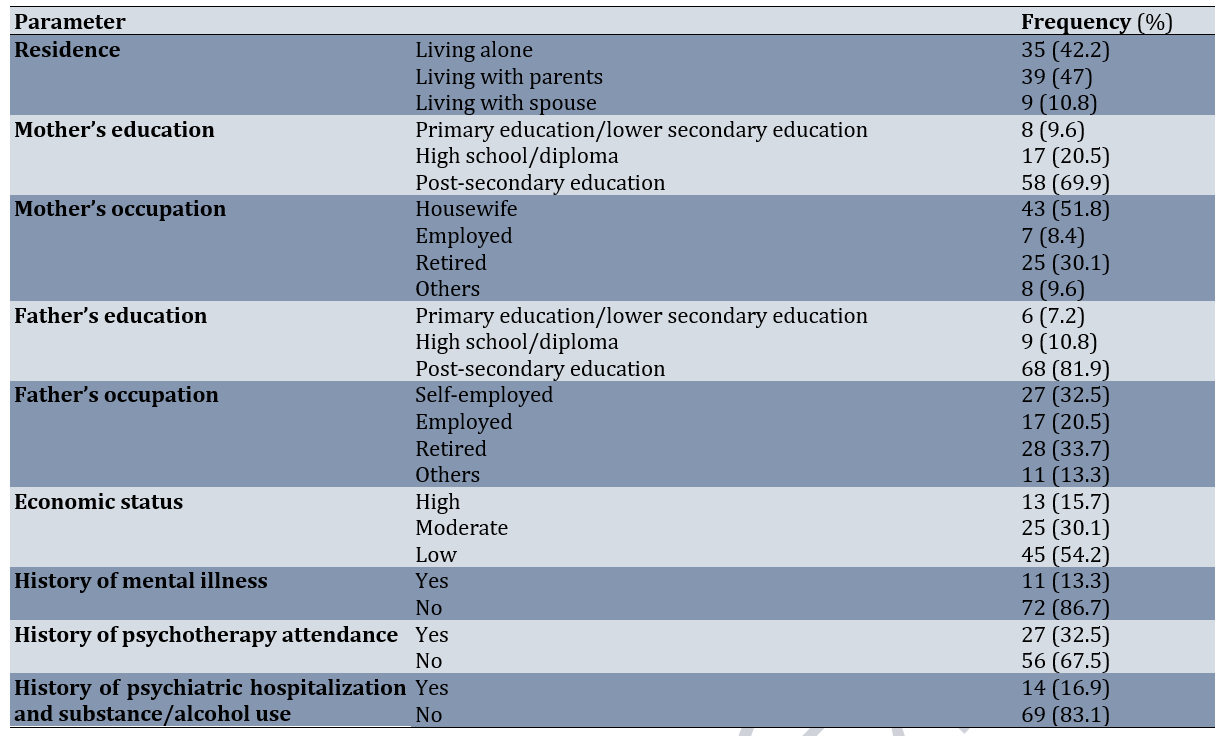
The majority of participants were female (54.22%) and single (74.7%). The mean age of the participants was 26.79±2.93 years. Most students (47%) resided with their parents. Regarding parental education and occupation, the majority of mothers (69.9%) had a high school diploma or higher, and most (51.8%) were housewives. Furthermore, the majority of fathers (81.9%) had an education beyond a high school diploma, and most (33.7%) were retired. The majority of participants (54.2%) reported having a good economic status, and the vast majority (86.7%) reported no history of psychiatric illness. Additionally, most participants (67.5%) had no history of participation in psychotherapy sessions, and 83.1% reported no history of psychiatric hospitalization, psychotropic drug use, or alcohol consumption (Table 1).
Table 1. Frequency of participants’ demographic characteristics
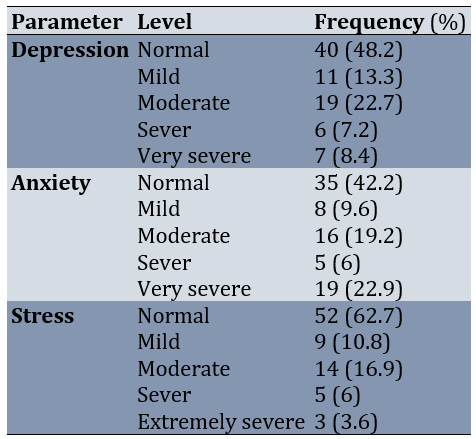
The mean scores for depression, anxiety, and stress among participants were 11.48±9.00, 11.17±8.84, and 13.38±9.59, respectively. Most participants fell within the normal to moderate severity levels, with 48.2% normal for depression, 42.2% normal for anxiety, and 62.7% normal for stress. However, a notable proportion experienced severe or very severe symptoms, particularly in anxiety and depression (Table 2).
Table 2. Frequency of depression, anxiety, and stress severity in participants
Depression, anxiety, and stress among students showed significant positive correlations with one another. Specifically, depression was strongly correlated with anxiety, with a correlation coefficient of 0.9 (r=0.9; p=0.001), and also showed a moderate correlation with stress, with a coefficient of (r=0.67; p=0.001). Anxiety was similarly correlated with stress (r=0.66; p=0.001).
Regarding clinical environment stressors, the highest mean stress score was in the clinical education domain (22.01±7.00), while the lowest was in the academic factors domain (2.30±0.86). Other stressors included academic efficacy (16.35±3.60), patient treatment (8.10±2.60), internal beliefs (8.16±3.30), and other items (7.96±2.80). The total perceived stressor score was 64.59±17.40.
Discussion
This study aimed to determine the levels of depression, anxiety, stress, and clinical environment stressors among dental students at the Islamic Azad University of Shiraz. Dental students represent a population that, by virtue of the nature of their discipline, is exposed to a range of psychological disorders, including depression, anxiety, and stress. Aside from the educational-environment stresses arising from the occupational nature of dentistry, they are also exposed to stressors related to the clinical environment.
A portion of clinical-level students experienced varying degrees of depression, ranging from mild to extremely severe. Shadman et al. demonstrated that 40% of dental students in southeastern Iran suffer from depression [16]. Similarly, Faruk et al. report that 27.4% of the dental students in Bangladesh suffer from moderate to severe depression [17]. These findings are consistent with ours. Depression has numerous physical and psychological consequences and can lead to physical illnesses, mood disorders, fatigue, and other conditions that affect individuals’ performance, consequently impairing learning and resulting in poor clinical performance among students.
Furthermore, more than half of the participating students experienced anxiety of varying severity. Morales-Montoya et al. in Lima also demonstrate that dental students experience high levels of anxiety [18]. Faruk et al. indicate that 18.2% of dental students in Bangladesh suffer from anxiety [17]. These findings were consistent with our results.
Regarding the stress levels, nearly half of the students experienced stress at various levels, ranging from mild to extremely severe. Shehada et al. report moderate stress levels among students [19]. Madhavan et al. in India also confirm that dental students in their internship endure greater stress [20]. Therefore, the causes of stress and anxiety in dental students are primarily related to educational and clinical factors. Moreover, clinical requirements and patient interaction during clinical training years, the need for sophisticated technical skills, and the fear of making mistakes during treatment significantly contribute to psychological stress, as this phase of education is directly connected to patient health and satisfaction and can induce significant psychological pressure. Consequently, these observations highlight the necessity of employing psychological support programs within educational settings.
On the other hand, the highest mean stressor score pertained to the clinical education domain. This finding is consistent with that of Jowkar et al., who demonstrated that, among clinical environment stressors, the clinical education factor accounts for the highest percentage [4]. Hashemipour et al., in a qualitative study, report factors such as reprimands and lack of time as the most common causes of clinical stress [21]. Among the stressors within the clinical education domain, the item pertaining to “the atmosphere created by faculty in the clinic” emerged as the most significant, accounting for 18.3% of responses in this domain, underscoring the pivotal role of faculty behavior in student stress.
The academic efficacy factor was the second most significant clinical environment stressor. This finding is also consistent with that of other studies, including those by Mehdizadeh et al. in Babol, Manolova et al. in France, and Akbari et al. in Mashhad [8, 22, 23]. Rabiei & Safarpour report that, among all clinical environmental stressors, the highest mean stress score is related to a full fear of examinations and grades [24], which falls within the same domain.
Furthermore, internal beliefs and patient treatment were ranked almost equally, representing the most important stressors after academic efficacy among the study samples. Among factors related to internal beliefs, the item “self-depreciation about becoming a successful dentist in the future” was the most significant stressor. Within the clinical environment stressors, the academic factor was ranked last, and this domain was found to be the least significant in creating stress among dental students.
In general, a low level of stress can help students perform more appropriately; however, severe stress can elevate an individual’s anxiety to a point that causes impairment in learning and performance [25]. Therefore, it is necessary to conduct a more precise pathological assessment of the aforementioned disorders. Analyzing these factors and the true nature of the pressures can pave the way for designing preventive and supportive strategies, such as revising the educational structure, reducing unnecessary workload, providing psychological support, and raising awareness. Also, a more precise pathological assessment of these disorders is necessary, and efforts to ameliorate these contributing factors warrant the attention of authorities. In light of the results obtained from this investigation and corroborating evidence from similar studies, clinical-level dental students require enhanced support from authorities, faculty members, and educational personnel. Moreover, the implementation of educational workshops focusing on interpersonal communication skills and associated challenges appears to be an important step in this regard. Conducting entry screening of students to identify vulnerable individuals provides an opportunity to develop initial screening programs and monitor identified vulnerable groups based on screening results.
Among the limitations of the present study was the small sample size; therefore, future research should be conducted on a broader population with a larger sample size.
Conclusion
Clinical-level dental students at the Islamic Azad University of Shiraz experience various levels of stress, anxiety, and depression, with stressors from clinical education environments contributing to the development of these disorders.
Acknowledgments: The authors would like to express their gratitude to all the students who participated in this research.
Ethical Permissions: The study protocol was approved by the Ethics Committee at Islamic Azad University, Shiraz Branch (IR.IAU.SHIRAZ.REC.1402.023).
Conflicts of Interest: The authors reported no conflicts of interest.
Authors' Contribution: Askari Sh (First Author), Main Researcher/Introduction Writer/Discussion Writer (50%); Zeini N (Second Author), Assistant Researcher/Methodologist/Statistical Analyst (50%)
Funding/Support: No funding was received.
Psychological disorders are conditions that not only increase the burden of disease and impose significant strain on society but also contribute to the impairment of individual and social functioning [1]. Among these, anxiety, depression, and stress are recognized as the most prevalent mental health challenges affecting university students. Dental students, in particular, encounter these challenges more acutely due to the rigorous demands of clinical training, the pressure of clinical responsibilities, and the necessity of direct patient interaction. Consequently, dental education is regarded as a profoundly stressful educational process [2].
The prevalence of depression, anxiety, and stress among dental students has been reported in the literature as 52%, 57%, and 55%, respectively. Fifth-year students, those in closest proximity to commencing clinical practice, exhibit higher levels of depression compared to students in other academic years. This finding substantiates the notion that the transition from theoretical education to clinical training, along with the exigencies of performing clinical procedures, direct patient contact, and assuming treatment responsibility, constitutes a substantial source of stress and psychological strain [3]. In addition to the pressures of clinical workload and assignments, the structure of the educational/clinical environment and the psychosocial conditions of students have also been identified as important sources of stress. Accordingly, it can be asserted that the clinical environment represents a primary source of stress for these students [4]. The Radeef & Faisal report academic and personal factors as stress-producing agents among dental students, which in turn precipitate psychological distress [5]. Furthermore, stress can give rise to various physical and mental health problems [6], resulting in diminished learning efficacy [7]. It can also negatively affect health, quality of life, academic achievement, and students’ readiness to assume their professional roles. Consequently, addressing stress, its associated consequences, and developing appropriate mitigation strategies are of paramount importance [8].
Depression is defined as a common mental disorder characterized by sadness, loss of interest or pleasure, feelings of guilt or low self-worth, disturbed sleep or appetite, fatigue, and poor concentration. This condition can be long-lasting or recurrent and may substantially impair an individual’s capacity to function in occupational or academic settings or to cope with daily life [9]. Anxiety disorders are also considered the most prevalent mental illnesses worldwide and have significantly contributed to the global burden of mental disease [10]. Given the demanding academic and clinical nature of their training, coupled with the responsibilities inherent in patient care, dental students may experience considerable anxiety [11], which can consequently exert adverse effects on clinical performance. Neglecting these disorders may culminate in a diminished quality of education and clinical services, professional burnout, reduced commitment, and even attrition among dental students [12].
Considering the importance of clinical training in shaping the core skills and professional competencies of dental students, the impact of these disorders on clinical education, the necessity of effectively coping with clinical environment stressors, and the recognition that stressors may vary across different clinical settings, this study aimed to determine the levels of depression, anxiety, stress, and stressors among dental students at the Islamic Azad University of Shiraz.
Instrument and Methods
This descriptive, cross-sectional study was conducted in 2023 on 112 dental students at the Islamic Azad University, Shiraz Branch, selected using census sampling, of whom 83 completed the questionnaires. Inclusion criteria were enrollment in the clinical stage of dental education and consent to participate. Participants with incomplete questionnaires were excluded.
Data collection tools included a demographic information questionnaire, the Depression, Anxiety and Stress Scale (DASS-42), and the Dental Environment Stressors (DES) Questionnaire.
The DASS-42 is designed to measure depression, anxiety, and psychological distress, capable of detecting and screening for symptoms experienced over the preceding week. Developed for adult populations, this scale uses a 4-point Likert scale (0=“did not apply to me at all”, 1=“applied to me to some degree”, 2=“applied to me to a considerable degree”, and 3=“applied to me very much”). The depression subscale assesses dysphoric mood, self-depreciation, hopelessness, devaluation of life, lack of interest/involvement, anhedonia, and inertia. The anxiety subscale evaluates physiological hyperarousal, situational anxiety, and fears. The stress subscale includes items related to difficulty relaxing, nervous arousal, irritability, and impatience [13]. Each of the depression, anxiety, and stress subscales comprises 14 items. The depression subscale score is obtained by summing the scores of items 3, 5, 10, 13, 16, 17, 21, 24, 26, 31, 34, 37, 38, and 42. The anxiety subscale score is obtained by summing the scores of items 2, 4, 7, 9, 15, 19, 20, 23, 25, 28, 30, 36, 40, and 41. The stress subscale score is obtained by summing the scores of items 1, 6, 8, 11, 12, 14, 18, 22, 27, 29, 32, 33, 35, and 39. The results from each subscale are then interpreted based on specific score ranges: for depression, scores from 0 to 9 indicate normal levels; 10 to 13, mild; 14 to 20, moderate; 21 to 27, severe; and 28 or above, extremely severe. For anxiety, scores from 0 to 7 are considered normal, 8 to 9 mild, 10 to 14 moderate, 15 to 19 severe, and 20 or above extremely severe. For stress, scores ranging from 0 to 14 are normal, 15 to 18 are mild, 19 to 25 are moderate, 26 to 33 are severe, and 34 or above are extremely severe. Samani & Joukar reported test-retest reliability values of 0.80, 0.76, and 0.77, and Cronbach’s α values of 0.81, 0.74, and 0.78 for the depression, anxiety, and stress subscales, respectively [14]. Using Cronbach’s alpha, the reliabilities of the scales were obtained as 0.82, 0.76, and 0.74, respectively.
The DES Questionnaire was used to determine clinical environment stressors. It consists of 32 items across 6 domains, including academic efficacy (7 items), patient treatment (4 items), internal beliefs (4 items), academic factors (2 items), clinical education (11 items), and other items (4 items). It is used to identify and classify stressors within the dental school environment. The questionnaire is scored on a 4-point Likert scale from 1 to 4, where 1 = no stress, 2 = low stress, 3 = moderate stress, and 4 = severe stress. The validity and reliability of this questionnaire were estimated at 0.85 in Kazemi & Bakhshi [15] and were calculated as 0.88 in our study.
The study obtained ethics approval from the University Ethics Committee. Informed consent was obtained from participants for their involvement, with research objectives and the voluntary nature of participation clearly explained. Participants were assured of the confidentiality of their personal information and that the data would be used solely for research purposes.
Data were analyzed using SPSS 23 software using descriptive statistics (mean, median, absolute and relative frequencies), and Pearson's correlation coefficient.
Findings
The majority of participants were female (54.22%) and single (74.7%). The mean age of the participants was 26.79±2.93 years. Most students (47%) resided with their parents. Regarding parental education and occupation, the majority of mothers (69.9%) had a high school diploma or higher, and most (51.8%) were housewives. Furthermore, the majority of fathers (81.9%) had an education beyond a high school diploma, and most (33.7%) were retired. The majority of participants (54.2%) reported having a good economic status, and the vast majority (86.7%) reported no history of psychiatric illness. Additionally, most participants (67.5%) had no history of participation in psychotherapy sessions, and 83.1% reported no history of psychiatric hospitalization, psychotropic drug use, or alcohol consumption (Table 1).
Table 1. Frequency of participants’ demographic characteristics
The mean scores for depression, anxiety, and stress among participants were 11.48±9.00, 11.17±8.84, and 13.38±9.59, respectively. Most participants fell within the normal to moderate severity levels, with 48.2% normal for depression, 42.2% normal for anxiety, and 62.7% normal for stress. However, a notable proportion experienced severe or very severe symptoms, particularly in anxiety and depression (Table 2).
Table 2. Frequency of depression, anxiety, and stress severity in participants
Depression, anxiety, and stress among students showed significant positive correlations with one another. Specifically, depression was strongly correlated with anxiety, with a correlation coefficient of 0.9 (r=0.9; p=0.001), and also showed a moderate correlation with stress, with a coefficient of (r=0.67; p=0.001). Anxiety was similarly correlated with stress (r=0.66; p=0.001).
Regarding clinical environment stressors, the highest mean stress score was in the clinical education domain (22.01±7.00), while the lowest was in the academic factors domain (2.30±0.86). Other stressors included academic efficacy (16.35±3.60), patient treatment (8.10±2.60), internal beliefs (8.16±3.30), and other items (7.96±2.80). The total perceived stressor score was 64.59±17.40.
Discussion
This study aimed to determine the levels of depression, anxiety, stress, and clinical environment stressors among dental students at the Islamic Azad University of Shiraz. Dental students represent a population that, by virtue of the nature of their discipline, is exposed to a range of psychological disorders, including depression, anxiety, and stress. Aside from the educational-environment stresses arising from the occupational nature of dentistry, they are also exposed to stressors related to the clinical environment.
A portion of clinical-level students experienced varying degrees of depression, ranging from mild to extremely severe. Shadman et al. demonstrated that 40% of dental students in southeastern Iran suffer from depression [16]. Similarly, Faruk et al. report that 27.4% of the dental students in Bangladesh suffer from moderate to severe depression [17]. These findings are consistent with ours. Depression has numerous physical and psychological consequences and can lead to physical illnesses, mood disorders, fatigue, and other conditions that affect individuals’ performance, consequently impairing learning and resulting in poor clinical performance among students.
Furthermore, more than half of the participating students experienced anxiety of varying severity. Morales-Montoya et al. in Lima also demonstrate that dental students experience high levels of anxiety [18]. Faruk et al. indicate that 18.2% of dental students in Bangladesh suffer from anxiety [17]. These findings were consistent with our results.
Regarding the stress levels, nearly half of the students experienced stress at various levels, ranging from mild to extremely severe. Shehada et al. report moderate stress levels among students [19]. Madhavan et al. in India also confirm that dental students in their internship endure greater stress [20]. Therefore, the causes of stress and anxiety in dental students are primarily related to educational and clinical factors. Moreover, clinical requirements and patient interaction during clinical training years, the need for sophisticated technical skills, and the fear of making mistakes during treatment significantly contribute to psychological stress, as this phase of education is directly connected to patient health and satisfaction and can induce significant psychological pressure. Consequently, these observations highlight the necessity of employing psychological support programs within educational settings.
On the other hand, the highest mean stressor score pertained to the clinical education domain. This finding is consistent with that of Jowkar et al., who demonstrated that, among clinical environment stressors, the clinical education factor accounts for the highest percentage [4]. Hashemipour et al., in a qualitative study, report factors such as reprimands and lack of time as the most common causes of clinical stress [21]. Among the stressors within the clinical education domain, the item pertaining to “the atmosphere created by faculty in the clinic” emerged as the most significant, accounting for 18.3% of responses in this domain, underscoring the pivotal role of faculty behavior in student stress.
The academic efficacy factor was the second most significant clinical environment stressor. This finding is also consistent with that of other studies, including those by Mehdizadeh et al. in Babol, Manolova et al. in France, and Akbari et al. in Mashhad [8, 22, 23]. Rabiei & Safarpour report that, among all clinical environmental stressors, the highest mean stress score is related to a full fear of examinations and grades [24], which falls within the same domain.
Furthermore, internal beliefs and patient treatment were ranked almost equally, representing the most important stressors after academic efficacy among the study samples. Among factors related to internal beliefs, the item “self-depreciation about becoming a successful dentist in the future” was the most significant stressor. Within the clinical environment stressors, the academic factor was ranked last, and this domain was found to be the least significant in creating stress among dental students.
In general, a low level of stress can help students perform more appropriately; however, severe stress can elevate an individual’s anxiety to a point that causes impairment in learning and performance [25]. Therefore, it is necessary to conduct a more precise pathological assessment of the aforementioned disorders. Analyzing these factors and the true nature of the pressures can pave the way for designing preventive and supportive strategies, such as revising the educational structure, reducing unnecessary workload, providing psychological support, and raising awareness. Also, a more precise pathological assessment of these disorders is necessary, and efforts to ameliorate these contributing factors warrant the attention of authorities. In light of the results obtained from this investigation and corroborating evidence from similar studies, clinical-level dental students require enhanced support from authorities, faculty members, and educational personnel. Moreover, the implementation of educational workshops focusing on interpersonal communication skills and associated challenges appears to be an important step in this regard. Conducting entry screening of students to identify vulnerable individuals provides an opportunity to develop initial screening programs and monitor identified vulnerable groups based on screening results.
Among the limitations of the present study was the small sample size; therefore, future research should be conducted on a broader population with a larger sample size.
Conclusion
Clinical-level dental students at the Islamic Azad University of Shiraz experience various levels of stress, anxiety, and depression, with stressors from clinical education environments contributing to the development of these disorders.
Acknowledgments: The authors would like to express their gratitude to all the students who participated in this research.
Ethical Permissions: The study protocol was approved by the Ethics Committee at Islamic Azad University, Shiraz Branch (IR.IAU.SHIRAZ.REC.1402.023).
Conflicts of Interest: The authors reported no conflicts of interest.
Authors' Contribution: Askari Sh (First Author), Main Researcher/Introduction Writer/Discussion Writer (50%); Zeini N (Second Author), Assistant Researcher/Methodologist/Statistical Analyst (50%)
Funding/Support: No funding was received.
Keywords:
References
1. Kumar S, Singh P, Shah R, Soni A. A study on assessment of family burden, quality of life and mental health in caregivers of patients with schizophrenia. Int Arch Biomed Clin Res. 2017;3:53-7. [Link]
2. Lugassy D, Naishlos S, Shapinko Y, Zissu S, Lahav RS, Shely A, et al. Analysis of stress, anxiety, and depression among dental students and dentists: A cross-sectional questionnaire-based survey. BMC Psychol. 2025;13(1):550. [Link] [DOI:10.1186/s40359-025-02884-w]
3. Lugassy D, Ben-Izhack G, Zissu S, Shitrit Lahav R, Rosner O, Elzami R, et al. Anxiety, stress, and depression levels among dental students: Gender, age, and stage of dental education related. Psychol Health Med. 2025;30(7):1394-408. [Link] [DOI:10.1080/13548506.2025.2476085]
4. Jowkar Z, Masoumi M, Mahmoodian H. Psychological stress and stressors among clinical dental students at Shiraz school of dentistry, Iran. Adv Med Educ Pract. 2020;11:113-20. [Link] [DOI:10.2147/AMEP.S236758]
5. Radeef AS, Faisal GG. Stressors and their association with symptoms of depression, anxiety and stress in dental students. Makara J Health Res. 2018;22(2):1. [Link] [DOI:10.7454/msk.v22i2.9064]
6. Chai MS, Low CS. Personality, coping and stress among university students. Am J Appl Psychol. 2015;4(3-1):33-8. [Link] [DOI:10.11648/j.ajap.s.2015040301.16]
7. Vogel S, Schwabe L. Learning and memory under stress: Implications for the classroom. NPJ Sci Learn. 2016;1:16011. [Link] [DOI:10.1038/npjscilearn.2016.11]
8. Mehdizadeh M, Kheirkhah F, Vojdani Fakhr H, Noori Bayat Sh. Evaluation of stress factors in dental students of Babol medical and dental university in 2011-2012. J Dent Sch. 2014;32(2):90-7. [Persian] [Link]
9. WHO. Health topic: Depression [Internet]. Geneva: World Health Organization; 2015 [cited 2014 Aug 15]. Available from: http://www.who.int/topics/depression/en/. [Link]
10. Li Z, Yang L, Chen H, Fang Y, Zhang T, Yin X, et al. Global, regional and national burden of autism spectrum disorder from 1990 to 2019: Results from the Global Burden of Disease Study 2019. Epidemiol Psychiatr Sci. 2022;31:e33. [Link] [DOI:10.1017/S2045796022000178]
11. Basudan S, Binanzan N, Alhassan A. Depression, anxiety and stress in dental students. Int J Med Educ. 2017;8:179-86. [Link] [DOI:10.5116/ijme.5910.b961]
12. Di Mario S, Rollo E, Gabellini S, Filomeno L. How stress and burnout impact the quality of life amongst healthcare students: An integrative review of the literature. Teach Learn Nurs. 2024;19(4):315-23. [Link] [DOI:10.1016/j.teln.2024.04.009]
13. Afzali A, Delavar A, Borjali A, Mirzamani M. Psychometric properties of DASS-42 as assessed in a sample of Kermanshah high school students. J Res Behav Sci. 2007;5(2):81-92. [Persian] [Link]
14. Samani S, Jokar B. A study on the reliability and validity of the short form of the depression anxiety stress scale (DASS-21). J Soc Sci Humanit Shiraz Univ. 2007;26(3):65-77. [Persian] [Link]
15. Kazemizadeh Z, Bakhshi H. Dental environment stress and students' personality in Rafsanjan dentistry school. Iran J Med Educ. 2011;11(5):467-77. [Persian] [Link]
16. Shadman N, Raoof M, Amanpour S, Mahdian M, Haghani J, Torabi Parizi M. Stress, anxiety, and depression and their related factors among dental students: A cross-sectional study from southeast of Iran. Strides Dev Med Educ. 2019;16(1):12. [Link] [DOI:10.5812/sdme.74295]
17. Faruk MO, Mamun MA, Siddique AB, Griffiths MD. Risk factors for depression and anxiety disorders among Bangladeshi dental students: A cross-sectional survey study. Int J Ment Health Addctn. 2021;1-4. [Link] [DOI:10.1007/s11469-021-00603-1]
18. Morales-Montoya M, Córdova-Limaylla N, Briceño-Vergel G, Ladera-Castañeda M, Garcia-Luna G, Cachay-Criado H, et al. Psychological impact on dental students and professionals in a Lima population during COVID-19s wave: A study with predictive models. Sci Rep. 2022;12(1):14752. [Link] [DOI:10.1038/s41598-022-18899-x]
19. Shehada MR, Alfakhry G, Jamous I, Aljoujou AA, Abdul Hak M. Major stress sources amongst dental students at Damascus University, Syria. Int Dent J. 2023;73(2):205-11. [Link] [DOI:10.1016/j.identj.2022.03.005]
20. Madhavan K, Karuppiah N, Karthick P. Evaluation of stress and its associated stressors among undergraduate dental students: A questionnaire-based study. Indian J Behav Sci. 2022;25(2):161-5. [Link] [DOI:10.55229/ijbs.v25i2.15]
21. Hashemipour MA, Hosseini V, Kamyabi H. Stressors in dental students during the transition from theory to practice: A qualitative research. S Afr Dent J. 2022;77(7):386-93. [Link] [DOI:10.17159/2519-0105/2022/v77no7a1]
22. Manolova MS, Stefanova VP, Panayotov IV, Romieu G, Belcheva AB, Markova KB, et al. Perceived sources of stress in fifth year dental students--a comparative study. Folia Med. 2012;54(2):52-9. [Link] [DOI:10.2478/v10153-011-0089-3]
23. Akbari M, Nejat A, Dastorani S, Rouhani A. Evaluation of stress level and related factors among students of mashhad dental school (Iran) in academic year of 2008-2009. J Mashhad Dent Sch. 2011;35(3):165-76. [Persian] [Link]
24. Rabiei M, Safarpour M. Assessment of dental environment stress and related factors in dental students. J Res Med Educ. 2017;9(1):46-57. [Persian] [Link] [DOI:10.18869/acadpub.rme.9.1.57]
25. Fallahi Bakhshayesh M, Amirahmadi Bakhshayesh T. A review of the effects of stress on students' academic performance. Proceedings of the Fourth National Conference on Psychopathology. Ardabil: University of Mohaghegh Ardabili; 2023. [Persian] [Link]