

IMEMR
EMRO
Volume 7, Issue 1 (2026)
J Clinic Care Skill 2026, 7(1): 33-38 |
Back to browse issues page
Article Type:
Subject:




Ethics code: IR.IAU.AHVAZ.REC.1404.052
History
Received: 2026/03/5 | Accepted: 2026/04/19 | Published: 2026/05/17
Received: 2026/03/5 | Accepted: 2026/04/19 | Published: 2026/05/17
How to cite this article
Yazdanipour M, Kazemian Moghadam K, Shahbazi M. Effect of Compassion-Focused Therapy on Self-Control and Cognitive Flexibility in Opioid-Dependent Women. J Clinic Care Skill 2026; 7 (1) :33-38
URL: http://jccs.yums.ac.ir/article-1-491-en.html
URL: http://jccs.yums.ac.ir/article-1-491-en.html
Download citation:
BibTeX | RIS | EndNote | Medlars | ProCite | Reference Manager | RefWorks
Send citation to:


Rights and permissions
BibTeX | RIS | EndNote | Medlars | ProCite | Reference Manager | RefWorks
Send citation to:


1- Department of Psychology, Ahv.C. (Ahvaz Campus), Islamic Azad University, Ahvaz, Iran
2- Department of Psychology, Dez.C. (Dezful Campus), Islamic Azad University, Dezful, Iran
3- Department of Counseling, MaS.C. (Masjed Soleiman Campus), Islamic Azad University, Masjed Soleiman, Iran
2- Department of Psychology, Dez.C. (Dezful Campus), Islamic Azad University, Dezful, Iran
3- Department of Counseling, MaS.C. (Masjed Soleiman Campus), Islamic Azad University, Masjed Soleiman, Iran
Full-Text (HTML) (103 Views)
Introduction
Opioid use disorder (OUD) represents a profound global health crisis, characterized by compulsive drug-seeking behavior despite catastrophic personal and social consequences [1]. While OUD affects both sexes, women grappling with opioid dependence face a unique and multifaceted set of biopsychosocial challenges. Women often experience a “telescoping effect,” wherein the progression from initial substance use to severe psychosocial impairment occurs significantly more rapidly than in men [2]. Furthermore, women with OUD frequently present with higher rates of co-occurring psychiatric conditions, including severe trauma, depression, and anxiety, which are often compounded by intense societal stigma and profound internal shame [3]. These intertwined emotional and structural barriers severely complicate their recovery trajectory, leading to higher attrition rates in standard treatment programs and increased vulnerability to relapse. Addressing the specific psychological deficits that precipitate and maintain addictive behaviors in this marginalized population is thus of paramount clinical importance [4].
A central psychological deficit in the pathogenesis and maintenance of OUD is diminished self-control. Self-control is broadly defined as the capacity to override prepotent impulses, regulate intense emotions, and delay immediate gratification in pursuit of long-term, goal-directed outcomes [5]. In the context of addiction, the chronic use of opioids disrupts the brain’s executive control networks, rendering individuals highly susceptible to craving and impulsive drug-seeking under stress [6]. For women with OUD, impaired self-regulation often translates into an inability to manage negative affective states without resorting to substance use as a maladaptive coping mechanism. Consequently, enhancing self-control is not merely about behavioral restriction; rather, it is about rebuilding the foundational psychological architecture necessary to resist triggers, manage emotional dysregulation, and sustain long-term abstinence [7].
In tandem with self-control, cognitive flexibility serves as a critical executive function that is heavily compromised in individuals with opioid dependence. Cognitive flexibility refers to the mental agility required to adapt one’s thinking and behavior in response to changing environmental demands or shifting contingencies [8]. Women with OUD frequently exhibit heightened cognitive rigidity, often manifesting as an inability to generate alternative solutions to interpersonal problems or a tendency to become perseveratively stuck in negative, self-defeating thought loops [9]. This psychological inflexibility strongly correlates with continued substance use, as individuals struggle to transition from entrenched addictive habits to novel, adaptive recovery behaviors. Cultivating cognitive flexibility is therefore essential, as it empowers patients to re-evaluate maladaptive beliefs, adapt to the dynamic challenges of rehabilitation, and actively engage in alternative coping strategies [10].
To address these complex psychological vulnerabilities, compassion-focused therapy (CFT) has emerged as a highly promising psychological intervention. Developed initially to treat individuals with high levels of shame and self-criticism—traits markedly prevalent among women with addiction—CFT targets the brain’s affect regulation systems [11]. The therapy focuses on stimulating the soothing-affiliative system to counteract the hyperactive threat-protection system, which is often dominant in traumatized and addicted populations [12, 13]. By cultivating self-compassion, individuals learn to relate to their own suffering, failures, and cravings with warmth and nonjudgmental understanding rather than punitive self-criticism. This compassionate self-stance creates a safe psychological environment, reducing the distress-induced drive to use opioids and providing the emotional bandwidth necessary to practice self-regulation and adaptive thinking [14].
A growing body of empirical literature supports the efficacy of CFT and related psychological interventions in mitigating addiction-related deficits. For instance, recent studies have demonstrated the positive impact of psychotherapeutic protocols on enhancing self-control among women with substance use issues [15]. Furthermore, interventions rooted in compassion have proven effective in modifying cognitive flexibility and reducing self-criticism in vulnerable adult populations [16]. Specific research utilizing CFT has also shown significant improvements in psychological flexibility and self-control across various clinical populations [17]. However, despite these promising findings, there remains a notable dearth of research examining the integrated effects of CFT on both self-control and cognitive flexibility, specifically tailored to the unique clinical profile of women diagnosed with OUD [18].
Given the severe societal and personal impact of OUD in women, alongside the limitations of purely pharmacological treatments, multidimensional psychological interventions are crucial. Women with OUD require therapeutic frameworks that not only target behavioral cessation but also heal underlying shame, thereby facilitating durable structural changes in self-regulation and cognitive adaptability [19]. Addressing this gap is necessary to optimize rehabilitation protocols and provide evidence-based, compassionate care for this highly vulnerable population.
This study aimed to investigate the effect of CFT on self-control and cognitive flexibility in opioid-dependent women.
Materials and Methods
Design and participants
This clinical trial was conducted on 30 women diagnosed with OUD who were receiving care at addiction treatment centers in Ahvaz, Iran, during 2025. Participants were selected using convenience sampling based on accessibility and voluntary willingness to participate and then randomly assigned to either the experimental group (n=15), which received CFT, or the control group (n=15), which received treatment as usual (TAU).
Inclusion criteria were a formal diagnosis of OUD according to DSM-5 criteria, age between 18 and 50 years, provision of written informed consent, at least primary-level literacy, no history of severe co-occurring psychiatric disorder (e.g., psychotic or bipolar disorders), no acute or severe physical illness, and no concurrent participation in other structured psychological interventions.
Instrument
The Brief Self-Control Scale (BSCS), developed by Tangney et al. [3], was used to measure dispositional self-control. This self-report instrument consists of 13 items rated on a 5-point Likert scale, ranging from 1 (not at all like me) to 5 (very much like me). Total scores range from 13 to 65, with higher scores indicating greater self-control. The scale has demonstrated strong psychometric properties in previous studies. In the Persian validation, Cronbach’s alpha was reported as 0.83 [20]. In the present study, Cronbach’s alpha for the BSCS was 0.87.
The Cognitive Flexibility Inventory (CFI), developed by Dennis and Vander Wal [21], is a 20-item self-report measure designed to assess cognitive flexibility, specifically the ability to challenge and replace maladaptive thoughts with more balanced ones. The inventory comprises two subscales: “Alternatives” (the ability to generate multiple alternative explanations for life events) and “Control” (the perception of difficult situations as controllable). Items are rated on a 7-point Likert scale from 1 (strongly disagree) to 7 (strongly agree). Total scores range from 20 to 140, with higher scores indicating greater cognitive flexibility. The Persian version of the CFI has shown excellent reliability, with a Cronbach’s alpha of 0.90 [22]. In the present study, Cronbach’s alpha was 0.92.
Procedure
The study protocol was approved by the Institutional Review Board of Islamic Azad University. All participants were assured of data confidentiality and their right to withdraw from the study at any time without penalty. Following ethical approval, the researchers coordinated with the directors of several addiction treatment centers in Ahvaz. Potential participants were identified and approached by the research team, who provided a comprehensive overview of the study’s objectives and procedures. Women who expressed interest were screened against the inclusion and exclusion criteria. Eligible participants provided written informed consent. All 30 participants then completed the pre-test battery, which included the Brief Self-Control Scale (BSCS) and the Cognitive Flexibility Inventory (CFI). After pre-test data collection, participants were randomly allocated to the experimental or control group. The experimental group attended eight sessions of CFT, while the control group continued with treatment as usual. Immediately after the intervention period, all participants completed the post-test questionnaires.
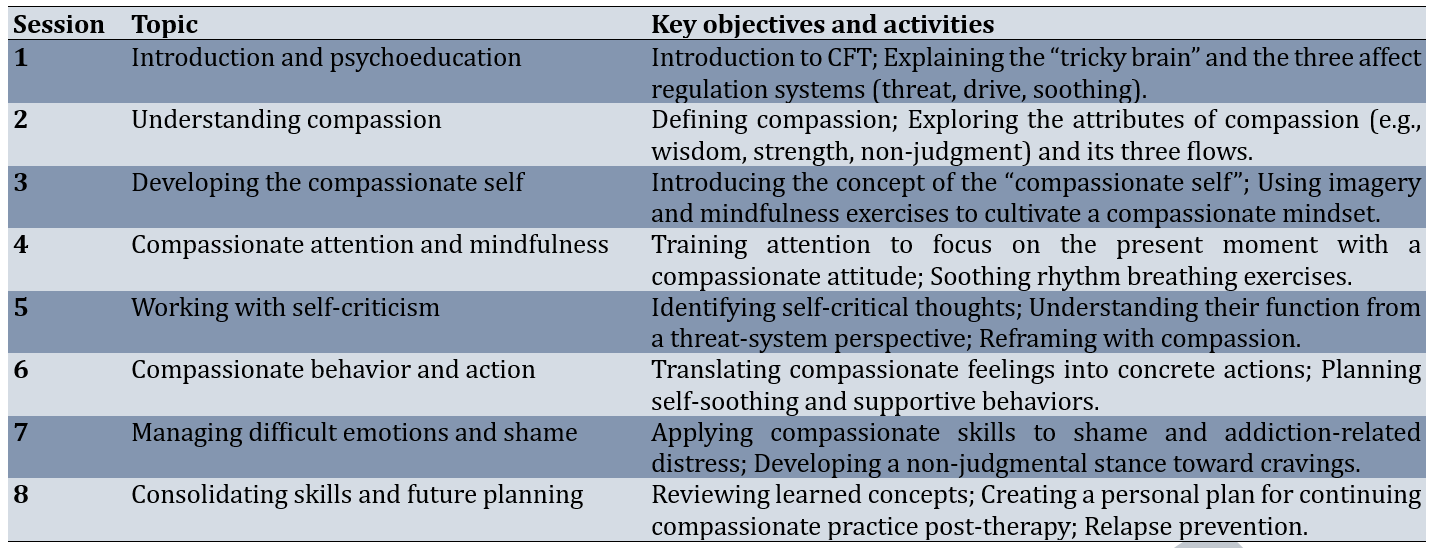
Participants in the experimental group received a structured CFT delivered in eight 90-minute weekly group sessions. The program was adapted from the model developed by Paul Gilbert [9] and focused on psychoeducation regarding the three affect regulation systems, cultivating a compassionate self, and developing skills to manage distressing thoughts and feelings without self-criticism. The control group received TAU, consisting of routine addiction counseling and, where applicable, methadone maintenance therapy (Table 1).
Table 1. Summary of compassion-focused therapy (CFT) content
Data analysis
All statistical analyses were performed using SPSS 26. Data were analyzed using a mixed-design analysis of variance (ANOVA) with repeated measures, and Bonferroni post-hoc tests were used for pairwise comparisons when significant interaction effects emerged.
Findings
The two groups were comparable in terms of demographic characteristics at baseline. The mean age of participants in the experimental group was 34.8±8.1 years, and in the control group, 35.1±7.2 years. Regarding educational level, 7 participants (46.7%) in the CFT group had completed high school, and 8 (53.3%) held university-level qualifications. In the control group, 8 participants (53.3%) had a high school education, and 7 participants (46.7%) possessed a university education.
The experimental and control groups had nearly identical baseline (pre-test) scores on both self-control and cognitive flexibility. Following the intervention, the CFT group demonstrated substantial improvement in self-control scores, increasing from the pre-test to post-test, with scores remaining relatively stable at follow-up. In contrast, the control group showed minimal change across all three time points. A similar pattern was observed for cognitive flexibility, with the CFT group improving markedly from pre-test to post-test, while the control group remained essentially unchanged (Table 2).
Table 2. Mean scores of self-control and cognitive flexibility across time points by group

Prior to conducting the mixed-design ANOVA, the normality (assessed via the Shapiro-Wilk test), homogeneity of variances (Levene’s test), and sphericity (Mauchly’s test) were examined and satisfactorily met (p<0.05). There was a statistically significant time×group interaction effect for self-control (sum of squares=189.75; df=1; F=54.98; η²=0.66; p<0.001), indicating a large effect size. Similarly, a significant time×group interaction was found for cognitive flexibility (sum of squares=117.22; df=1; F=23.16; η²=0.45; p<0.001).
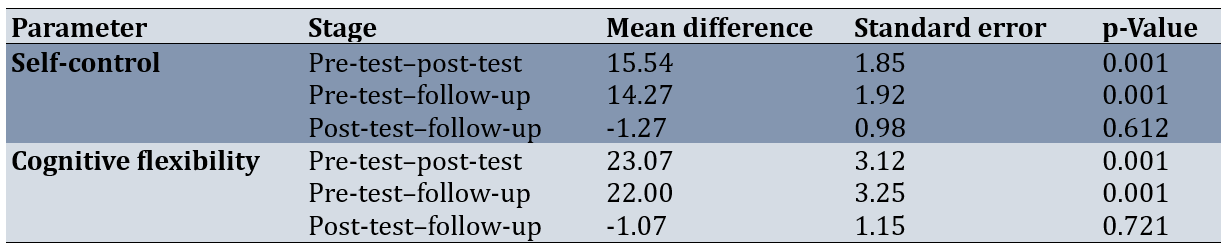
Within the CFT group, self-control scores showed significant improvement from pre-test to post-test (p<0.001) and from pre-test to follow-up (p<0.001). The slight decrease observed between post-test and follow-up was not statistically significant (p=0.612). For cognitive flexibility, significant gains were also observed from pre-test to post-test (p<0.001) and from pre-test to follow-up (p<0.001), with no significant change between post-test and follow-up (p=0.721). No significant changes across time points were observed in the control group (all p>0.05). Between-group comparisons at post-test and follow-up also significantly favored the CFT group (p<0.001; Table 3).
Table 3. Within-group comparisons in the compassion-focused therapy group for self-control and cognitive flexibility
Discussion
This study aimed to investigate the effect of CFT on self-control and cognitive flexibility in opioid-dependent women. CFT significantly enhanced both self-control and cognitive flexibility among women with OUD. Beyond symptom reduction, understanding the underlying psychological mechanisms of these improvements is crucial. OUD is frequently maintained by a vicious cycle of intense psychological distress, pervasive shame, and severe self-criticism, which collectively deplete cognitive resources and impair self-regulatory capacity [1]. Individuals with OUD often resort to substance use as a maladaptive strategy to escape this internal distress. CFT directly targets this dynamic by activating the affiliative and soothing emotion regulation system [23]. By cultivating a warm, nonjudgmental, and compassionate self-stance, the therapy reduces the intense negative affect associated with shame. This emotional stabilization frees cognitive resources, thereby strengthening self-control and enabling individuals to better resist cravings and manage destructive impulses [9]. These findings align with those of a recent study [11], showing that compassion-based interventions significantly improve impulse control and emotional regulation in populations with substance use disorders. Similarly, another study [24] found that fostering self-compassion reduces self-punitive behaviors that typically undermine self-control during addiction recovery.
Furthermore, the intervention produced substantial improvements in cognitive flexibility. Chronic opioid dependence is often characterized by cognitive rigidity and entrenched behavioral patterns, in which individuals repeatedly engage in drug-seeking behavior despite adverse consequences [25]. Key components of CFT—particularly mindfulness, decentering, and present-moment awareness—help dismantle these rigid, ruminative cognitive structures [7]. By training participants to observe distressing thoughts and physiological urges without immediate reactivity or harsh self-judgment, CFT promotes cognitive decoupling [16]. This mental flexibility allows individuals to generate alternative perspectives, move beyond dichotomous thinking, and adopt more adaptive coping strategies when facing psychosocial stressors [26]. These results are consistent with prior research [7], indicating that reducing internal self-criticism through compassion training enhances executive functioning and facilitates adaptive shifts in cognitive sets.
The concurrent enhancement of self-control and cognitive flexibility highlights the comprehensive therapeutic value of CFT. Traditional addiction treatments often emphasize abstinence while insufficiently addressing the profound emotional dysregulation and self-criticism that perpetuate the dependency cycle [14]. By transforming the individual’s internal dialogue from self-hostility to self-care, CFT establishes a resilient psychological foundation. This enables patients not only to inhibit destructive impulses but also to navigate the complex emotional demands of sustained recovery more effectively [18].
Despite these promising results, several limitations should be acknowledged. The use of convenience sampling within a specific population (women with OUD in Ahvaz, Iran) limits the generalizability of the findings to men, other cultural contexts, or different clinical settings. Additionally, reliance on self-report measures may have introduced social desirability or response biases. Future studies should employ larger, multicenter randomized controlled trials and incorporate objective behavioral or neurophysiological measures to strengthen the evidence base.
Conclusion
Compassion-focused therapy is effective in enhancing self-control and cognitive flexibility among women with opioid use disorder.
Acknowledgments: The authors would like to express their deepest gratitude to all the women who participated in this study; their time, patience, and willingness to share their experiences were essential to the successful completion of this research.
Ethical Permissions: The study protocol was reviewed and cleared by the Ethics Committee of Islamic Azad University (Approval ID: IR.IAU.AHVAZ.REC.1404.052). The clinical trial was officially registered under the IRCT identifier IRCT20250606066093N3.
Conflicts of Interest: There were no conflicts of interest.
Authors' Contribution: Yazdanipour M (First Author), Methodologist/Main Researcher/Discussion Writer (40%); Kazemian Moghaddam K (Second Author), Introduction Writer/Assistant Researcher/Statistical Analyst (30%); Shahbazi M (Third Author), Introduction Writer/Assistant Researcher/Discussion Writer (30%)
Funding/Support: This study was self-funded by the authors and received no external financial support.
Opioid use disorder (OUD) represents a profound global health crisis, characterized by compulsive drug-seeking behavior despite catastrophic personal and social consequences [1]. While OUD affects both sexes, women grappling with opioid dependence face a unique and multifaceted set of biopsychosocial challenges. Women often experience a “telescoping effect,” wherein the progression from initial substance use to severe psychosocial impairment occurs significantly more rapidly than in men [2]. Furthermore, women with OUD frequently present with higher rates of co-occurring psychiatric conditions, including severe trauma, depression, and anxiety, which are often compounded by intense societal stigma and profound internal shame [3]. These intertwined emotional and structural barriers severely complicate their recovery trajectory, leading to higher attrition rates in standard treatment programs and increased vulnerability to relapse. Addressing the specific psychological deficits that precipitate and maintain addictive behaviors in this marginalized population is thus of paramount clinical importance [4].
A central psychological deficit in the pathogenesis and maintenance of OUD is diminished self-control. Self-control is broadly defined as the capacity to override prepotent impulses, regulate intense emotions, and delay immediate gratification in pursuit of long-term, goal-directed outcomes [5]. In the context of addiction, the chronic use of opioids disrupts the brain’s executive control networks, rendering individuals highly susceptible to craving and impulsive drug-seeking under stress [6]. For women with OUD, impaired self-regulation often translates into an inability to manage negative affective states without resorting to substance use as a maladaptive coping mechanism. Consequently, enhancing self-control is not merely about behavioral restriction; rather, it is about rebuilding the foundational psychological architecture necessary to resist triggers, manage emotional dysregulation, and sustain long-term abstinence [7].
In tandem with self-control, cognitive flexibility serves as a critical executive function that is heavily compromised in individuals with opioid dependence. Cognitive flexibility refers to the mental agility required to adapt one’s thinking and behavior in response to changing environmental demands or shifting contingencies [8]. Women with OUD frequently exhibit heightened cognitive rigidity, often manifesting as an inability to generate alternative solutions to interpersonal problems or a tendency to become perseveratively stuck in negative, self-defeating thought loops [9]. This psychological inflexibility strongly correlates with continued substance use, as individuals struggle to transition from entrenched addictive habits to novel, adaptive recovery behaviors. Cultivating cognitive flexibility is therefore essential, as it empowers patients to re-evaluate maladaptive beliefs, adapt to the dynamic challenges of rehabilitation, and actively engage in alternative coping strategies [10].
To address these complex psychological vulnerabilities, compassion-focused therapy (CFT) has emerged as a highly promising psychological intervention. Developed initially to treat individuals with high levels of shame and self-criticism—traits markedly prevalent among women with addiction—CFT targets the brain’s affect regulation systems [11]. The therapy focuses on stimulating the soothing-affiliative system to counteract the hyperactive threat-protection system, which is often dominant in traumatized and addicted populations [12, 13]. By cultivating self-compassion, individuals learn to relate to their own suffering, failures, and cravings with warmth and nonjudgmental understanding rather than punitive self-criticism. This compassionate self-stance creates a safe psychological environment, reducing the distress-induced drive to use opioids and providing the emotional bandwidth necessary to practice self-regulation and adaptive thinking [14].
A growing body of empirical literature supports the efficacy of CFT and related psychological interventions in mitigating addiction-related deficits. For instance, recent studies have demonstrated the positive impact of psychotherapeutic protocols on enhancing self-control among women with substance use issues [15]. Furthermore, interventions rooted in compassion have proven effective in modifying cognitive flexibility and reducing self-criticism in vulnerable adult populations [16]. Specific research utilizing CFT has also shown significant improvements in psychological flexibility and self-control across various clinical populations [17]. However, despite these promising findings, there remains a notable dearth of research examining the integrated effects of CFT on both self-control and cognitive flexibility, specifically tailored to the unique clinical profile of women diagnosed with OUD [18].
Given the severe societal and personal impact of OUD in women, alongside the limitations of purely pharmacological treatments, multidimensional psychological interventions are crucial. Women with OUD require therapeutic frameworks that not only target behavioral cessation but also heal underlying shame, thereby facilitating durable structural changes in self-regulation and cognitive adaptability [19]. Addressing this gap is necessary to optimize rehabilitation protocols and provide evidence-based, compassionate care for this highly vulnerable population.
This study aimed to investigate the effect of CFT on self-control and cognitive flexibility in opioid-dependent women.
Materials and Methods
Design and participants
This clinical trial was conducted on 30 women diagnosed with OUD who were receiving care at addiction treatment centers in Ahvaz, Iran, during 2025. Participants were selected using convenience sampling based on accessibility and voluntary willingness to participate and then randomly assigned to either the experimental group (n=15), which received CFT, or the control group (n=15), which received treatment as usual (TAU).
Inclusion criteria were a formal diagnosis of OUD according to DSM-5 criteria, age between 18 and 50 years, provision of written informed consent, at least primary-level literacy, no history of severe co-occurring psychiatric disorder (e.g., psychotic or bipolar disorders), no acute or severe physical illness, and no concurrent participation in other structured psychological interventions.
Instrument
The Brief Self-Control Scale (BSCS), developed by Tangney et al. [3], was used to measure dispositional self-control. This self-report instrument consists of 13 items rated on a 5-point Likert scale, ranging from 1 (not at all like me) to 5 (very much like me). Total scores range from 13 to 65, with higher scores indicating greater self-control. The scale has demonstrated strong psychometric properties in previous studies. In the Persian validation, Cronbach’s alpha was reported as 0.83 [20]. In the present study, Cronbach’s alpha for the BSCS was 0.87.
The Cognitive Flexibility Inventory (CFI), developed by Dennis and Vander Wal [21], is a 20-item self-report measure designed to assess cognitive flexibility, specifically the ability to challenge and replace maladaptive thoughts with more balanced ones. The inventory comprises two subscales: “Alternatives” (the ability to generate multiple alternative explanations for life events) and “Control” (the perception of difficult situations as controllable). Items are rated on a 7-point Likert scale from 1 (strongly disagree) to 7 (strongly agree). Total scores range from 20 to 140, with higher scores indicating greater cognitive flexibility. The Persian version of the CFI has shown excellent reliability, with a Cronbach’s alpha of 0.90 [22]. In the present study, Cronbach’s alpha was 0.92.
Procedure
The study protocol was approved by the Institutional Review Board of Islamic Azad University. All participants were assured of data confidentiality and their right to withdraw from the study at any time without penalty. Following ethical approval, the researchers coordinated with the directors of several addiction treatment centers in Ahvaz. Potential participants were identified and approached by the research team, who provided a comprehensive overview of the study’s objectives and procedures. Women who expressed interest were screened against the inclusion and exclusion criteria. Eligible participants provided written informed consent. All 30 participants then completed the pre-test battery, which included the Brief Self-Control Scale (BSCS) and the Cognitive Flexibility Inventory (CFI). After pre-test data collection, participants were randomly allocated to the experimental or control group. The experimental group attended eight sessions of CFT, while the control group continued with treatment as usual. Immediately after the intervention period, all participants completed the post-test questionnaires.
Participants in the experimental group received a structured CFT delivered in eight 90-minute weekly group sessions. The program was adapted from the model developed by Paul Gilbert [9] and focused on psychoeducation regarding the three affect regulation systems, cultivating a compassionate self, and developing skills to manage distressing thoughts and feelings without self-criticism. The control group received TAU, consisting of routine addiction counseling and, where applicable, methadone maintenance therapy (Table 1).
Table 1. Summary of compassion-focused therapy (CFT) content
Data analysis
All statistical analyses were performed using SPSS 26. Data were analyzed using a mixed-design analysis of variance (ANOVA) with repeated measures, and Bonferroni post-hoc tests were used for pairwise comparisons when significant interaction effects emerged.
Findings
The two groups were comparable in terms of demographic characteristics at baseline. The mean age of participants in the experimental group was 34.8±8.1 years, and in the control group, 35.1±7.2 years. Regarding educational level, 7 participants (46.7%) in the CFT group had completed high school, and 8 (53.3%) held university-level qualifications. In the control group, 8 participants (53.3%) had a high school education, and 7 participants (46.7%) possessed a university education.
The experimental and control groups had nearly identical baseline (pre-test) scores on both self-control and cognitive flexibility. Following the intervention, the CFT group demonstrated substantial improvement in self-control scores, increasing from the pre-test to post-test, with scores remaining relatively stable at follow-up. In contrast, the control group showed minimal change across all three time points. A similar pattern was observed for cognitive flexibility, with the CFT group improving markedly from pre-test to post-test, while the control group remained essentially unchanged (Table 2).
Table 2. Mean scores of self-control and cognitive flexibility across time points by group
Prior to conducting the mixed-design ANOVA, the normality (assessed via the Shapiro-Wilk test), homogeneity of variances (Levene’s test), and sphericity (Mauchly’s test) were examined and satisfactorily met (p<0.05). There was a statistically significant time×group interaction effect for self-control (sum of squares=189.75; df=1; F=54.98; η²=0.66; p<0.001), indicating a large effect size. Similarly, a significant time×group interaction was found for cognitive flexibility (sum of squares=117.22; df=1; F=23.16; η²=0.45; p<0.001).
Within the CFT group, self-control scores showed significant improvement from pre-test to post-test (p<0.001) and from pre-test to follow-up (p<0.001). The slight decrease observed between post-test and follow-up was not statistically significant (p=0.612). For cognitive flexibility, significant gains were also observed from pre-test to post-test (p<0.001) and from pre-test to follow-up (p<0.001), with no significant change between post-test and follow-up (p=0.721). No significant changes across time points were observed in the control group (all p>0.05). Between-group comparisons at post-test and follow-up also significantly favored the CFT group (p<0.001; Table 3).
Table 3. Within-group comparisons in the compassion-focused therapy group for self-control and cognitive flexibility
Discussion
This study aimed to investigate the effect of CFT on self-control and cognitive flexibility in opioid-dependent women. CFT significantly enhanced both self-control and cognitive flexibility among women with OUD. Beyond symptom reduction, understanding the underlying psychological mechanisms of these improvements is crucial. OUD is frequently maintained by a vicious cycle of intense psychological distress, pervasive shame, and severe self-criticism, which collectively deplete cognitive resources and impair self-regulatory capacity [1]. Individuals with OUD often resort to substance use as a maladaptive strategy to escape this internal distress. CFT directly targets this dynamic by activating the affiliative and soothing emotion regulation system [23]. By cultivating a warm, nonjudgmental, and compassionate self-stance, the therapy reduces the intense negative affect associated with shame. This emotional stabilization frees cognitive resources, thereby strengthening self-control and enabling individuals to better resist cravings and manage destructive impulses [9]. These findings align with those of a recent study [11], showing that compassion-based interventions significantly improve impulse control and emotional regulation in populations with substance use disorders. Similarly, another study [24] found that fostering self-compassion reduces self-punitive behaviors that typically undermine self-control during addiction recovery.
Furthermore, the intervention produced substantial improvements in cognitive flexibility. Chronic opioid dependence is often characterized by cognitive rigidity and entrenched behavioral patterns, in which individuals repeatedly engage in drug-seeking behavior despite adverse consequences [25]. Key components of CFT—particularly mindfulness, decentering, and present-moment awareness—help dismantle these rigid, ruminative cognitive structures [7]. By training participants to observe distressing thoughts and physiological urges without immediate reactivity or harsh self-judgment, CFT promotes cognitive decoupling [16]. This mental flexibility allows individuals to generate alternative perspectives, move beyond dichotomous thinking, and adopt more adaptive coping strategies when facing psychosocial stressors [26]. These results are consistent with prior research [7], indicating that reducing internal self-criticism through compassion training enhances executive functioning and facilitates adaptive shifts in cognitive sets.
The concurrent enhancement of self-control and cognitive flexibility highlights the comprehensive therapeutic value of CFT. Traditional addiction treatments often emphasize abstinence while insufficiently addressing the profound emotional dysregulation and self-criticism that perpetuate the dependency cycle [14]. By transforming the individual’s internal dialogue from self-hostility to self-care, CFT establishes a resilient psychological foundation. This enables patients not only to inhibit destructive impulses but also to navigate the complex emotional demands of sustained recovery more effectively [18].
Despite these promising results, several limitations should be acknowledged. The use of convenience sampling within a specific population (women with OUD in Ahvaz, Iran) limits the generalizability of the findings to men, other cultural contexts, or different clinical settings. Additionally, reliance on self-report measures may have introduced social desirability or response biases. Future studies should employ larger, multicenter randomized controlled trials and incorporate objective behavioral or neurophysiological measures to strengthen the evidence base.
Conclusion
Compassion-focused therapy is effective in enhancing self-control and cognitive flexibility among women with opioid use disorder.
Acknowledgments: The authors would like to express their deepest gratitude to all the women who participated in this study; their time, patience, and willingness to share their experiences were essential to the successful completion of this research.
Ethical Permissions: The study protocol was reviewed and cleared by the Ethics Committee of Islamic Azad University (Approval ID: IR.IAU.AHVAZ.REC.1404.052). The clinical trial was officially registered under the IRCT identifier IRCT20250606066093N3.
Conflicts of Interest: There were no conflicts of interest.
Authors' Contribution: Yazdanipour M (First Author), Methodologist/Main Researcher/Discussion Writer (40%); Kazemian Moghaddam K (Second Author), Introduction Writer/Assistant Researcher/Statistical Analyst (30%); Shahbazi M (Third Author), Introduction Writer/Assistant Researcher/Discussion Writer (30%)
Funding/Support: This study was self-funded by the authors and received no external financial support.
Keywords:
References
1. Saraiya TC, Helpinstill S, Gray D, Hien DA, Brady KT, Hood CO, et al. The lived experiences and treatment needs of women with opioid use disorder and posttraumatic stress symptoms: A mixed methods study. J Subst Use Addctn Treat. 2024;161:209344. [Link] [DOI:10.1016/j.josat.2024.209344]
2. Evans EA, Goff SL, Upchurch DM, Grella CE. Childhood adversity and mental health comorbidity in men and women with opioid use disorders. Addctn Behav. 2020;102:106149. [Link] [DOI:10.1016/j.addbeh.2019.106149]
3. Tangney JP, Baumeister RF, Boone AL. High self-control predicts good adjustment, less pathology, better grades, and interpersonal success. J Pers. 2004;72(2):271-324. [Link] [DOI:10.1111/j.0022-3506.2004.00263.x]
4. Van Steenbergen H, Eikemo M, Leknes S. The role of the opioid system in decision making and cognitive control: A review. Cogn Affect Behav Neurosci. 2019;19(3):435-58. [Link] [DOI:10.3758/s13415-019-00710-6]
5. Garland EL, Howard MO. Opioid attentional bias and cue-elicited craving predict future risk of prescription opioid misuse among chronic pain patients. Drug Alcohol Depend. 2014;144:283-7. [Link] [DOI:10.1016/j.drugalcdep.2014.09.014]
6. Dajani DR, Uddin LQ. Demystifying cognitive flexibility: Implications for clinical and developmental neuroscience. Trends Neurosci. 2015;38(9):571-8. [Link] [DOI:10.1016/j.tins.2015.07.003]
7. Regier PS, Macedo De Arruda TC, Sinko L, Teitelman AM, Childress AR. Factors associated with cognitive flexibility in people with opioid-use disorder: A pilot study. Front Psychiatry. 2024;15:1505391. [Link] [DOI:10.3389/fpsyt.2024.1505391]
8. Díaz-López A, Lozano ÓM, Moraleda-Barreno E, Velo S. Differential contribution of drug classes to impulsive behaviors in patients diagnosed with substance use disorder. Curr Addctn Rep. 2026;13(1):40. [Link] [DOI:10.1007/s40429-026-00739-x]
9. Gilbert P. The origins and nature of compassion focused therapy. Br J Clin Psychol. 2014;53(1):6-41. [Link] [DOI:10.1111/bjc.12043]
10. Gilbert P. Compassion focused therapy: An introduction to the theoretical framework and clinical applications. In: Gilbert P, editor. Compassion: Concepts, research and applications. London: Routledge; 2017. p. 97-114. [Link]
11. Carlyle M, Rockliff H, Edwards R, Ene C, Karl A, Marsh B, et al. Investigating the feasibility of brief compassion focused therapy in individuals in treatment for opioid use disorder. Subst Abuse. 2019;13:1178221819836726. [Link] [DOI:10.1177/1178221819836726]
12. Ameri Felihi N, Bavi S, Farashbandi A. Effect of resilience and self-compassion training on emotion regulation and frustration tolerance in students with clinical aggression symptoms. J Clin Care Skill. 2025;6(3):161-7. [Link]
13. Millard LA, Wan MW, Smith DM, Wittkowski A. The effectiveness of compassion focused therapy with clinical populations: A systematic review and meta-analysis. J Affect Disord. 2023;326:168-92. [Link] [DOI:10.1016/j.jad.2023.01.010]
14. Kotera Y, Beaumont J, Edwards AM, Cotterill M, Kirkman A, Tofani AC, et al. A narrative review of compassion focused therapy on positive mental health outcomes. Behav Sci. 2024;14(8):643. [Link] [DOI:10.3390/bs14080643]
15. Alijani F. The effectiveness of compassion-focused therapy on integrative self-knowledge, self-destructive behaviors and fatigue in drug users. J Assess Res Appl Couns. 2026;8(1). [Link] [DOI:10.61838/kman.jarac.1934]
16. Leaviss J, Uttley L. Psychotherapeutic benefits of compassion-focused therapy: An early systematic review. Psychol Med. 2015;45(5):927-45. [Link] [DOI:10.1017/S0033291714002141]
17. Roberts G, Parish N, Samuel V. The use and outcomes of compassion-focused group interventions with children and adolescent clinical populations: A systematic review and narrative synthesis. Clin Psychol Psychother. 2026;33(2):e70259. [Link] [DOI:10.1002/cpp.70259]
18. Durpoix A, Rolling J, Coutelle R, Lalanne L. Psychotherapies in opioid use disorder: Toward a step-care model. J Neural Transm. 2024;131(5):437-52. [Link] [DOI:10.1007/s00702-023-02720-8]
19. Barbosa-Leiker C, Campbell ANC, McHugh RK, Guille C, Greenfield SF. Opioid use disorder in women and the implications for treatment. Psychiatr Res Clin Pract. 2021;3(1):3-11. [Link] [DOI:10.1176/appi.prcp.20190051]
20. Asgarian FS, Namdari M, Soori H. Reliability and validity of Persian version of Brief Self-Control Scale (BSCS) in motorcyclists. Int J Psychiatry Clin Pract. 2020;24(2):176-82. [Link] [DOI:10.1080/13651501.2019.1711423]
21. Dennis JP, Vander Wal JS. The cognitive flexibility inventory: Instrument development and estimates of reliability and validity. Cogn Ther Res. 2010;34(3):241-53. [Link] [DOI:10.1007/s10608-009-9276-4]
22. Feizollahi Z, Asadzadeh H, Bakhtiarpour S, Farrokhi N. Association between mental flexibility and somatic symptom disorder mediated by smartphone addiction among university students. Soc Determinants Health. 2021;7(1):1-10. [Link]
23. Joseph VW, Moniz-Lewis DIK, Richards DK, Pearson MR, Luoma JB, Witkiewitz K. Internalized shame among justice-involved women in substance use disorder treatment: Measurement invariance and changes during treatment. Stigma Health. 2024;9(3):303-10. [Link] [DOI:10.1037/sah0000427]
24. Karlou I, Karakasidou E. The predictive and mediating role of self-compassion in substance use disorders. Eur J Couns Psychol. 2025. [Link] [DOI:10.46853/001c.133794]
25. Chen G. The role of self-compassion in recovery from substance use disorders. OBM Integr Complement Med. 2019;4(2). [Link] [DOI:10.21926/obm.icm.1902026]
26. Gilbert P, Simos G. Compassion focused therapy: Clinical presentation and applications. London: Routledge; 2017. [Link]